Oxygen XML Editor

xml editor

RSS  
About
Downloads
Register
Shop
Resources
Support
Supported platforms

Visual - WYSIWYG DITA Editor

DITA Editing Support

<oXygen/> DITA Editor (available in all <oXygen/> distributions) allows the users with less knowledge of XML to edit DITA documents in a similar way to a regular text processing application.The DTDs and XSL stylesheets from the DITA Open Toolkit are packed in the standard <oXygen/> distribution.

<oXygen/> includes the latest version of the Dita Open Toolkit. This contains the basic DTDs and XSL stylesheets. Based on these files, <oXygen/> offers intelligent XML editing, validation, content completion and a number of predefined transformation scenarios to PDF and HTML. Please note that for a complete publishing solution based on DITA, you (or a developer) should create a new set of DTD files (specialization) and several ANT scripts.

With <oXygen/> XML Editor you can create:

  • topics
  • tasks
  • concepts
  • composites
  • references
  • maps

All the standard DITA elements are supported. If you are using/creating a DITA specialization, you will find that <oXygen/> uses the class attribute to identify one of the default styles for your element. If you are not satisfied with the default style, you can change the CSS files that are distributed in the frameworks/dita/css_classed directory.

DITA Maps Manager

The DITA Maps are key components for authoring DITA content. Managing these files and the referenced topics is an important feature for a DITA aware editor.

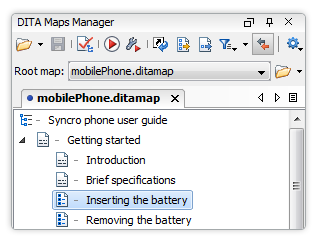
The new DITA Maps Manager allows viewing and editing of DITA map files. It acts also similar with a project manager allowing you to easily open different topics/concepts for editing. The DITA maps manager is shown each time you open a .ditamap file in <oXygen/> and it will appear as a tab in the same stack as the Project view. A double click on a file reference listed in a DITA map opens that file in the editor. The toolbar, the contextual menu and drag and drop actions allow you to easily edit the map content.

The DITA Maps Manager

Closely integration of the DITA Open Toolkit for generating different output formats

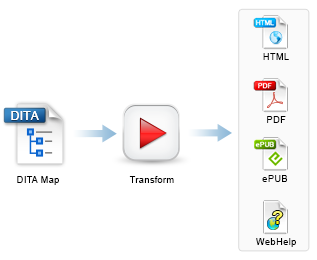
The tool chain for generating output in a multitude of formats (XHTML, PDF, HTML, JavaHelp, Eclipse Help, DocBook, etc.) is ready to use out of the box as <oXygen/> includes the latest version of the DITA-OT.

Power users have also the possibility to fine tune the transformations by using the advanced options like specifying parameters for the ANT build files, filtering content using a DITAVAL file, providing a custom build file, etc.

Transformation Scenario for a DITA Map

Integrated the Idiom FO plugin for DITA Open Toolkit

You can generate high quality PDF output using the PDF2 transformation scenario. It uses the Idiom FO plugin that comes already installed in the DITA Open Toolkit bundled in <oXygen/>. The plugin transforms a DITA map to PDF using the XEP processor - if this is configured in <oXygen/> XML Editor - or the built-in Apache FOP processor.

Support for creation of conref links

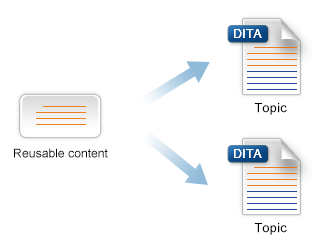
You can easily insert a conref in a DITA document using the "Insert a DITA Content Reference" action. It allows you to choose the target ID by selecting it from the list of IDs defined in a topic.

Insert DITA Conref dialog

Display of the resolved DITA content in the editor

The XML content referred with DITA conref is presented in place as a read only block that can be collapsed/expanded. In this way the XML editor shows a picture of the entire XML document with all the XML references resolved.

DITA Conref

In the above screenshot the referred XML element appears selected. If you need to edit a referred element content, you can click the link that is placed before it. <oXygen/> will open the file and place the caret at the beginning of the referred element.

Specific DITA Actions

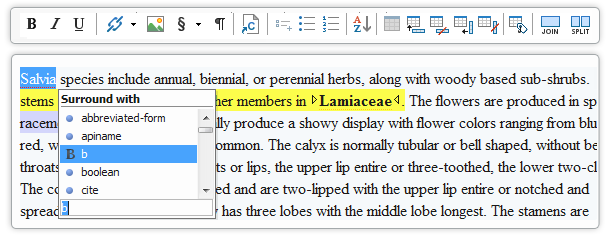
<oXygen/> is able to recognize the DITA documents based either on the root element name or the DITAArchVersion attribute. When you switch to the Author mode, the XML editor loads both the set of CSS files and the available actions that were associated in the <oXygen/> DITA configuration.

The action set includes operations for emphasising text, creating lists, tables, sections and paragraphs.

DITA Toolbar

Extensible DITA Support

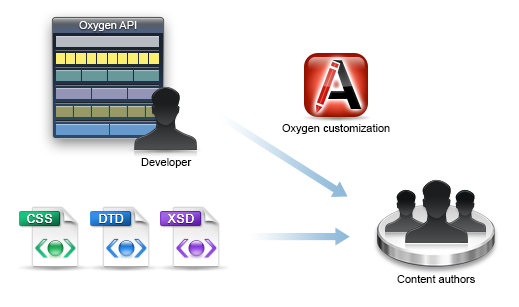
The CSS files, DTDs and even the actions from the toolbar and menus can be changed. You can create new operations either customizing the default ones - used for the insertion of XML fragments - or by creating new Java Implementations. For more information, see the User Manual.

The next figure shows how the "Insert Paragraph" action has been added to the menu.

CALS Table Support

You can easily create CALS tables, join or split cells, add or remove rows. <oXygen/> will create all the column specifications for you.

Table Toolbar

A CALS table example. The caret is positioned between two cells.

CALS Table

<oXygen/>can manage table width and column width specifications from the source document both in fixed and proportional dimensions. The tables and columns widths can be visually adjusted by dragging with the mouse their edges.

In the figure below the column widths are being adjusted.

Adjusting Column Widths

DITA Documents Storage and Access

The access to document repositories can be made through WebDAV, FTP, SFTP. More, <oXygen/> supports access to native XML databases (eXist, Berkeley XML, MarkLogic, etc.. ) and relational databases (Oracle, IBM DB2). If you are accessing a different content management system, the editor can be extended by writing a Java URL protocol handler.

Visual Content Change Tracking

Change Tracking is a way to keep a history of the changes made to a document. When change tracking is enabled the inserted and deleted content is highlighted in the document allowing to easily identify the affected regions.

Multiple authors support

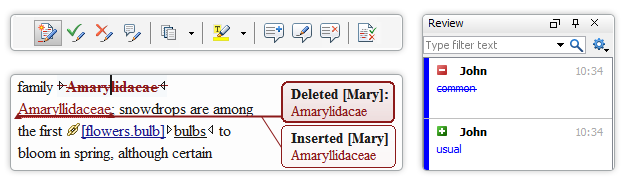
<oXygen/> supports changes from multiple authors, rendering each author changes with different colors.

For each change oXygen stores the author and the date when that change was performed. The name of the author who is currently making changes and the colors can be customized from the Track Changes preferences page.

Change Tracking in the Author page

In the above screenshot you can see how various insert/delete changes made by various authors are displayed. The tooltip shows information about the change.

Change management

You can review the changes made by you or other authors and then accept or reject them using the Track Changes toolbar buttons or by using the change management dialog.

© 2002-2009 SyncRO Soft Ltd. All rights reserved. | Sitemap | Privacy Policy | This website was created & generated with <oXygen/>® XML Editor
News
Buy oXygen license
XML Editor
Enterprise $449
Professional $349
Academic & SMP $64
XML Author
Enterprise $269
Professional $199
Video Demonstrations
Quotes
quote ..oXygen still hits a sweet spot -- but a wider one than ever. The feature set, performance and interfaces get better with every release, while its core virtues remain, including the portability across platforms and the enlightened licensing (to users, not machines). Bravo for creating a product that needs no apology. quote
Wendell Piez
Mulberry Technologies Inc