SVG Editor
SVG is a platform for two-dimensional graphics. It has two parts: an XML-based file format and a programming API for graphical applications. Some of the key features include:
- Shapes, text and embedded raster graphics with many painting styles
- Scripting through languages such as ECMAScript
- Support for animation
SVG is a vendor-neutral open standard that has important industry support. Companies such as Adobe, Apple, IBM, and others have contributed to the W3C specification. Many documentation frameworks, including DocBook, have support for SVG by means of defining the graphics directly in the document.
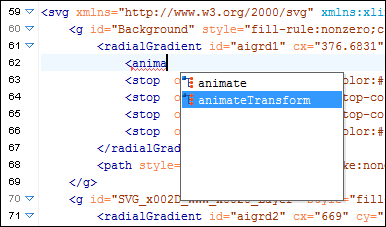
Oxygen adds SVG support by using the Batik package, an open source project developed by the Apache Software foundation. The SVG DTD is solved through the default XML catalog.
Oxygen can render SVG by two means:
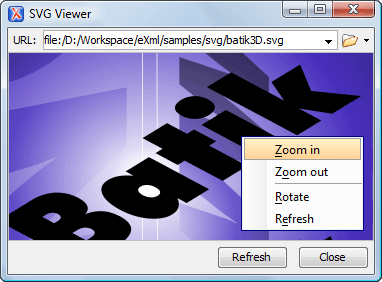
The Preview Result Pane
This panel can render the result of an XSLT transformation that generates SVG documents.
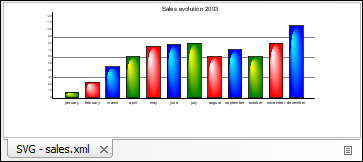
The basic use-case resides in the development of the XSLT stylesheets capable of producing rich SVG graphics. For example, if you have an XML document describing the evolution of a parameter over time and you need to create a graphic from it, you can start with a static SVG, written directly in Oxygen, or one exported from a graphics tool (such as the Adobe suite). Then you would extract the parts that are dependent of the data from the XML document and create the XSLT templates.