xml editor

    XML Editor
    XML Author
        DITA Editor
        DocBook Editor
        TEI Editor
        XHTML Editor
        XML Schema Editor
        RelaxNG Editor
    XML Diff
    XSL / XSLT
        XSL / XSLT Editor
        XSL / XSLT Debugger
        XSLT documentation
    XQuery
        XQuery Editor
        XQuery Debugger
    SVN Client
        Office Open XML
        Open Document Format
        XSL:FO Editor
        SVG Editor
        WSDL Editor
Supported platforms
Compatible with Windows7 & Mac OS X Snow Leopard
Ready for
data server software

XSL / XSLT Debugger

XSLT Debugging Perspective

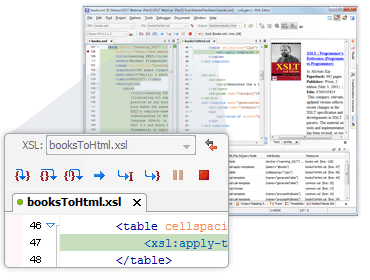
<oXygen/> provides a special layout when entering in debugging mode to show the XML source and the XSL stylesheet documents side by side and to show also the results and special XSLT debugging views and toolbars. The perspective allows you to use the common XML and XSL editor features.

Multiple XSLT Engine Support

<oXygen/> offers XSL debugging support based on the most used XSLT processors: Xalan-J and Saxon. Due to the open source architecture, they are more stable and bug free than proprietary XSLT processors, and the most important: they are true XSLT 1.0 compliant. Our XSLT debugger bundles the Saxon 6.5.5, Saxon EE and Xalan 2.7.1 transformation engines. Selecting the processor is very simple and involves changing the selection in the XSL processor combo box. Although the processors are very similar, sometimes they produce different output for the same input, so it is best to test your XSL stylesheets using the same processor type you are using in production.

Full Control Over the XSLT Debugging Process

<oXygen/> provides all XSLT debugger capabilities: step into, step over, step out, run, run to cursor, run to end, pause, stop. The current XML and XSL node reached by the debugging process are shown (see the right part in the image below) with the following details: an arrow icon to show the action performed on it (entering/leaving), the name, the resource and the line. By clicking the arrow the text sections corresponding to the XML and XSL stylesheet nodes are highlighted in the editor.

Control toolbar

Output Result is Linked to the Generating XSL Element.

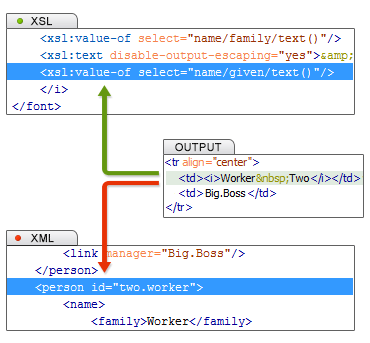
Allows you to easily find out what element from the XSL stylesheet generated a section of the output. For this you just have to click on the output text, either in the plain text result panel or in the XHTML preview panel. The editor will highlight the line in the stylesheet that generated the output. This allows you to find out immediately what template did not fire correctly.

The following image shows the right part of the debugging perspective, with the XSL source in the left and the output in the right. The "december" string was generated by the xsl:value-of element.

Output is linked to the XSL element

Pause the Debugger Execution with Breakpoints

Breakpoints can be set on both XML or XSL documents used in the transformation. The breakpoints appear in the left bar of the XML and XSL editors, as a red dot, and they can be created easily by using the shortcut key or by clicking the breakpoints area.

XSL Breakpoints

Conditional Breakpoints

A condition can be attached to a breakpoint set in the Debugger perspective so that processing stops only if the condition is true.

Break Conditions

XSLT Call Stack View

The current stack containing both XSL stylesheet and XML source nodes can be seen at any time during XSLT debugging. The advantage of this approach is that the source scope on which a stylesheet instruction is being executed (the last red coloured node on the stack) is easily visible.

Call stack

Trace History View

Entering and leaving node events are logged and made available in a view to show the history of the processor execution. You can click the entries in the list to see the corresponding node into the editor.

Trace history

Save the Debug Trace

It is possible to save the element trace obtained from a debug session as XML. This permits comparing different debug runs.

Save XSLT trace

XPath Watch View

You can add custom XPath expressions to the Watch View . The XPath expressions are evaluated automatically and the XSLT debugger updates the values dynamically as the processor changes its XML source context. The results of an evaluation can be a single value, a tree fragment or a list of nodes and are presented in the Node Set View. The watches are useful when debugging the expressions for template matches.

XPath Watch

Tree View For Presenting Node Set Values

The current context node value or the values of variables or XPath expressions that are evaluated to tree fragment or list of nodes are presented in tree views, thus giving access to the whole variable content. This is useful especially in debugging stylesheets that keep intermediary results in variables like DocBook for instance.

The user can easily locate the nodes from the tree by simply clicking on them: the editor will select the corresponding XML source nodes.

Nodes values view

Support for Imported/Included XSL Stylesheets and XML Entities

Once a node from an XML entity or an imported/included XSL stylesheet is processed by the transformation engine, the editor will open that resource in order to highlight the current node location.

XSL Templates View

The list with all the XSL templates used during the transformation and their corresponding number of calls are presented in the XSL templates view. This allows to spot unused templates and the most frequently used templates as they are ordered based on the hits count.

XSLT Variables View

The debugger lists all XSLT variables and parameters that are visible in the current XSLT context together with their scope and actual value. The view is updated as the XSLT processor changes the context during the transformation.

Variables and parameters view

Dynamic XSLT Output Generation

The output is dynamically presented as it is generated by the XSLT transformation process. The user can examine directly the output as XML source or rendered as XHTML.

Capture Multiple Outputs In The XSLT 2.0 Debugger

While executing XSLT 2.0 stylesheets the debugger will capture the output of xsl:result-document and will present it in a view inside <oXygen/>.

Multiple Outputs in XSLT 2.0

Scenario Based XSLT Debugging Session

<oXygen/> has a powerful transformation support based on reusable scenarios. The same scenarios can be used for debugging. The XSLT Debugger will be initialized with the information from the scenario (source or stylesheet location, XSLT processor, transformation parameters) when the Debug scenario action is executed. This allows to easily manage and trigger different debugging sessions.

XSLT Profiler

You can profile your XSLT stylesheets to identify the performance issues using two comprehensive data views of the activated templates: an Invocation tree view and a Hotspots view. The profiling information can be saved to XML or HTML formats.

The profiling is available for the following XSLT processors that are bundled with <oXygen/>: Saxon 6.5.5, Saxon EE, and Xalan 2.7.1. Thus you can profile both XSLT 1.0 and XSLT 2.0 stylesheets.

Invocation tree view

Using invocation tree view, also named call tree, you can examine how style instructions are processed in a top down manner. The profiling result shows the duration time for each of the style-instruction including the time needed for its children and then, when an instruction is expanded, you can see how the instruction time is composed from child instruction times.

Invocation tree view

Hotspots view

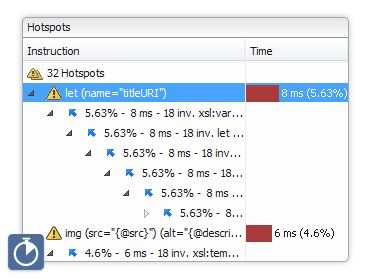
Using profiler hotspots view, you can immediately detect the time the processor spent in each instruction. The hotspot only presents the inherent time of the instruction, that is the total time of processing that instruction minus the time for processing its children instructions. When a hotspot is expanded one can see all the different paths that instruction was called from (a reverse invocation tree), each path being labeled with the number of invocations, the instruction time on that path and what percentage from the instruction total execution that path contributes.

Hotspots view
News
Upcoming Events:
Buy <oXygen/> License
XML Editor
Enterprise $449
Professional $349
Academic & SMP $64
XML Author
Enterprise $269
Professional $199
XML Diff
Professional $99  $59
Most Wanted Features
Cast your vote now! What feature would you need the most in the next version?
<oXygen/> XML Editor
Video Demonstrations
Support Life Program
Syncro SVN Client
Quotes
quote ..oXygen XML Editor still hits a sweet spot -- but a wider one than ever. The feature set, performance and interfaces get better with every release, while its core virtues remain, including the portability across platforms and the enlightened licensing (to users, not machines). Bravo for creating a product that needs no apology. quote
Wendell Piez
Mulberry Technologies Inc
XML Editor | XML Author | WYSIWYG Editors | Schema Editor | XSD Documentation | XSL/XSLT Editor | XQuery | XML Databases | SVN Client
© 2002-2010 SyncRO Soft Ltd. All rights reserved. | Sitemap | Privacy Policy | This website was created & generated with <oXygen/>® XML Editor