IBM DB2 XML support
The support for IBM DB2 Pure XML
database includes: multiple server connections, resource management, XML Schema
registration, XQuery and SQL execution, table data editing. A more detailed explanation
can be found in the following tutorial.
About this Tutorial
This tutorial shows you, step by step, how to configure the IBM DB2 support in
oXygen XML editor, browse and edit the database tables (and particularly the XML
content of the cells belonging to an XML type column), register, view or drop the XSD
schema used to validate the XML cell content as well as running SQL/SQL/XML or XQuery
interrogations.
The tutorial assumes that you have a basic knowledge of databases, SQL, XML
technologies and of oXygen XML editor tool. The explanations and screen shots are
given for the standalone version of the oXygen XML editor. However the same set of
features are available in Eclipse plugin version of the product with minor interface
differences.
How to Configure the IBM DB2 Support in oXygen
There are two notions you need to understand in order to configure the DB2 support
in oXygen: the data source and the connection.
A data source defines all that is needed in order to have a connection to the
database. oXygen uses JDBC as a way to connect, so a data source defines the DB2 JDBC
driver details. If you want to connect to servers running different versions of DB2
you need to configure a data source for each DB2 version so that it will properly
match the JDBC driver version.
oXygen currently supports version 9 of IBM DB2 database also known as pureXML. The
recommended way to connect is using the JDBC type 4 drivers.
Go to oXygen's Preferences->Data Sources and press the New button in order to
add a new data source. Insert a data source name (make sure that each data source has
an unique name) and select the DB2 type from driver type combo box.
You also need to add the following IBM DB2 specific driver files:- db2jcc.jar
- db2jcc_license_cisuz.jar
- db2jcc_license_cu.jar
In order to get these driver files go to the IBM website: http://www.ibm.com/software/data/db2/udb/, select the Trials and betas link,
enter jdbc in the Search for field, press the link of the match DB2 Personal
Developer's Edition: Redistributable JDBC Type 4 Driver and download the zip file that
contains the needed jars. After adding the driver files oXygen will automatically
detect the available driver classes so you can choose the most suited one.
See manual : http://www.oxygenxml.com/doc/ug-standalone/working-with-databases.html#configure-db2-datasource
Once you have created the data source you may proceed further by defining one or
more connection based on it. The connections can be configured on the same
Preferences->Data Source page.
Start by choosing a unique connection name and set the Data Source combo box to
the already configured DB2 data source. For the URL field use the specific JDBC driver
syntax (for example
jdbc:db2://10.0.0.16:50000/SAMPLE:retrieveMessagesFromServerOnGetMessage=true; means a
connection to a DB2 server database SAMPLE located at IP 10.0.0.16)
See manual: http://www.oxygenxml.com/doc/ug-standalone/working-with-databases.html#configure-db2-connection
Sometimes you need to work with two database servers (for example a development
sever and a production server) so it makes sense to define a connection on each
database server to be further used when executing SQL/XQuery or browsing/editing the
database content. If the two database servers have the same version you only need to
configure a data source and add two connections for it.
Database Explorer View
Once we finished the configuration of the connection we are able to browse the
database content using the Database Explorer view from the Database perspective.
Besides this view, the Database perspective is also featuring a Table Explorer view
that will be explained later.
Drag and drop support between tree nodes and an opened SQL editor is also
available: http://www.oxygenxml.com/doc/ug-standalone/working-with-databases.html#sql-dnd-support
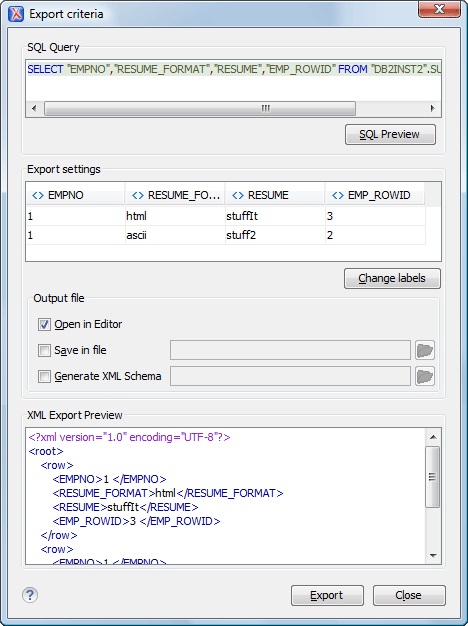
One of interesting operation available on table nodes is the "Export to XML"
action. That allows the export of database table content under an XML structure.
Please note that on demand, oXygen is able create a basic XSD schema for the table you
need to export.
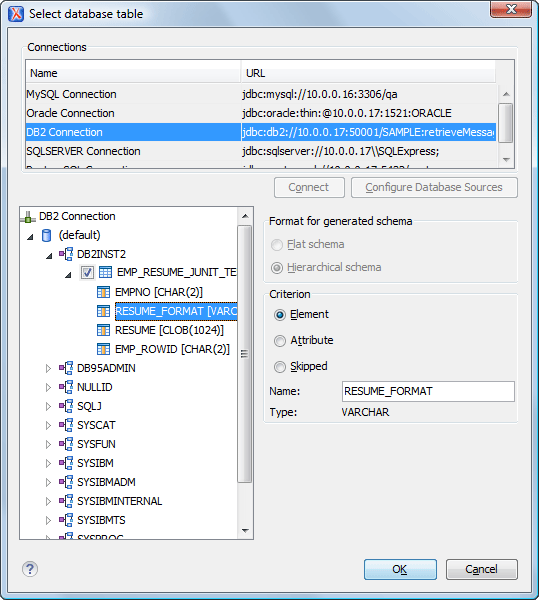
oXygen also features a tool that is able to generate an XSD schema based on a set
of database tables. The tool is available under the "Tools" menu "Create Schema from
DB Structure" action. Basically if you select a set of tables oXygen can generate an
XSD schema that describes table data definitions and take into account the key
relationships.
Table Explorer View
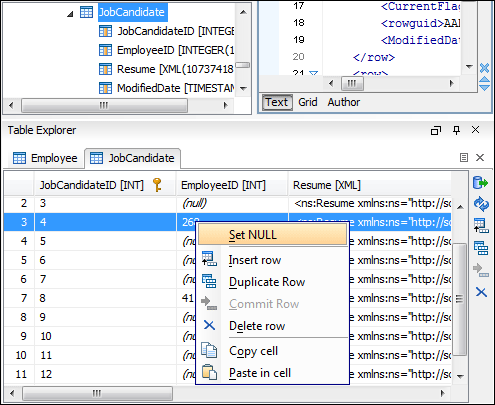
The Table Explorer view from the Database Perspective is able to represent a
database table content or the result of an SQL interrogation. If you like to edit a
database table content you can use the Edit operation from contextual menu of the
Database Explorer view.
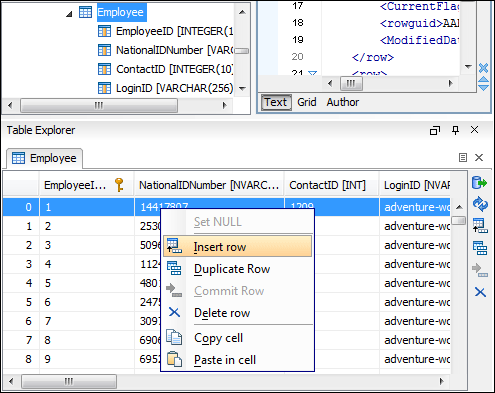
The view allows you to add a new table row or duplicate or delete a previous one.
If the database constraints are violated due to your changes, you will get a proper
error message that will help you to correct the problem.
The table columns can be sorted by clicking on the table header.
Editing XML Content of the XMLType Columns
The true power of oXygen comes when you need to edit content from the XML type
columns. These column data can be opened directly into the oXygen XML editor so you
can benefit of all oXygen editing features. Saving the edited data in the database is
simple like in the case of a normal file (you can use the Save action). If the
database rejects your changes during this operation you get an error message and the
file status will remains as modified.
There are other interesting operations available for an XML cell:- Insert XML file - inserts the content of an XML file on the respective cell.
- Validate - validates the current XML cell content against an already
registered XSD schema.
XML Schema Repository
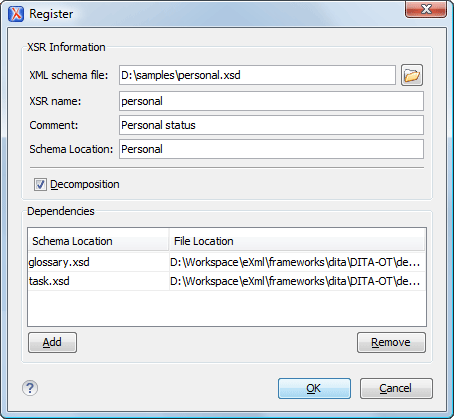
Every DB2 database schema has associated an "XML Schema repository" where all the
XSD schemas available to validate XML content of the XML type columns are stored. The
"XML Schema repository" is available as a child node in the Database View for any
database schema node. You can expand the "XML Schema repository" node and perform
operations like registering a new schema or dropping an already existing one.
See manual: http://www.oxygenxml.com/doc/ug-standalone/working-with-databases.html#db2-xml-schema-repository-level
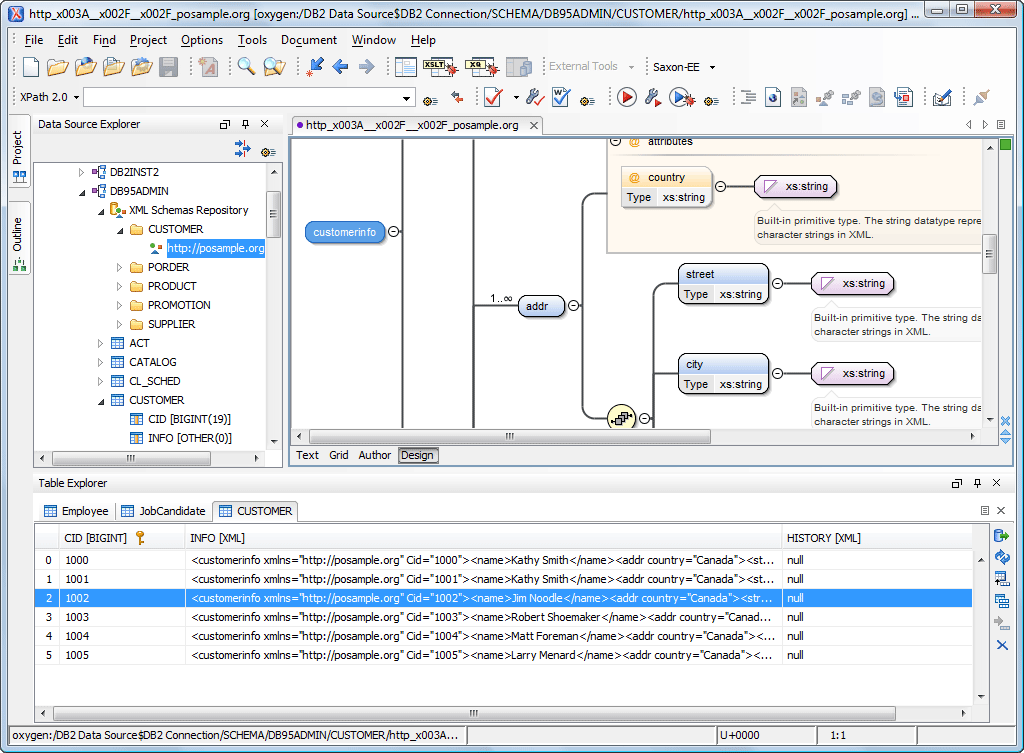
The XSD schema stored in "XML Schema repository" can be viewed into the oXygen XSD
editor. However you cannot modify them (as you only get a read-only access).
SQL, SQL/XML Support
You can use oXygen to run SQL (including DDL) or SQL/XML interrogations. For that
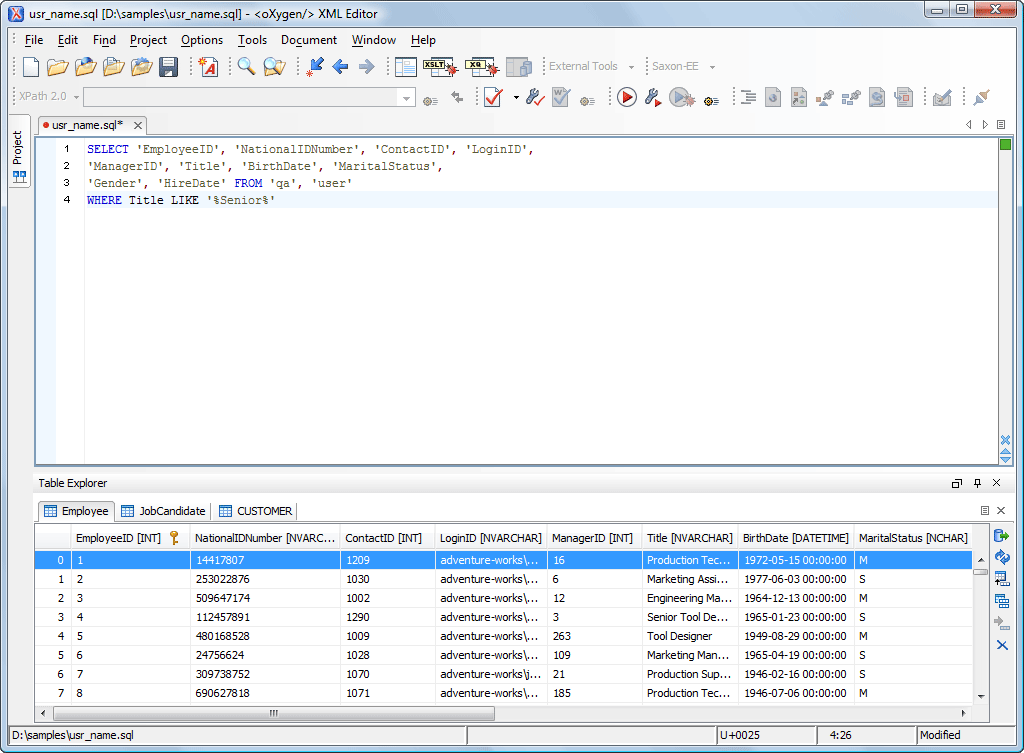
you need to open an SQL Editor (available from menu New->"SQL Editor") and write
your query content. The SQL editor has an associated scenario where you need to
specify as transformer the previously created DB2 connection.
If you want to reuse the SQL queries, you can specify parameter markers (?) into
the SQL content and add their corresponding mapping into the parameters dialog from
associated scenario. For example we need to write a SQL interrogation to get a report
with all employees from one department and their last evaluation dates. For this SQL
query we should use a parameter marker (the ID of the department) configurable from
Transformation Scenario so we can easily reuse the query for another department.
XQuery Support
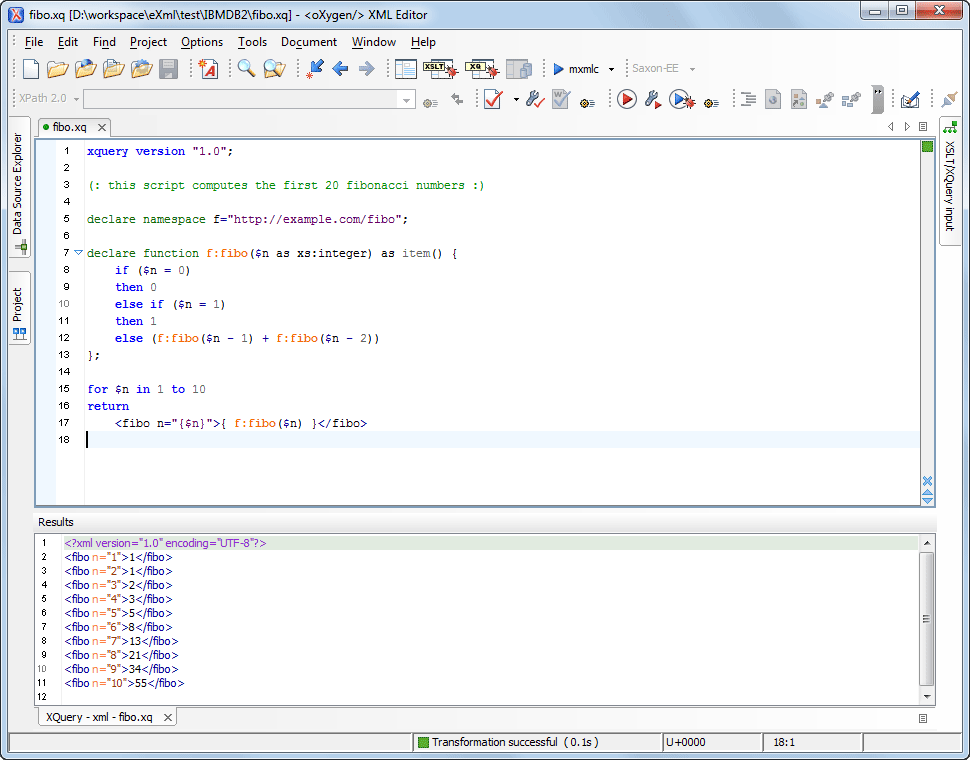
DB2 pureXML supports XQuery interrogations when working with the XML content of
the XML column types. For example if you like to generate a XQuery to measure the
employee satisfaction levels regarding the company rules, you can open an XQuery
editor (New->XQuery), configure the transformation scenario to match the DB2
connection for the transformer field, write the XQuery and then execute it.
|