MarkLogic support
Introduction
This tutorial shows you, step by step, how to configure the MarkLogic support in
<oXygen/> XML Editor, browse and edit resources through WebDAV, as well as running
XQuery interrogations.
An XDBC application server must be running in order to be able to connect to the
MarkLogic server using oXygen. More information about how to configure an XDBC server
can be found in MarkLogic documentation: http://xqzone.marklogic.com/pubs/3.2/books/admin.pdf
The tutorial assumes that you have a basic knowledge of databases, XML
technologies and of oXygen XML editor tool. The explanations and screen shots are
given for the standalone version of the <oXygen/> XML Editor. However the same set of
features are available in Eclipse plugin version of the product with minor interface
differences.
How to Configure the MarkLogic Support in oXygen
There are two notions you need to understand in order to configure the MarkLogic
support in oXygen: the data source and the connection.
A data source defines all that is needed in order to have a connection to the
database. <oXygen/> currently supports MarkLogic version 3.0 or higher. Debugging is
available only starting with MarkLogic 3.2 or higher.
Go to <oXygen/>'s Preferences->Data Sources and press the New button in order
to add a new data source. Insert a data source name (make sure that each data source
has an unique name) and select the MarkLogic type from driver type combo box.
You also need to add the following MarkLogic specific driver file:
In order to get these driver files download Java and .NET XCC distributions (XCC
Connectivity Packages) from http://xqzone.marklogic.com/download/binaries/3.1/MarkXCC.Java-3.1-5.zip
available on the page http://xqzone.marklogic.com/download/.
More information about configuring a MarkLogic datasource can be found in the user
manual: http://www.oxygenxml.com/doc/ug-standalone/native-xml-database-support.html
Once you have created the data source you may proceed further by defining one or
more connection based on it. The connections can be configured on the same
Preferences->Data Source page.
Start by choosing a unique connection name and set the Data Source combo box to
the already configured MarkLogic data source. In the Host field specify the name or IP
address of the XDBC server.
In the WebDAV URL field you can specify an URL pointing to a MarkLogic WebDAV
server. More information about how to configure a WebDAV Server for MarkLogic can be
found here: http://xqzone.marklogic.com/pubs/3.2/books/admin.pdf. This URL will be used
for browsing and editing resource. The WebDAV url has the following structure:
http://<host>:<port>.
Sometimes you need to work with two database servers (for example a development
sever and a production server) so it makes sense to define a connection on each
database server to be further used when executing XQuery or browsing/editing the
database resources. If the two database servers have the same version you only need to
configure a data source and add two connections for it.
Database Explorer View
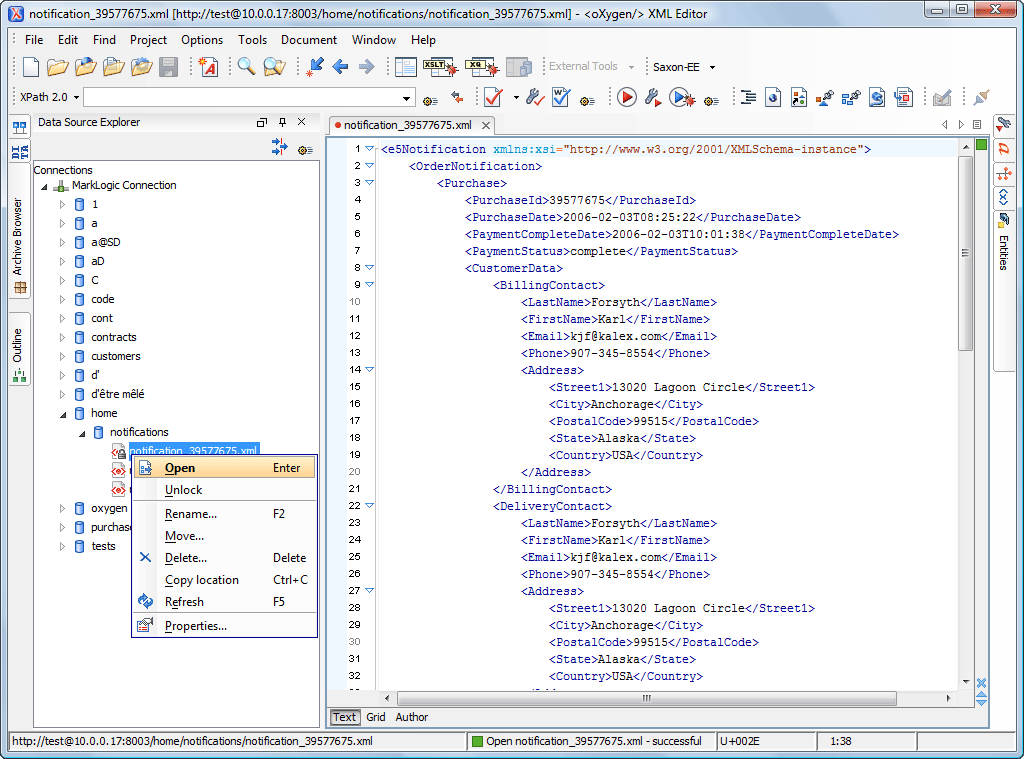
Once we finished the configuration of the connection (and have specified a WebDAV
URL) we are able to browse the database content using the Database Explorer view from
the Database perspective.
XQuery Support
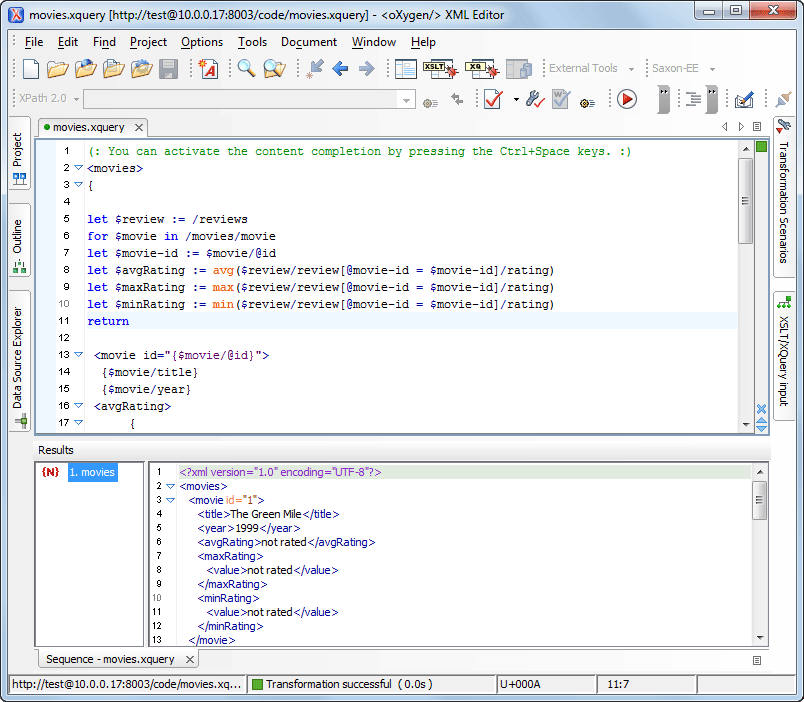
MarkLogic supports XQuery interrogations over the stored XML content. For example
if you like to create a XQuery to generate a report with the billing contact data from
the latest purchase notifications. You can open an XQuery editor (New->XQuery),
configure the transformation scenario to match the MarkLogic connection for the
transformer field, write the XQuery and then execute it.
XQuery Debugger Support
<oXygen/> XML Editor brought the first XQuery debugger against a native XML
database allowing users of the MarkLogic 3.2 (or higher) database to debug their
XQuery code based on the new MarkLogic Server 3.2 (or higher) XQuery debugging API.
When entering in the XQuery Debugging mode <oXygen/> provides a special layout
that display the XML source (optional) and the XQuery documents side by side. It can
also show the debugging output and specific XQuery debugging views and toolbars that
allow you to set breakpoints, inspect variable bindings, evaluate expressions in the
request context.
More details about the <oXygen/> Xquery Debugger can be found here: http://www.oxygenxml.com/xquery_debugger.html
|