What's New in Oxygen XML Editor 28.1
Oxygen XML Editor 28.1 introduces
important enhancements in AI-powered workflows, including the new
Planner chat mode in Oxygen AI Positron and improved sensitive data
masking. This release also adds built-in support for S1000D®
issue 4.x, improves DITA editing and PDF publishing, and includes
the new Oxygen AI Translator add-on for AI-powered XLIFF translation
workflows.
There are changes in:
AI Enhancements Powered by Oxygen AI Positron
Sensitive Data Masking for AI Requests
Personal or private information (such as email addresses, phone numbers, IDs,
or API keys) is now automatically identified and masked in AI requests to help protect
sensitive data. You can extend this protection by adding custom patterns to cover
additional data types. The masked information is automatically restored in the AI
response, ensuring that users see the correct content and that any generated or updated
files remain accurate.
Improved Review Experience for AI-Modified Files
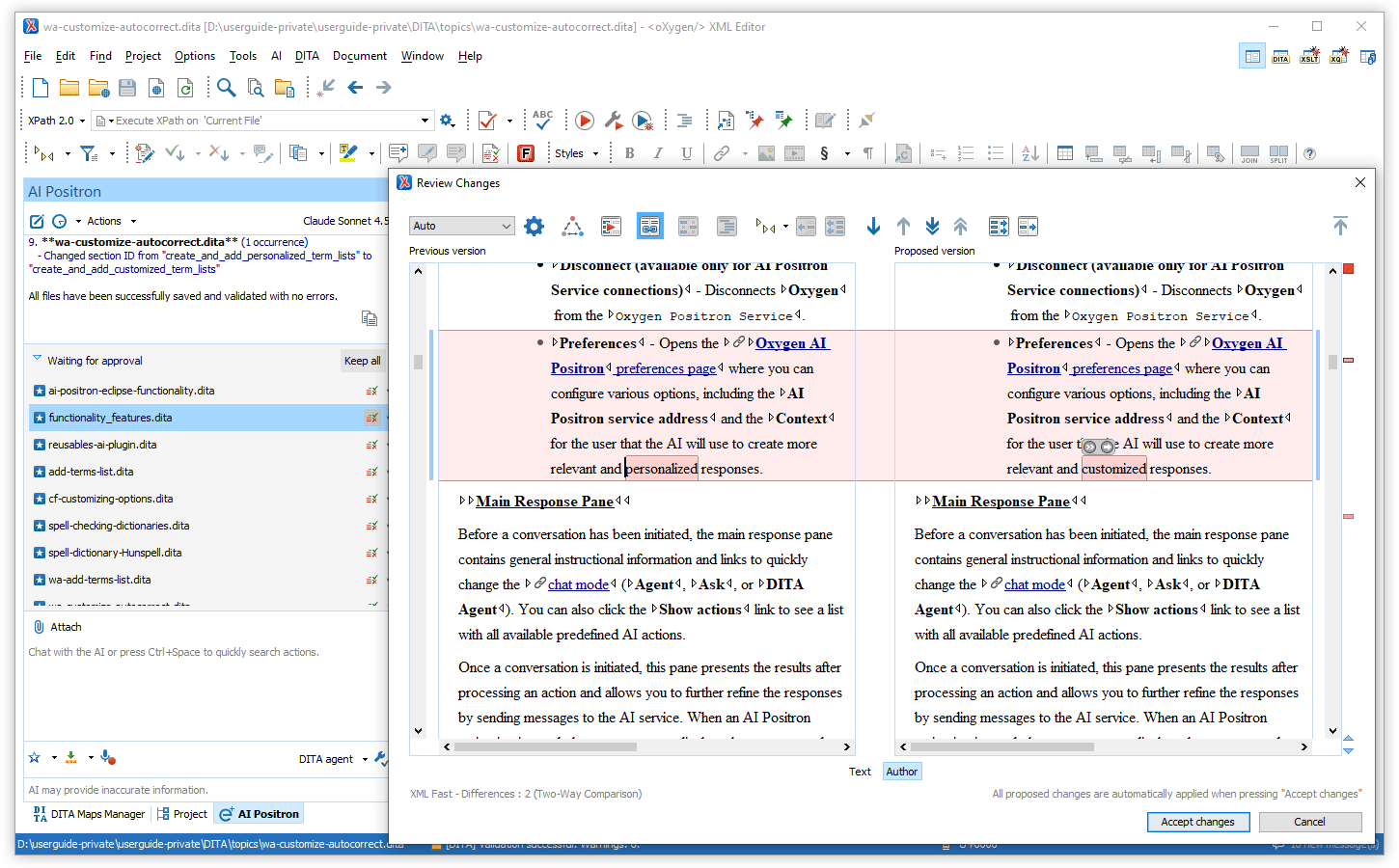
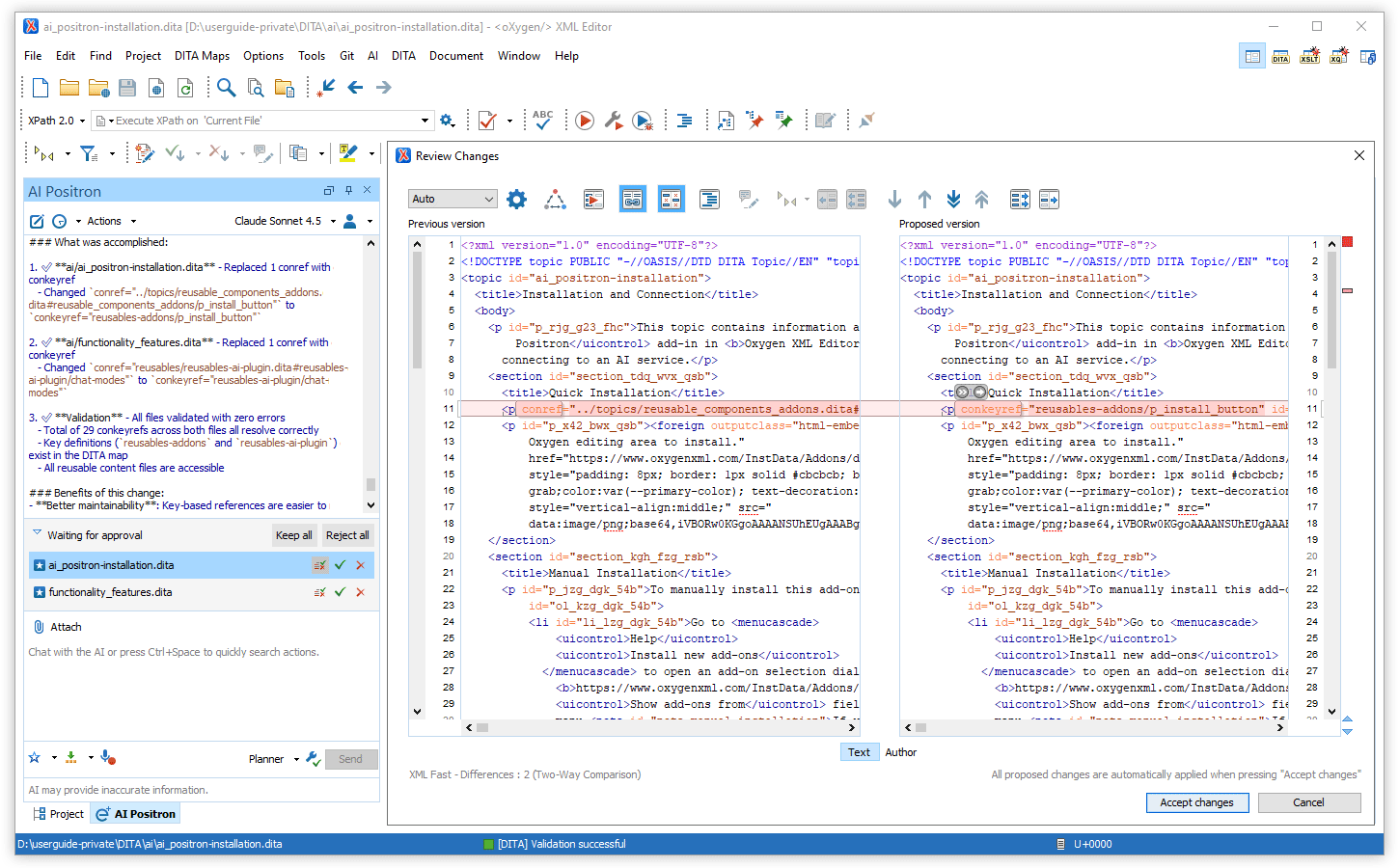
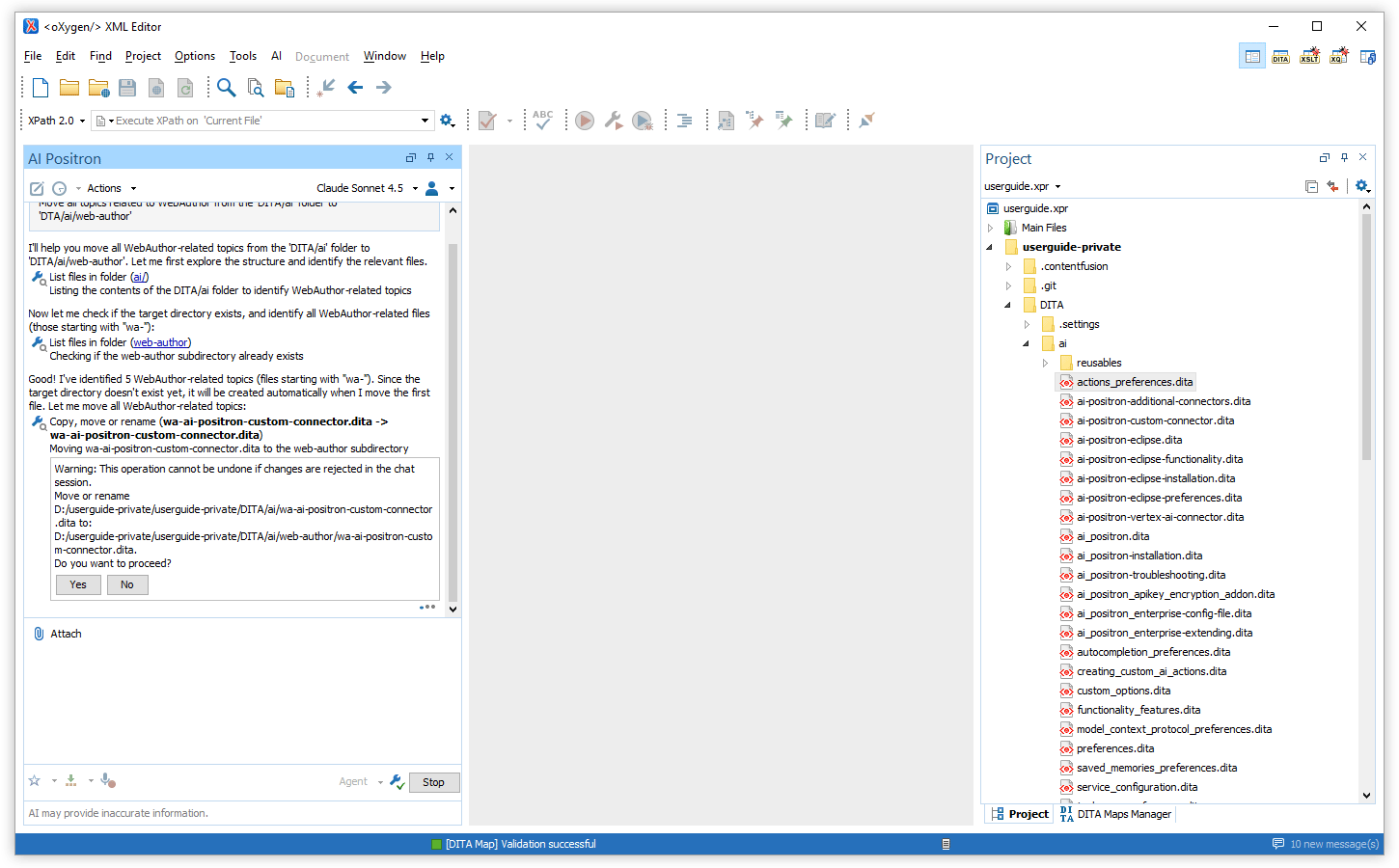
All files created or modified by AI now appear directly in the chat area, so
you can review the proposed changes and accept or discard them without leaving the
conversation. You can also open each file individually and accept only a subset of the
proposed changes while rejecting the rest.
Optimized Token Consumption for AI Prompts and Tools
The prompts and tools that the AI uses to generate answers have been improved
to consume fewer tokens/credits.
New Planner Chat Mode for Resource-Consuming Tasks
The newly introduced Planner chat mode is available for complex,
token-intensive operations (e.g., “Translate all files in the current folder” or “Find
all conrefs and replace them with conkeyrefs in userguide.ditamap”).
After being given the prompt, the AI explores your project, proposes a multi-step
plan, and, after your approval, delegates each step to the most suitable AI agent. This
means large, project-wide changes can be coordinated without hitting LLM context limits,
while still showing you the tool calls and results for review.
Smarter PDF/Word Attachment Expansion in Planner Mode
When using the Planner chat mode with PDF or Word (.docx) attachments, the
document is automatically split into multiple Markdown files, with embedded images
extracted into a temporary folder. This allows the Planner to invoke sub-agents that can
process, transform, or convert the extracted files and assets as needed (for example,
converting them to other formats or generating new project structures).
More Context Information Available in Chat
The AI chat now automatically includes additional information about your
environment and editing context, such as the Oxygen application version, operating system
details, current date, main file information, and caret or selection data (Oxygen 28.1 or
newer). Having richer contextual information leads to higher-quality AI responses. For
example, when the AI needs to run a command-line tool, knowing whether you are using
Windows or macOS is essential to generate correct and relevant commands.
Tools Selector
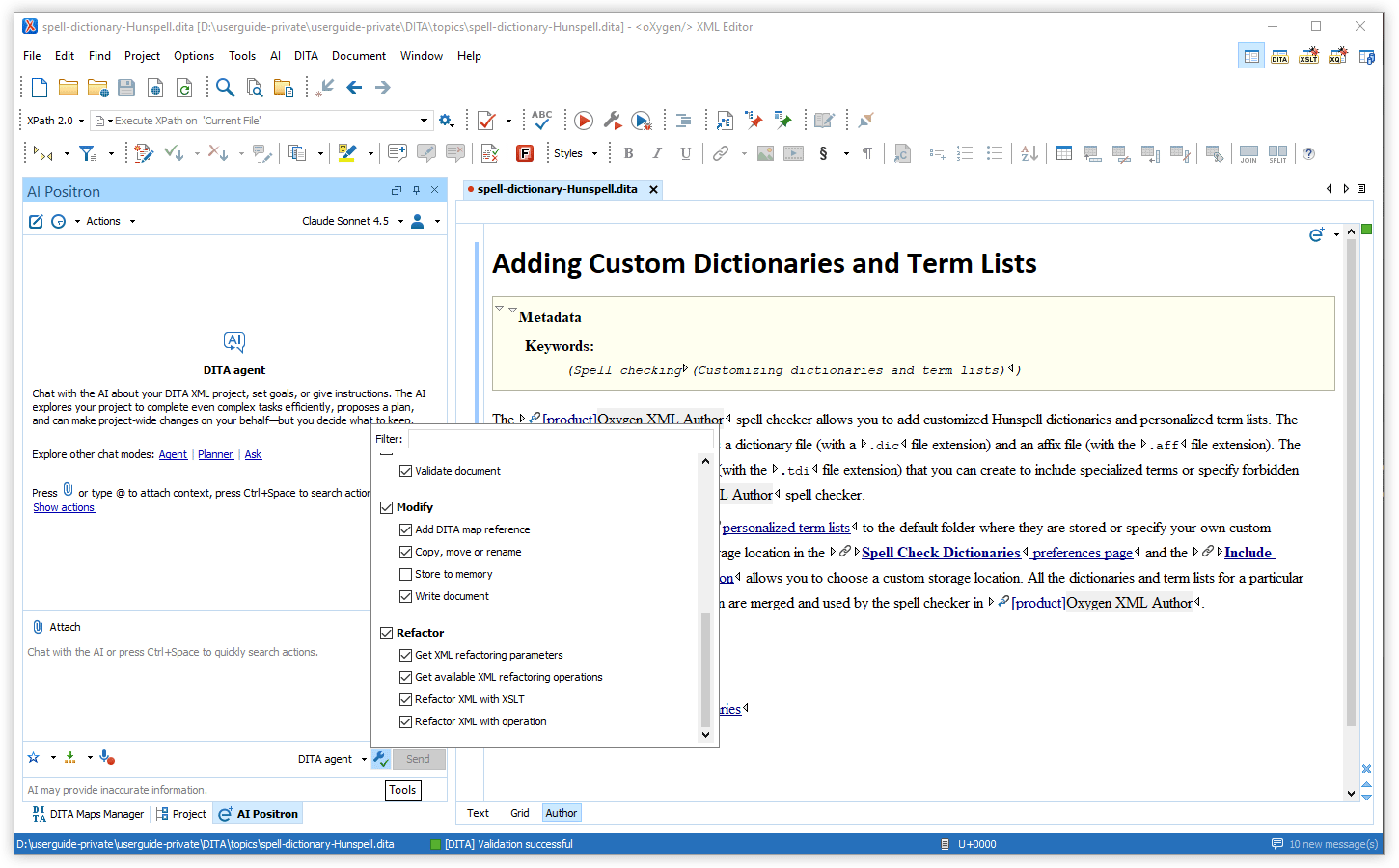
You can now customize the AI's capabilities for each chat mode. The new
Tools selector allows you to disable or enable specific tools (either added
via Model Context Protocol or provided in the chat mode definition), giving you
more control to fine-tune the AI's responses and behavior for your specific
tasks.
Chat Selection Includes Images
When you use the AI chat with content selected in your document, any images
within that selection are now also included for the LLM to analyze along with the
text.
AI Positron Fix Action Turns Agentic
The AI Positron Fix action now automatically applies proposed fixes directly in
your document and continues to explore additional sections when more context is
needed.
Documentation and APIs to Create New Chat Modes
You can now officially define new chat modes by creating new AI actions that
contain the "output-action": "agentic" property.
Tools to List and Invoke AI Agents
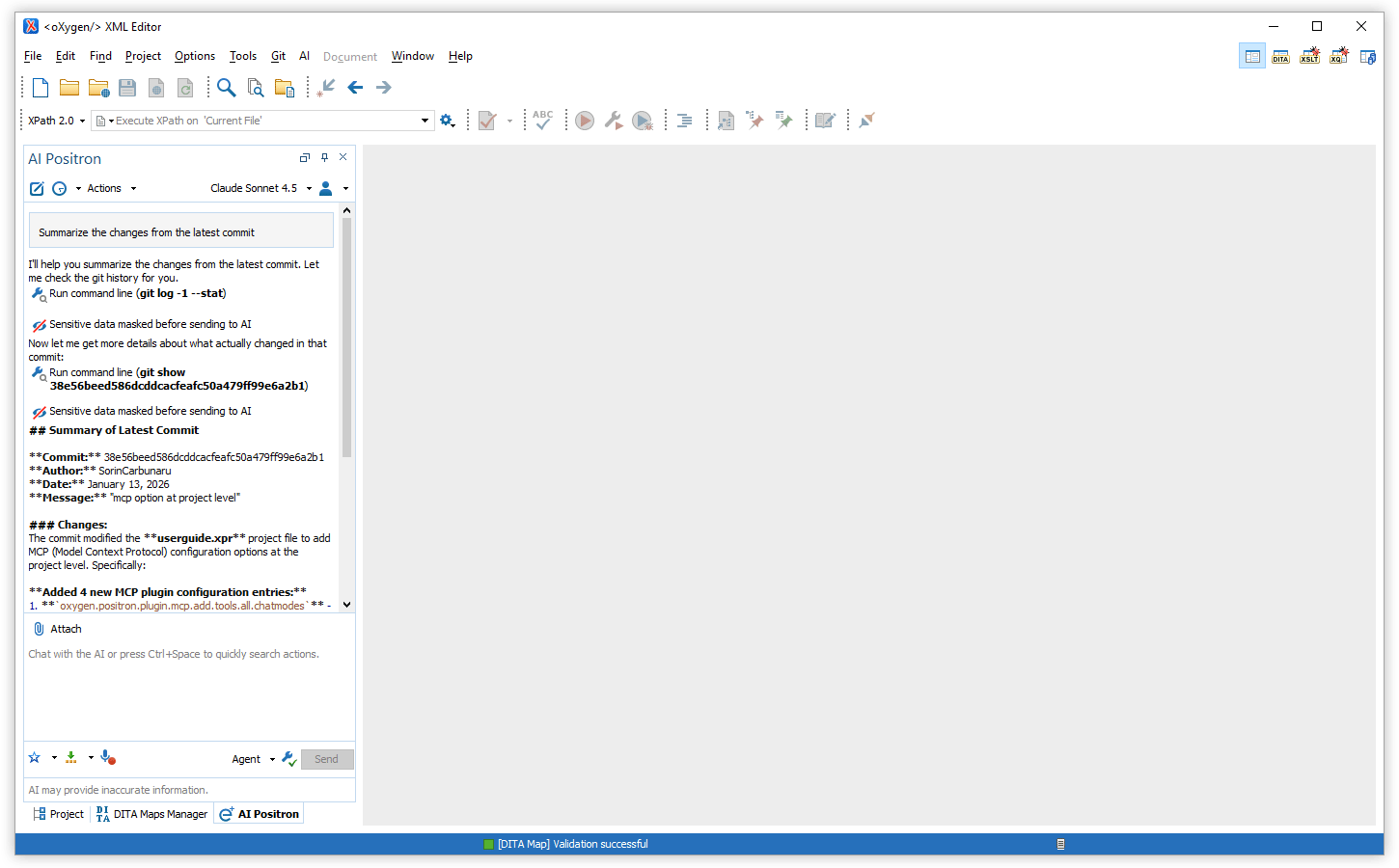
Tool to Run Command Line
A newly added tool is available in all chat modes and can be used to invoke a
command-line process. Note that the tool needs explicit user approval when it is invoked.
For more details, see
AI Positron User Guide: Multi Purpose Tools.
Tool to Copy/Move/Rename Local Resources
A new tool is available in all chat modes and can be used to copy, move, or
rename a local file or folder path. When used in Oxygen 28.1 and newer, if the
Main
Files feature is enabled in Oxygen, references to the moved or renamed resource
are also automatically updated. For more details, see
AI Positron User Guide: Tools that Change Content.
Control AI Action Visibility
You can now choose whether a defined AI action is visible in the UI or only
available to other AI actions as a sub-agent by using the new
visibility
property. For more details, see
AI Positron User Guide: Visibility Property.
Create AI Actions with Vision Support
You can now decide whether a custom AI action sends both content and referenced
images to the LLM by using the "input-type": "markup-with-images" JSON
property. This helps you include images only when they are relevant for the AI
response.
Generate Image Alternate Text Improvements
The Generate Image Alternate Text action can now be used on
all images that are referenced within a document at once, while you can still use the
action on individual selections as well.
Preserve Structure and Styles for Attached Word and PDF Documents
When attaching Word (.docx) or PDF documents in the chat, their internal
structure (headings, lists, tables, code blocks) and styling (bold, italic) are now
preserved when being sent to the AI so that it better understands the
document.
Updated Model Context Protocol Library
The Model Context Protocol SDK that is bundled with AI Positron 8.1
was updated to contain the latest fixes in the 0.16.0 SDK.
Removed Support for Older Models
Support for older models (such as GPT-4, GPT-4 Turbo, GPT-4o, Sonnet 3.7, and
more) has been removed. Alternatives with improved characteristics are available, such as
models with higher intelligence, lower prices, or larger context windows.
DITA Editing
Edit DITA Change History using Form Controls
Use inline actions and form controls in the DITA prolog section to quickly add,
edit, or delete change history entries, including setting completion dates and updating
revision details, so you can keep audit trails accurate.
DITA Publishing
Character-Level Fallback Fonts
For DITA to PDF publishing, you can use the new
enable.character.level.font.fallback parameter to enable
character-level font fallbacks so that mixed-language content (for example, Latin and
non-Latin) is rendered correctly in the same document.
S1000D
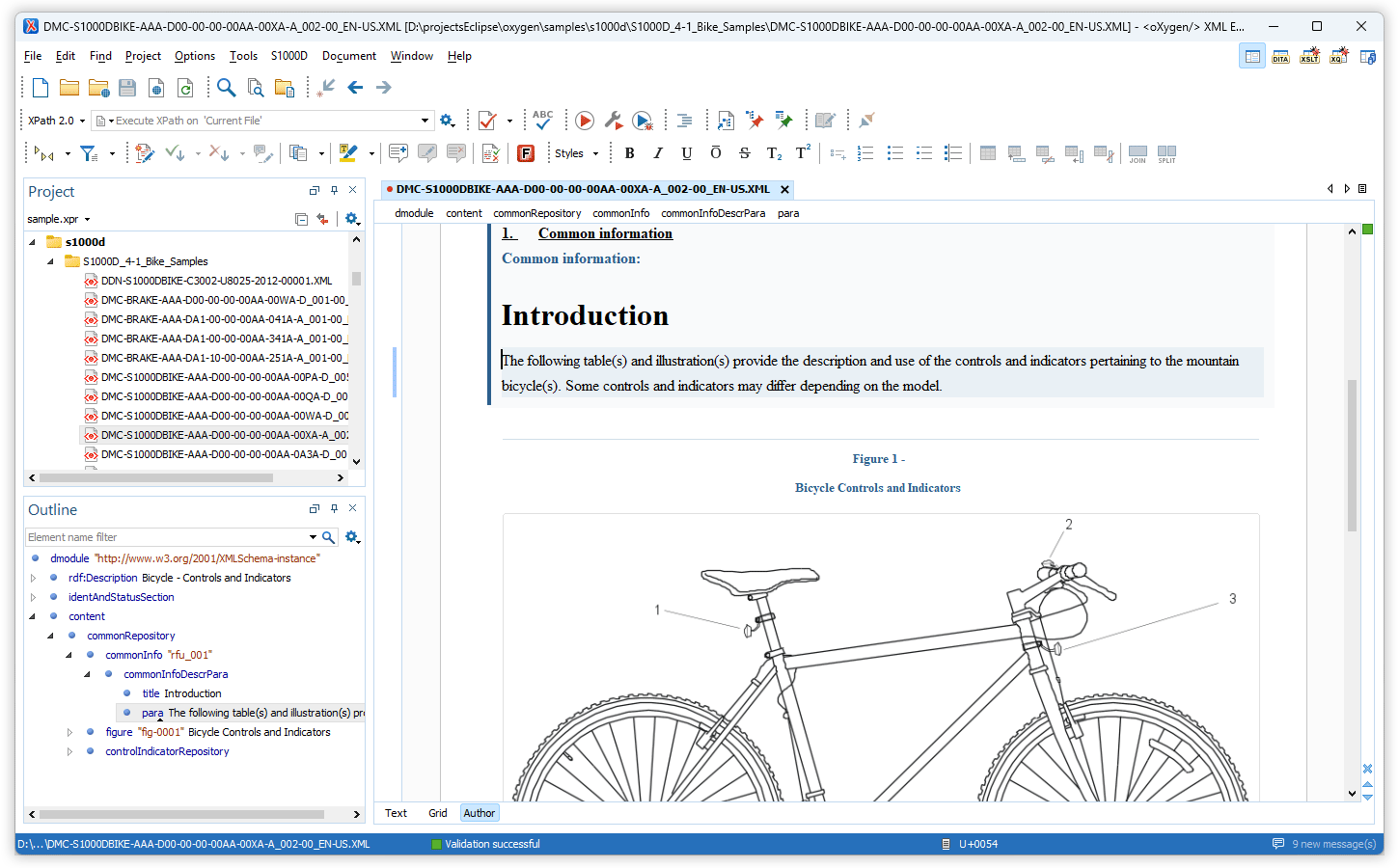
You can now work with S1000D issue 4.x content using built-in support for
editing and visual authoring, including templates, BREX (Business Rules Exchange) handling,
and Smart Paste.
Editing and Validation
Edit S1000D documents with schema-guided editing, content completion,
and validation support: XML Schema-based validation, and currently BREX-based validation
through conversion to Schematron.
Visual Editing and Actions
Visually edit S1000D documents in the Author page and switch between
full-width, print preview, or large-font styles. Use dedicated actions to insert
and edit tables, lists, and text styling.
New File Templates
Create new S1000D data modules or publication modules for issues 4.0,
4.1, and 4.2 using the provided file templates.
BREX Editing and Transformation
Edit BREX modules in the Text or Author page with content completion
and validation support. You can also convert BREX modules to Schematron using
the provided transformation scenario.
Documentation for S1000D Elements and Attributes
View documentation for S1000D elements and attributes directly in the
content completion window and in the Attributes
view.
Smart Paste for S1000D Documents
Paste content from web browsers or Word documents into S1000D documents
while preserving structure and formatting.
CGM Add-on Update
The CGM add-on that adds support for rendering CGM images in the
Author visual editor was updated to use the latest jcgm version 2.0.5
library.
File/Directory Comparison
Control Comment Callout Width and Visibility
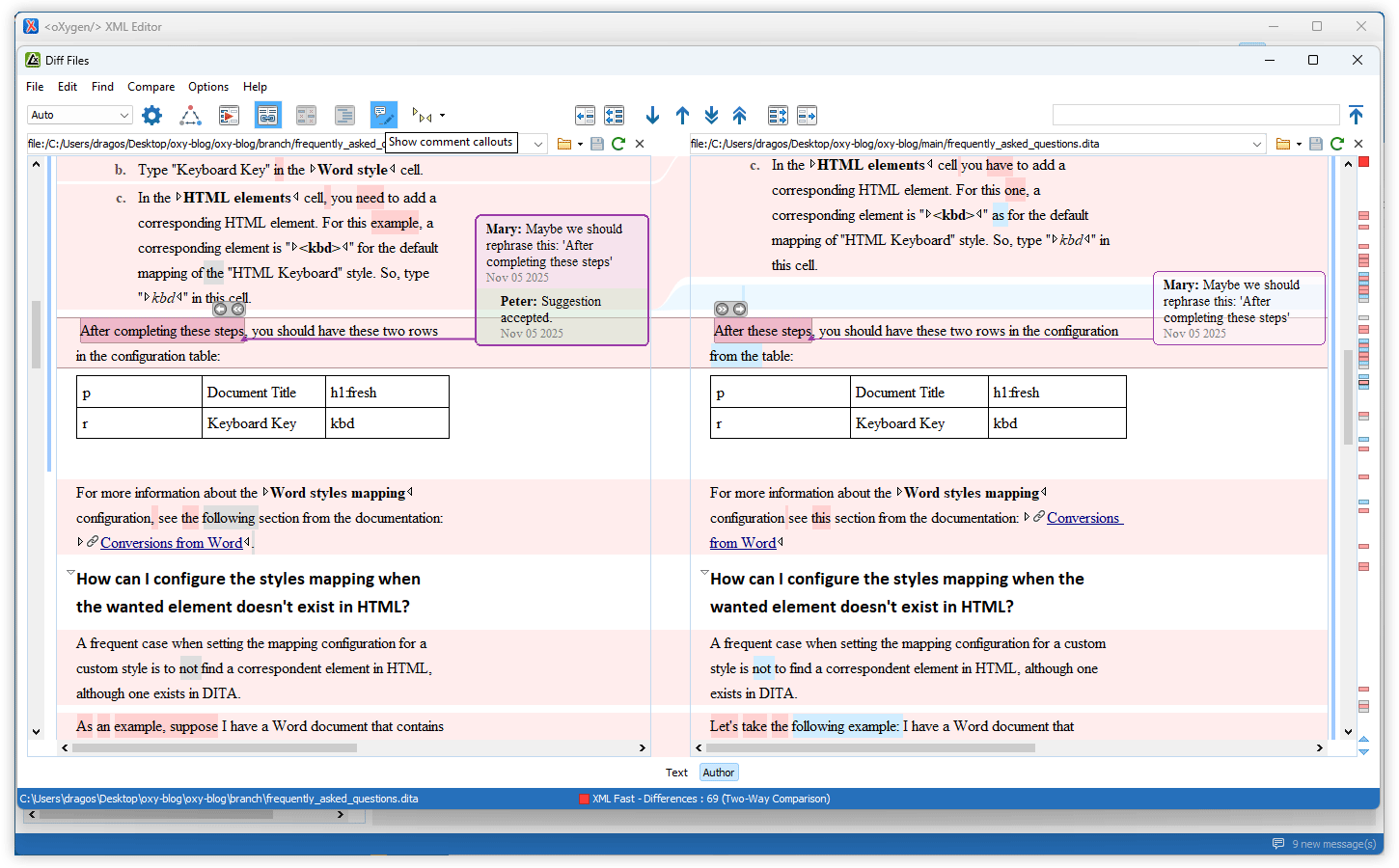
You can now choose the width used for rendering comment callouts using the new
Comment callout width option in the File Comparison Appearance
preferences page, so you can better control how much space they take in the comparison
view. You can also toggle displaying comment callouts when comparing files in Author mode
using the Show comment callouts toolbar button.
Timestamps and User Information in Comparison Reports
Your comparison reports now include metadata about who ran the comparison, when
it was run, and how long it took. This helps you track and audit comparison activity over
time. For HTML reports, this information is also displayed in the browser in a collapsible
section.
XProc
Improved Support for XProc 3.0/3.1
XProc pipelines are now more robust, flexible, and easier to run in Oxygen.
Some specific improvements include:
- Saxon XInclude support is now enabled, so XProc pipelines can process documents
that rely on XInclude.
- Options parsing has been enhanced to not only accept strings, but also
primitive types (such as numbers, booleans), allowing pipeline parameters to be passed
in a more natural and type-safe way.
- The HTML5 Validator has been integrated into the XProc Calabash engine, so HTML
documents are now validated and handled correctly within XProc workflows.
AI Translator Add-on
The new
Oxygen AI Translator add-on brings AI-powered
translation capabilities to your XLIFF workflows with intelligent task-based management,
quality checks and retries, smart caching, and fully configurable AI model settings. The AI
Translator requires Oxygen version 28 or later and the
Oxygen AI Positron add-on. It
supports XLIFF 1.2 for translations and TMX 1.4b for translation memory.
AI-Powered Translation Engine
The translation engine delivers high-quality XLIFF translations powered by a
built-in quality control mechanism. It validates results through quality checks, detects
structural and formatting issues, and escalates retries through alternative models when
needed. The engine reuses approved content via TMX-based translation memory, follows your
custom instructions (terminology, style, context) for consistent output, and caches AI
responses to reduce costs and accelerate repeat translations.
Key features
include:
- Translation Quality Checks & Retries - The translation
engine detects low-quality translations, structural errors, or formatting problems,
and retries failed translations using alternative AI models to meet quality
standards.
- Translation Memory Integration - The built-in translation
memory system provides intelligent reuse of existing translations. You can provide TMX
1.4b files to leverage previously translated content, improving consistency across
your translation projects.
- Custom User Translation Instructions - Provide custom
instructions to guide the AI translation process. Upload files with specific
terminology, style guidelines, or contextual information to ensure translations meet
your exact requirements and maintain consistency with your organization's
standards.
- Caching System - The translation engine implements a caching
mechanism that stores AI API responses locally to avoid redundant calls. Cached
translations are retrieved instantly from local storage, significantly reducing
translation costs and improving performance for repeated translations.
AI Translator View
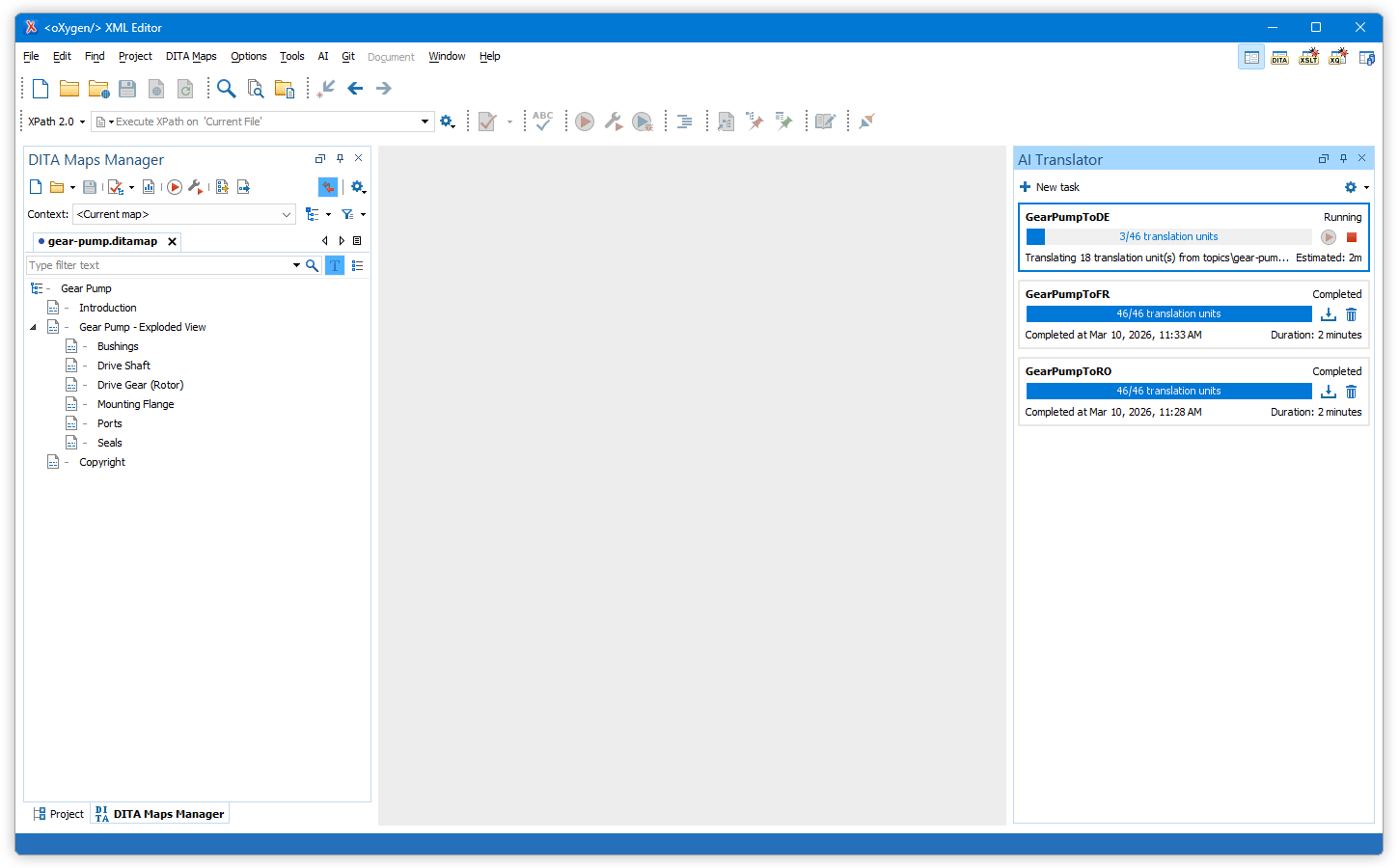
An intuitive graphical interface is integrated into Oxygen for creating and
managing translation tasks. Create translation tasks by specifying an XLIFF file, optional
TMX memory files, and custom user instructions. The view includes inline validation for
XLIFF and TMX inputs and provides quick access to preferences.
Key features
include:
- Real-Time Progress Tracking - Visual progress monitoring
provides detailed status updates, including task states, translation unit counts and
completion percentages, time estimates, and elapsed time. Track multiple translation
jobs simultaneously with individual progress indicators and play/stop controls for
each task.
- Job Persistence - Translation jobs automatically survive JVM
restarts and can be resumed from where they left off, ensuring no translation work is
lost even in case of unexpected interruptions.
- XLIFF/TMX Validation Utilities - Built-in validators for XLIFF
1.2 structure and TMX 1.4b inputs catch format issues before processing begins,
preventing wasted API calls and ensuring clean translation workflows.
- Translation Logging and Statistics - Each translation task
generates a detailed log file that tracks the entire translation process. The log
includes a comprehensive report with translation metrics to help you identify
optimization opportunities and manage your translation budget effectively.
Custom Translation Configurations
You can now define multiple AI translation configurations from a dedicated
preferences page. For each configuration, you choose the AI model used for the initial
translation, a model used for quality validation (which can differ from the primary
model), and alternative models that are used if quality checks fail, creating a fallback
chain. You can also adjust performance-related options such as the maximum number of
parallel translation jobs and caching behavior. This helps you tailor translation
workflows to different projects and balance quality, cost, and speed.
Add-on Updates
Git Client
Version 5.6.0 of the Git Client was released with the following updates:
- Multiple worktrees are now supported, allowing you to manage several branches
simultaneously without the hassle of stashing changes or performing a fresh
clone.
- A new Explain commit action is available (when
right-clicking commits in the Git History view) that utilizes AI
Positron to explain the changes from the selected commits.
- Actions were added to quickly open the working copy folder in your system's
file manager or terminal.
- New actions are available in the Git Branch Manager to show
the head of a selected branch in the Git History or to track a
remote branch from a local one.
- The performance of the Git Client was significantly improved when working
without access to the remote repository.
- Various other improvements, component updates, and bug fixes were
implemented.
- The minimum required version of Oxygen was updated to 27.1.
For more information, see the release notes at https://www.oxygenxml.com/addons/com.oxygenxml.git.html.
API Additions
Retrieve Line/Column for Offset in Author Mode
The new WSTextBasedEditorPage.getColumnOfOffset and
WSTextBasedEditorPage.getLineOfOffset APIs allow you to retrieve the
corresponding line and column information for a caret offset location in the Author visual
editor mode.
Accessibility
Support for VPAT 2.5
Oxygen was evaluated against the latest VPAT 2.5 accessibility
guidelines.
Component Updates
Updated OpenJDK to Version 21.0.10
The version of OpenJDK that is bundled with the installation kits for providing
the Java Runtime Environment was updated to version 21.0.10 from Eclipse
Adoptium.
Updated Jackson JSON Libraries to Version 2.20.1
Updated the Jackson JSON libraries that are used by the Oxygen core to version
2.20.1.
Support for DITA-OT 4.4
The publishing engine was updated to integrate DITA-OT 4.4.
Support for Eclipse 4.38 and 4.39
The Oxygen plugins for Eclipse were updated to fully support Eclipse versions
4.38 and 4.39.
Integrated XML Calabash 3.0.38
XML Calabash 3.0.38 was integrated into Oxygen to offer support for validating
and transforming XProc scripts.
Updated TEI Schemas to Version 4.11
The TEI XML schemas were updated to version 4.11.
Updated TEI Stylesheets to Version 7.60.0
The TEI XSLT Stylesheets were updated to version 7.60.0.
Scripting
Provide Options for Directory/File Comparison Scripts via a Configuration
File
Timestamps and User Information in Comparison Reports
Your comparison reports now include metadata about who ran the comparison, when
it was run, and how long it took. This helps you track and audit comparison activity over
time. For HTML reports, this information is also displayed in the browser in a collapsible
section.