
Oxygen AI Positron Suite 8.1
Oxygen AI Positron 8.1 delivers a new level of productivity, security, and flexibility for users leveraging AI in their XML authoring workflows. This release introduces support for OpenAI’s latest GPT-5.2 and GPT-5.2 Thinking models and enables more accurate and context-aware agentic tasks. Sensitive data masking is now built-in, automatically protecting personal information in AI requests, with the ability to extend coverage to custom data types. The review experience is streamlined as AI-modified files are now presented directly in the chat for easy acceptance or rejection of changes. Token consumption for AI prompts and tools has been optimized, reducing costs and improving efficiency.
A new Planner chat mode empowers users to coordinate complex, multi-step, project-wide changes, while smarter handling of PDF and Word attachments enables advanced document processing. The chat interface now provides richer context about your editing environment, leading to higher-quality AI responses. Users gain granular control over AI capabilities with the new Tools selector, and can now create custom chat modes and actions, including those with vision support for image analysis. Additional enhancements include agentic AI Positron Fixes, improved alternate text generation for images, preservation of structure and styles in attached documents, and new tools for command-line operations and resource management.
There are changes in:
Oxygen AI Positron for Desktop
OpenAI GPT-5.2 Models Available
Sensitive Data Masking for AI Requests

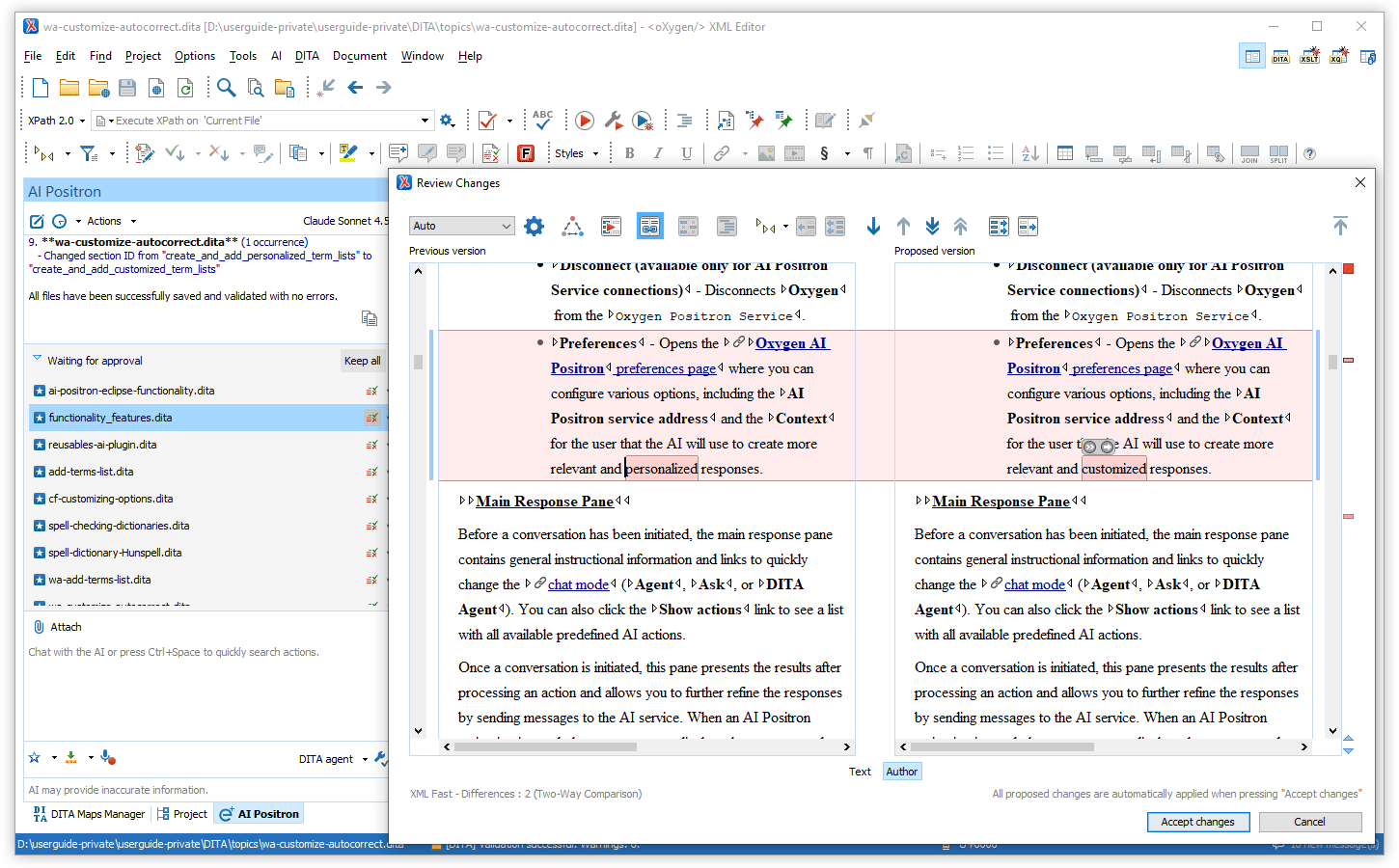
Improved Review Experience for AI-Modified Files
Optimized Token Consumption for AI Prompts and Tools
New Planner Chat Mode for Resource Consuming Tasks
The newly-introduced Planner chat mode is available for complex, token-intensive operations (e.g. “Translate all files in the current folder” or “Find all conrefs and replace them with conkeyrefs in userguide.ditamap”).
After being given the prompt, the AI explores your project, proposes a multi-step plan, and after your approval, delegates each step to the most suitable AI agent. This means large, project-wide changes can be coordinated without hitting LLM context limits, while still showing you the tool calls and results for review.
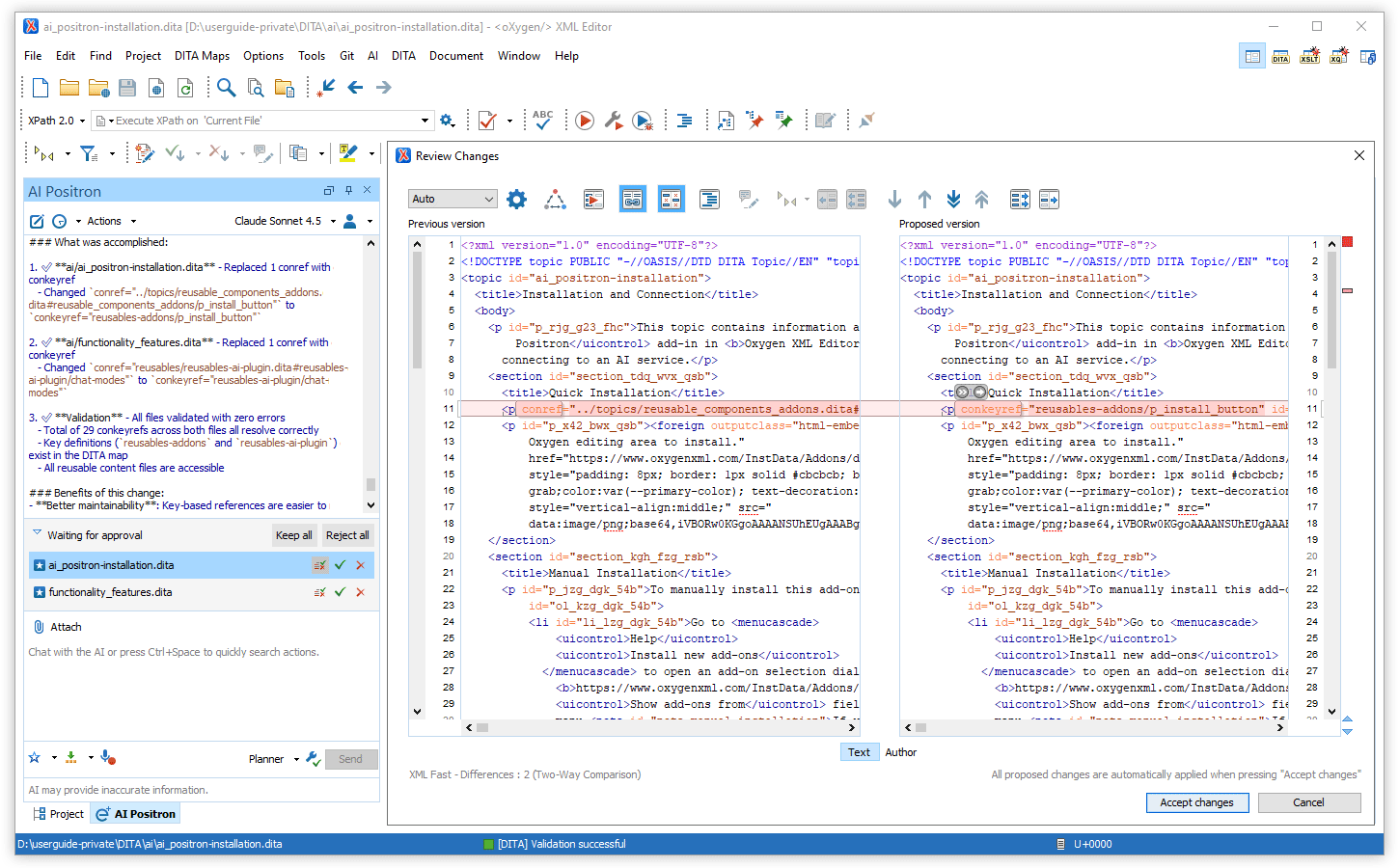
Smarter PDF/Word Attachment Expansion in Planner Mode
More Context Information Available in Chat
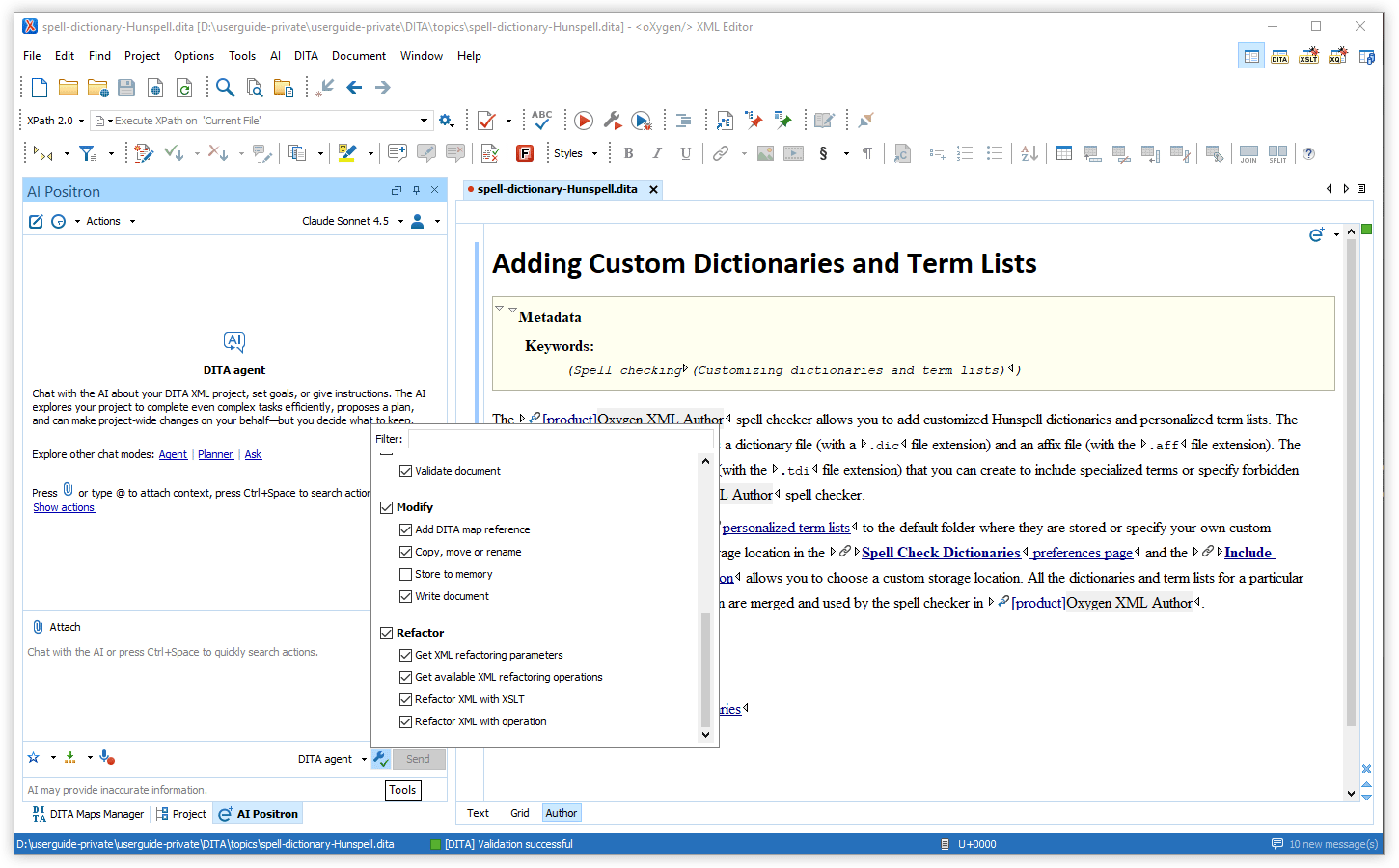
Tools Selector
Chat Selection Includes Images
Create New AI Chat Modes
AI Positron Fix Action Turns Agentic
Documentation and APIs to Create New Chat Modes
"output-action": "agentic" property.Tools to List and Invoke AI Agents
Tool to Run Command Line
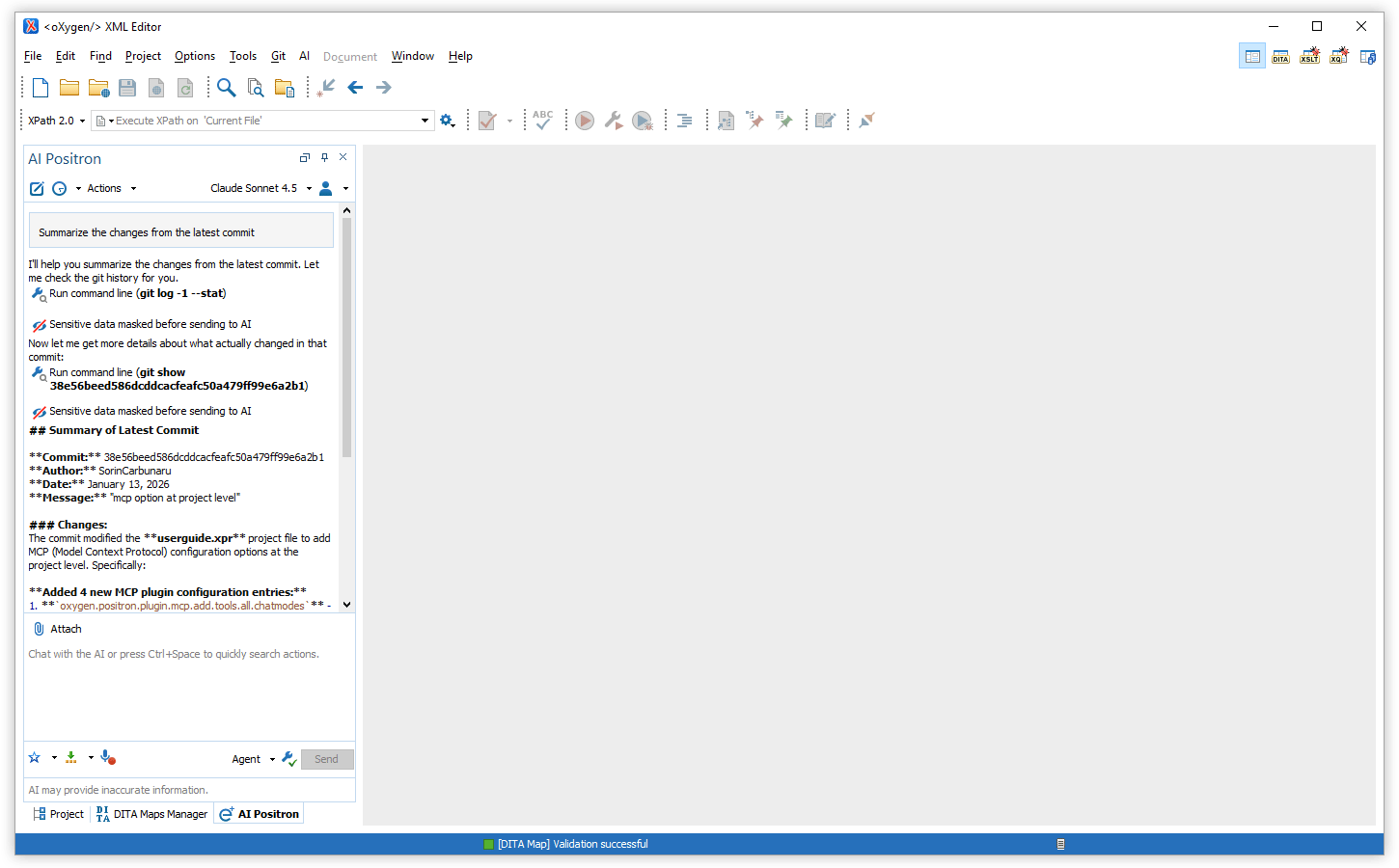
Tool to Copy/Move/Rename Local Resources
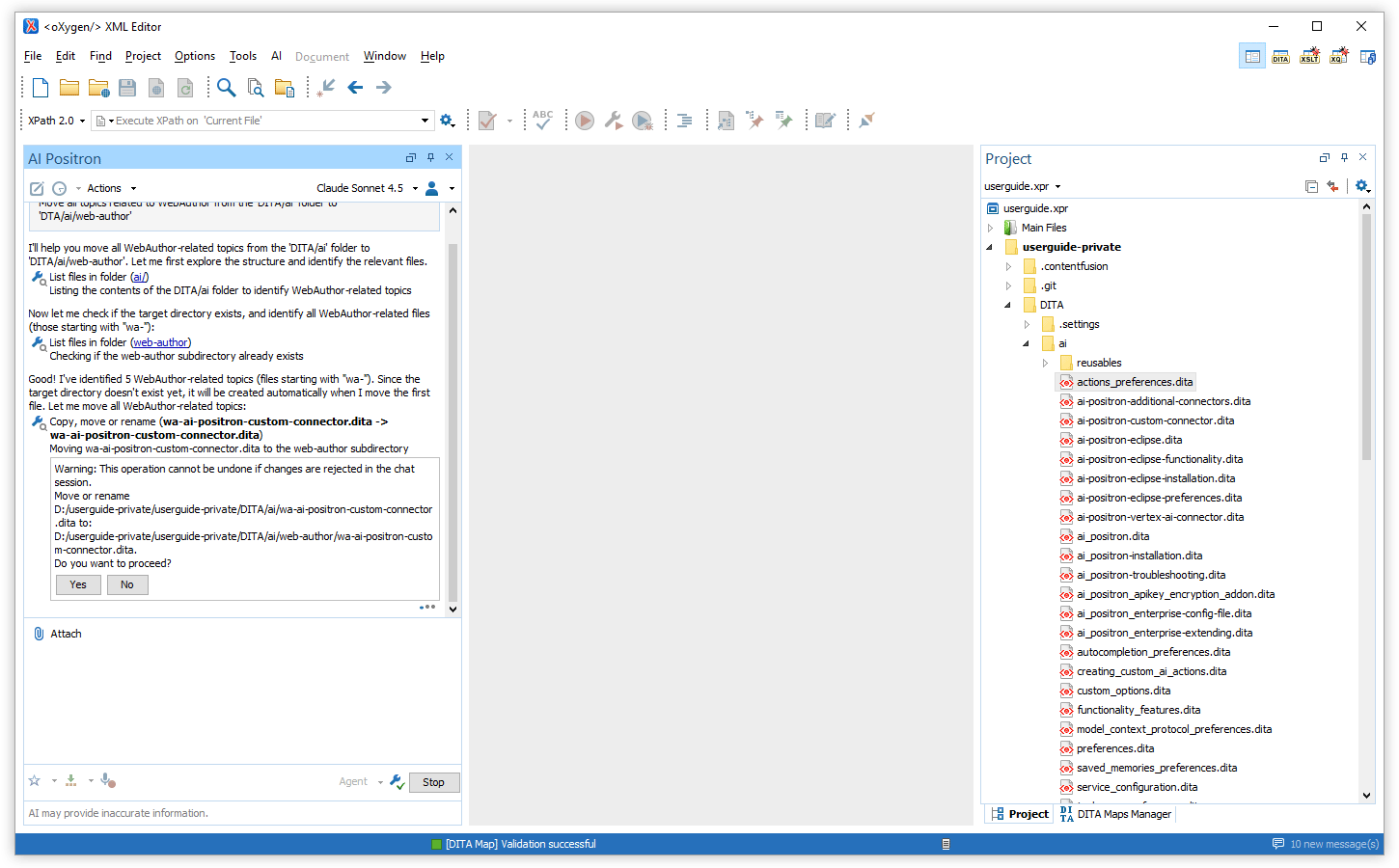
Control AI Action Visibility
Create AI Actions with Vision Support
"input-type":
            "markup-with-images"
JSON
property. This helps you include images only when they are relevant for the AI
response.Generate Image Alternate Text Improvements
Preserve Structure and Styles for Attached Word and PDF Documents
Updated Model Context Protocol Library
Removed Support for Older Models
Oxygen AI Positron for Eclipse
OpenAI GPT-5.2 Models Available
Optimized Token Consumption for AI Prompts and Tools
More Context Information Available in Chat
The AI chat now automatically includes additional information about your environment and editing context, such as the Oxygen application version, operating system details, current date, and caret or selection data (Oxygen 28.1 or newer). Having richer contextual information leads to higher-quality AI responses.
Control AI Action Visibility
Create AI Actions with Vision Support
"input-type":
            "markup-with-images"
JSON
property. This helps you include images only when they are relevant for the AI
response.Generate Image Alternate Text Improvements
Preserve Structure and Styles for Attached Word and PDF Documents
Oxygen AI Positron for Content Fusion
OpenAI GPT-5.2 Models Available
Optimized Token Consumption for AI Prompts and Tools
New Planner Chat Mode for Resource Consuming Tasks
The newly-introduced Planner chat mode is available for complex, token-intensive operations (e.g. “Translate all files in the current folder” or “Find all conrefs and replace them with conkeyrefs in userguide.ditamap”).
After being given the prompt, the AI explores your project, proposes a multi-step plan, and, after your approval, delegates each step to the most suitable AI agent. This means large, project-wide changes can be coordinated without hitting LLM context limits, while still showing you the tool calls and results for review.
More Context Information Available in Chat
Documentation and APIs to Create New Chat Modes
"output-action": "agentic" property.Tools to List and Invoke AI Agents
List Directory Tool (Available with the Upcoming Content Fusion 9.1)
Control AI Action Visibility
Create AI Actions with Vision Support
"input-type":
            "markup-with-images"
JSON property.Generate Image Alternate Text Improvements
Preserve Structure and Styles for Attached Word and PDF Documents
Oxygen AI Positron for Web Author
OpenAI GPT-5.2 Models Available
Optimized Token Consumption for AI Prompts and Tools
New Planner Chat Mode for Resource Consuming Tasks
The newly-introduced Planner chat mode is available for complex, token-intensive operations (e.g. “Translate all files in the current folder” or “Find all conrefs and replace them with conkeyrefs in userguide.ditamap”).
After being given the prompt, the AI explores your project, proposes a multi-step plan, and, after your approval, delegates each step to the most suitable AI agent. This means large, project-wide changes can be coordinated without hitting LLM context limits, while still showing you the tool calls and results for review.
More Context Information Available in Chat
The AI chat now automatically includes additional information about your environment and editing context, such as the Oxygen application version, current date, and caret or selection data (Web Author 28.1 or newer). Having richer contextual information leads to higher-quality AI responses.
Documentation and APIs to Create New Chat Modes
"output-action": "agentic" property.Tools to List and Invoke AI Agents
Control AI Action Visibility
Create AI Actions with Vision Support
"input-type":
"markup-with-images" JSON property.Generate Image Alternate Text Improvements
Preserve Structure and Styles for Attached Word and PDF Documents
Oxygen AI Positron Suite 8.0
Oxygen AI Positron 8.0 for Desktop unifies the AI Positron Assistant and AI Positron Assistant Enterprise add-ons into a single add-on.
AI assistance is now more effective with project-aware context prompts that allow chat and AI actions to follow project-specific style guides, as well as new tools such as project-wide search, directory listing, precise edit operations, and XML refactoring.
You can create multiple connections to each supported AI service, with new options including an AWS Bedrock connector and models like OpenAI GPT-5.1, Claude Sonnet 4.5, Claude Haiku 4.5, and xAI Grok 4 Fast, giving you greater flexibility in choosing the right AI assistance for your tasks.
This version introduces an experimental local Model Context Protocol (MCP) server that lets desktop AI assistants start Oxygen and use its tools for validation, editing, and refactoring.
In Web Author, AI-powered new file creation generates starter documents from prompts and attachments (XML, Markdown, images, or PDFs and Office files). In Content Fusion, project-wide search is available as an AI tool, improving agentic chat performance. The chat area is also cleaner, with attachments as chips, context inspection, quick action invocation, and richer tool-call details.
There are changes in:
Oxygen AI Positron for Desktop
A New Unified AI Positron Add-on
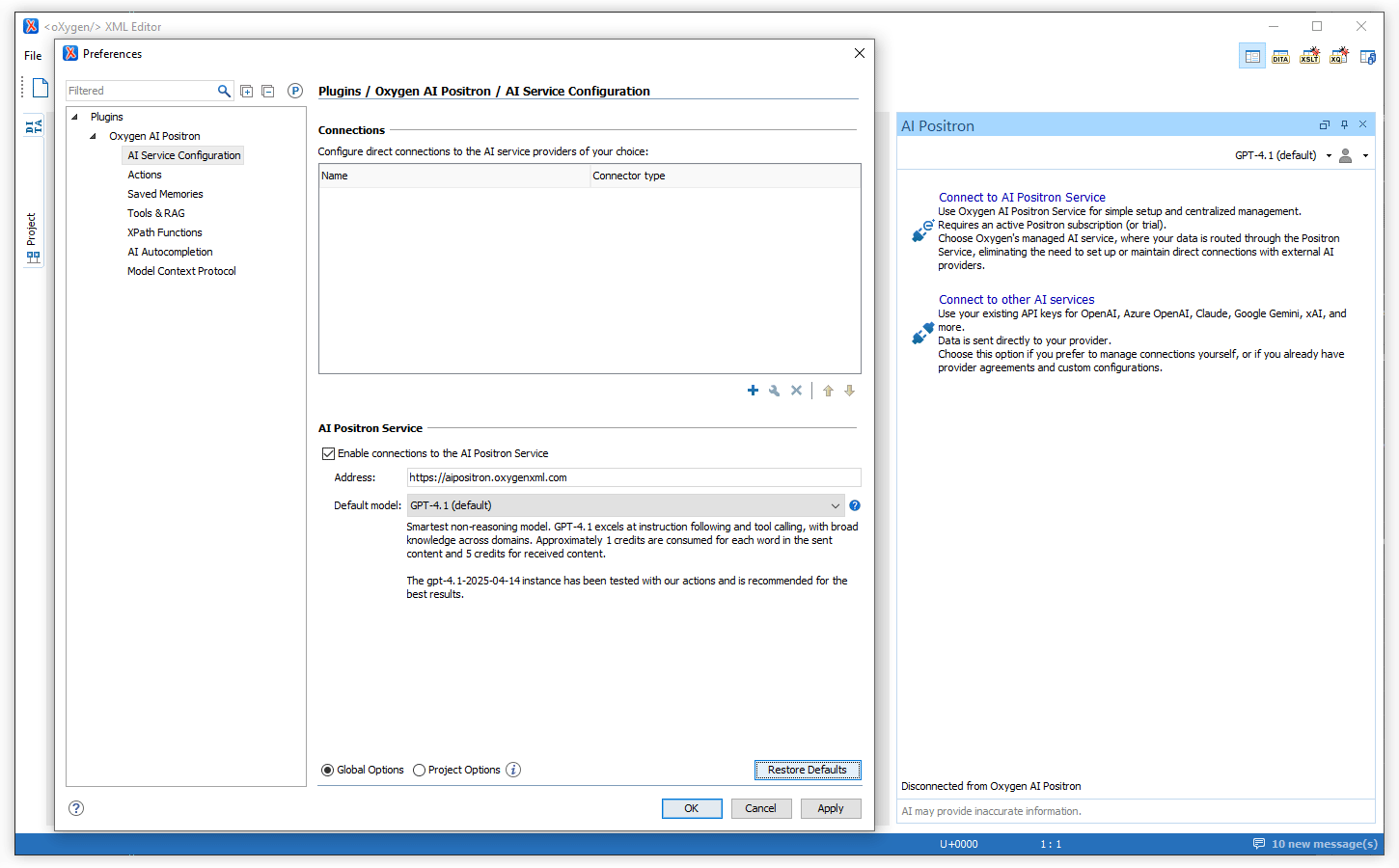
Support Multiple Connections to AI Service Providers
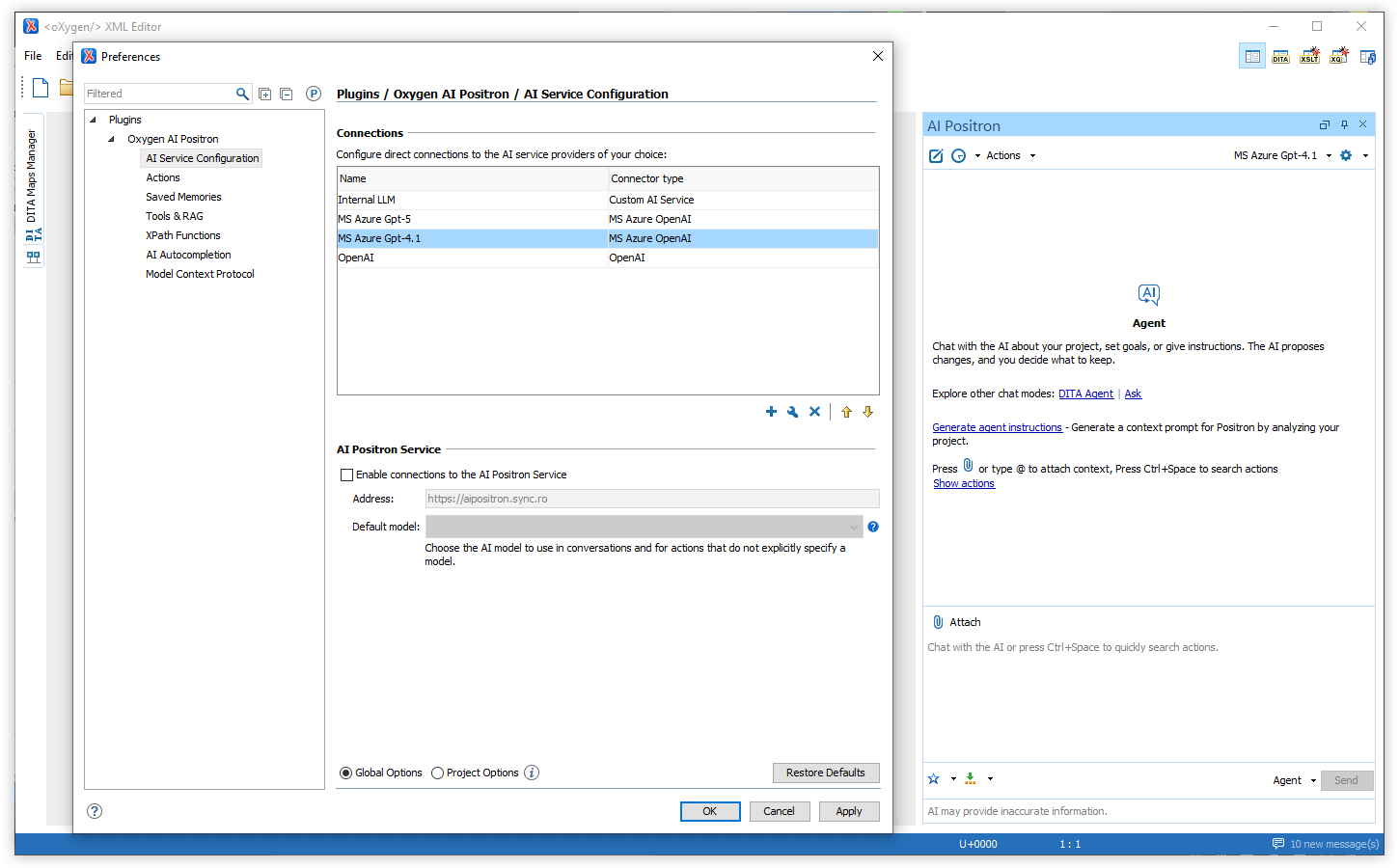
New Dedicated Connector: AWS Bedrock
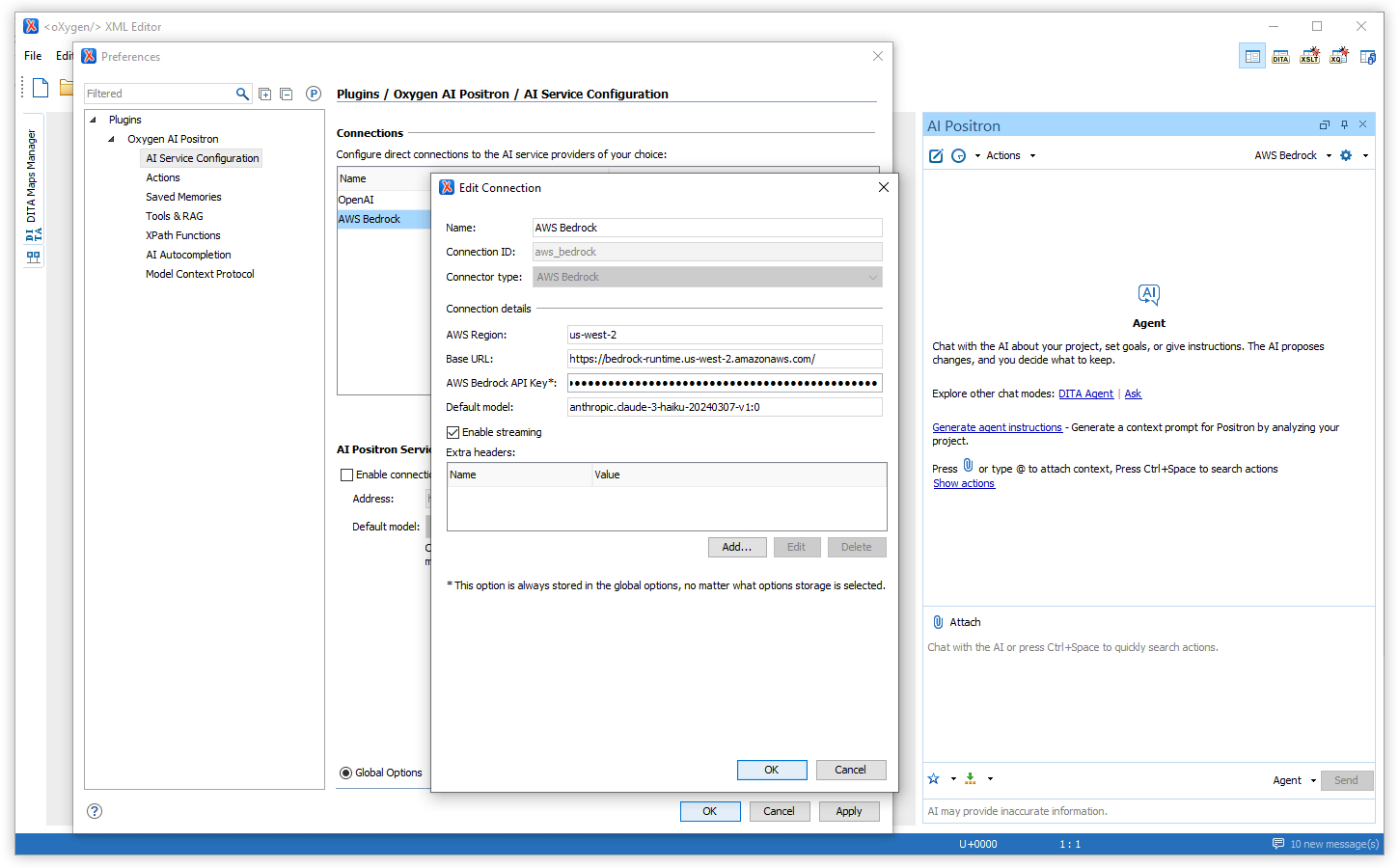
Smarter AI Context Prompt Setup
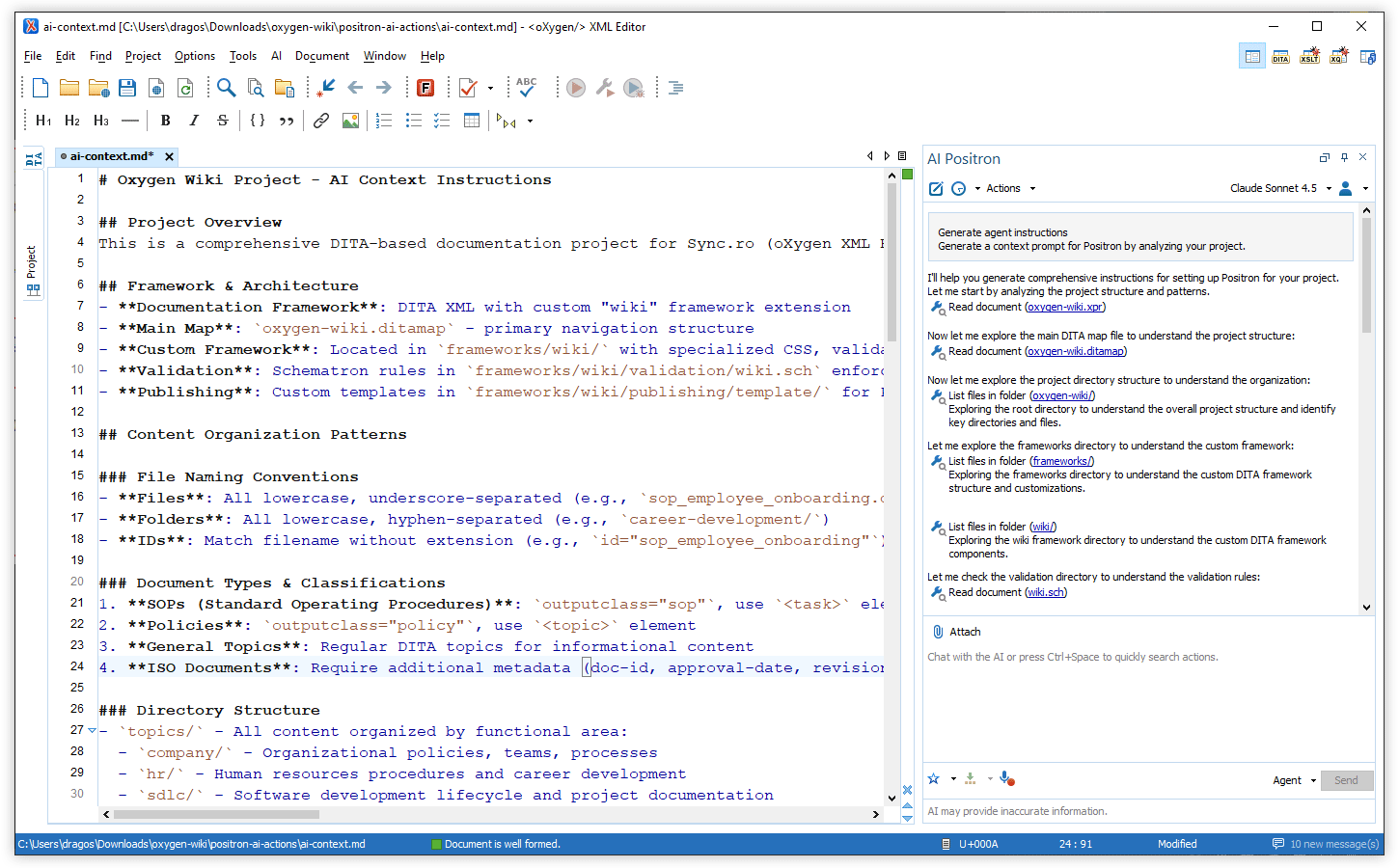
Edit Document Tool
List Directory Tool
XML Refactoring Tools in Chat Modes (Oxygen 28.0 Required)
Project-wide Search Tool (Oxygen 28.0 Required)
*.dita), regular expressions, and XPath filters, making searches both
flexible and powerful. By leveraging this tool, the AI can efficiently explore your
project, resulting in improved performance on complex agentic tasks.AI-Powered New File Creation (Oxygen 28.0 Required)
Chat Welcome Screen
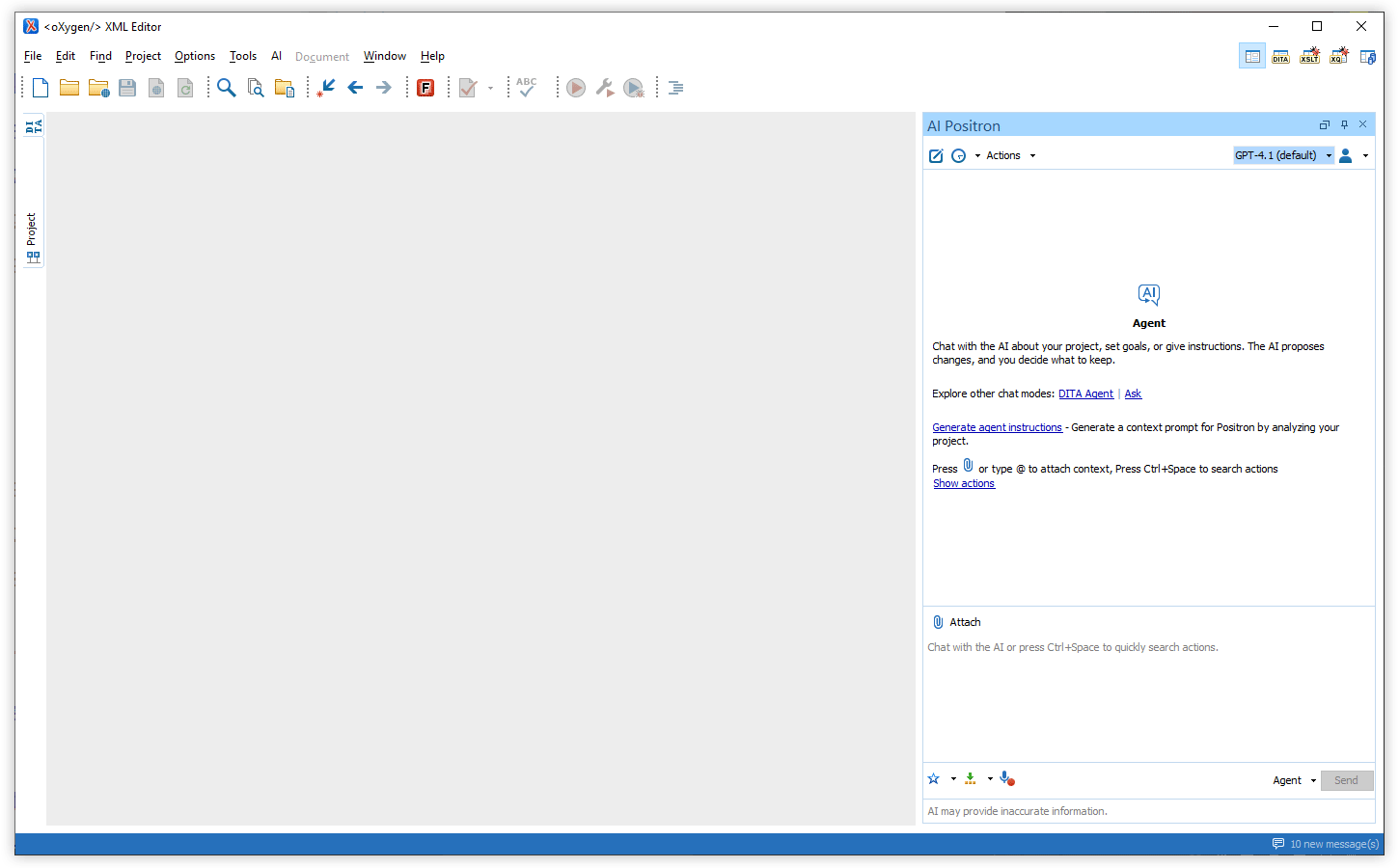
Oxygen XML as a Local Model Context Protocol Server (Experimental, Oxygen 28.0 Required)
Model Context Protocol Improvements
More information about MCP integration is available at:
https://www.oxygenxml.com/doc/ug-positron-desktop/ai/model_context_protocol_preferences.html.
Autocomplete Development Action (Oxygen 28.0 Required)
Generate Code Improvements (Oxygen 28.0 Required)
Enhanced Project Content Search Options (Oxygen 28.0 Required)
OpenAI GPT-5.1 Models Available
xAI Grok 4 Fast Models Available
Claude Sonnet 4.5 Model Available
Claude Haiku 4.5 Model Available
Improved Tool Names and Descriptions
Additional Context Files
Custom Actions Prioritized
Oxygen AI Positron for Eclipse
New Dedicated Connector: AWS Bedrock
Smarter AI Context Prompt Setup
Edit Document Tool
Generate Code Improvements (Oxygen 28.0 Required)
OpenAI GPT-5.1 Models Available
xAI Grok 4 Fast Models Available
Claude Sonnet 4.5 Model Available
Claude Haiku 4.5 Model Available
Improved Tool Names and Descriptions
Custom Actions Prioritized
Oxygen AI Positron for Content Fusion
Uncluttered Chat Input Area
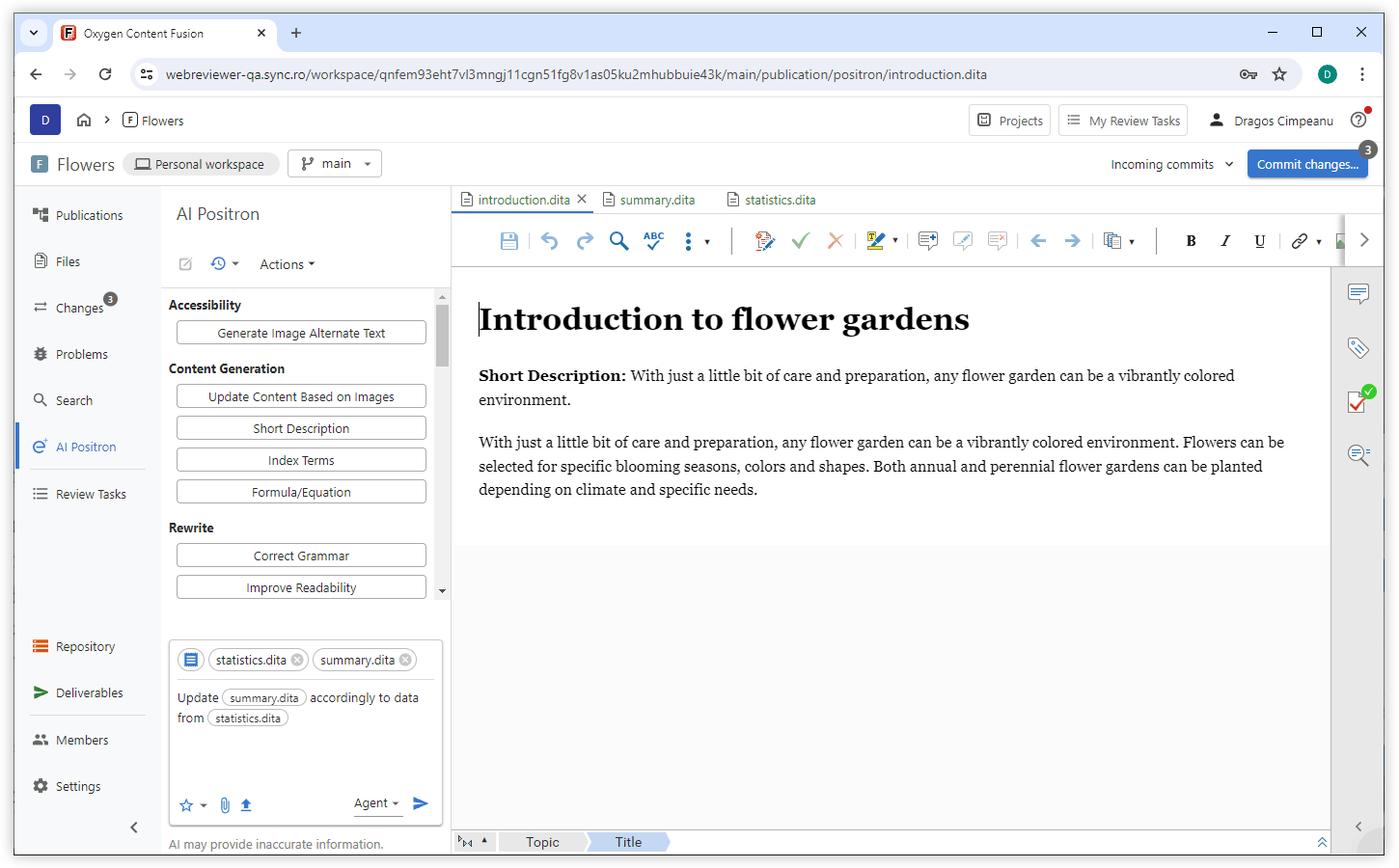
Project-wide Search Tool (Oxygen Content Fusion 9.0 Required)
*.dita), regular expressions, and XPath filters, making searches both
flexible and powerful. By leveraging this tool, the AI can efficiently explore your
project, resulting in improved performance on complex agentic tasks.OpenAI GPT-5.1 Models Available
xAI Grok 4 Fast Models Available
Claude Sonnet 4.5 Model Available
Claude Haiku 4.5 Model Available
Inspect Chat Context
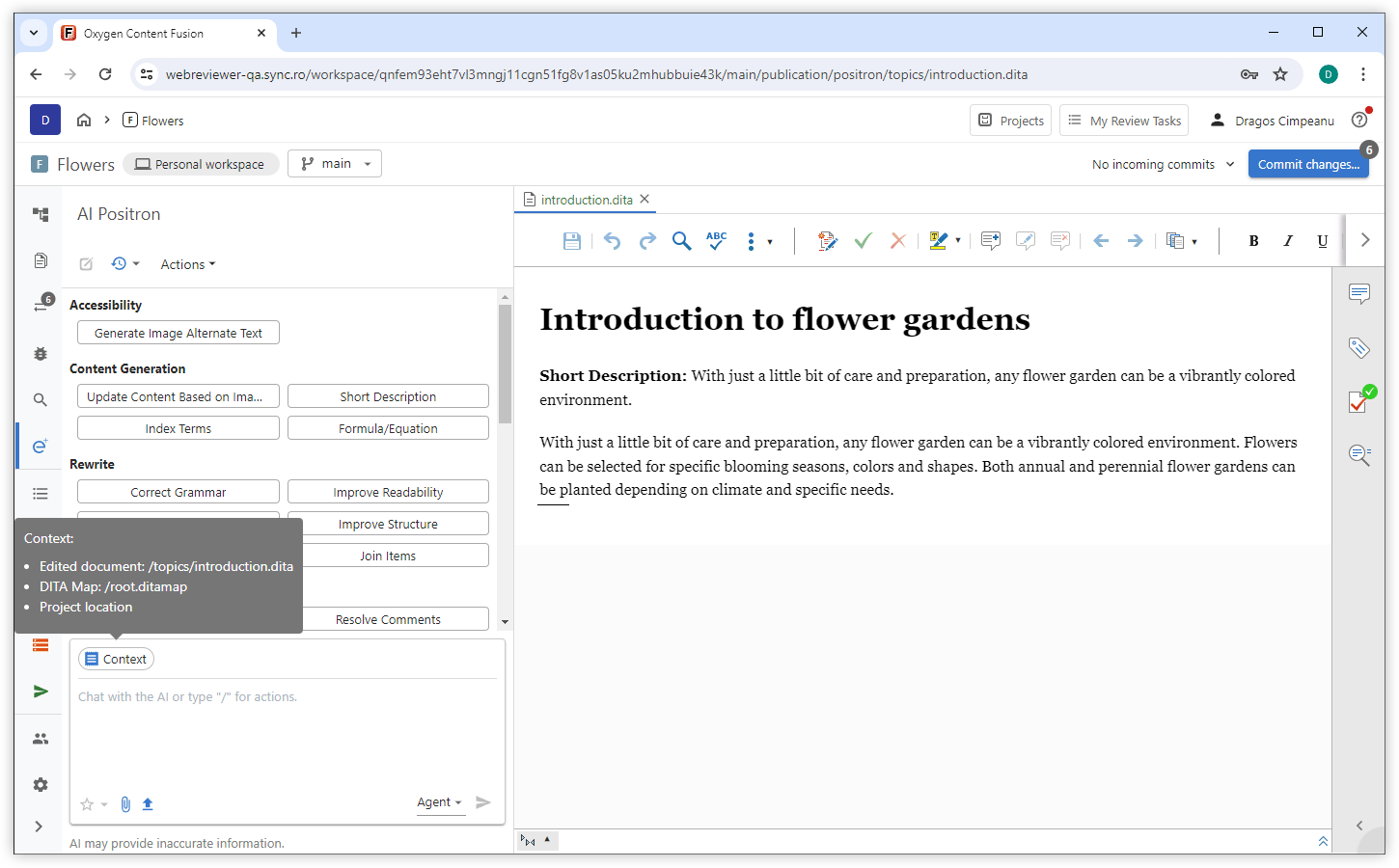
Invoke AI Actions with Keyboard Shortcut
Edit Document Tool
Easier Access to Tool Call Details
Custom Actions Prioritized
Improved Tool Names and Descriptions
Oxygen AI Positron for Web Author
AI-Powered New File Creation (Oxygen XML Web Author 28.0 Required)

Uncluttered Chat Input Area
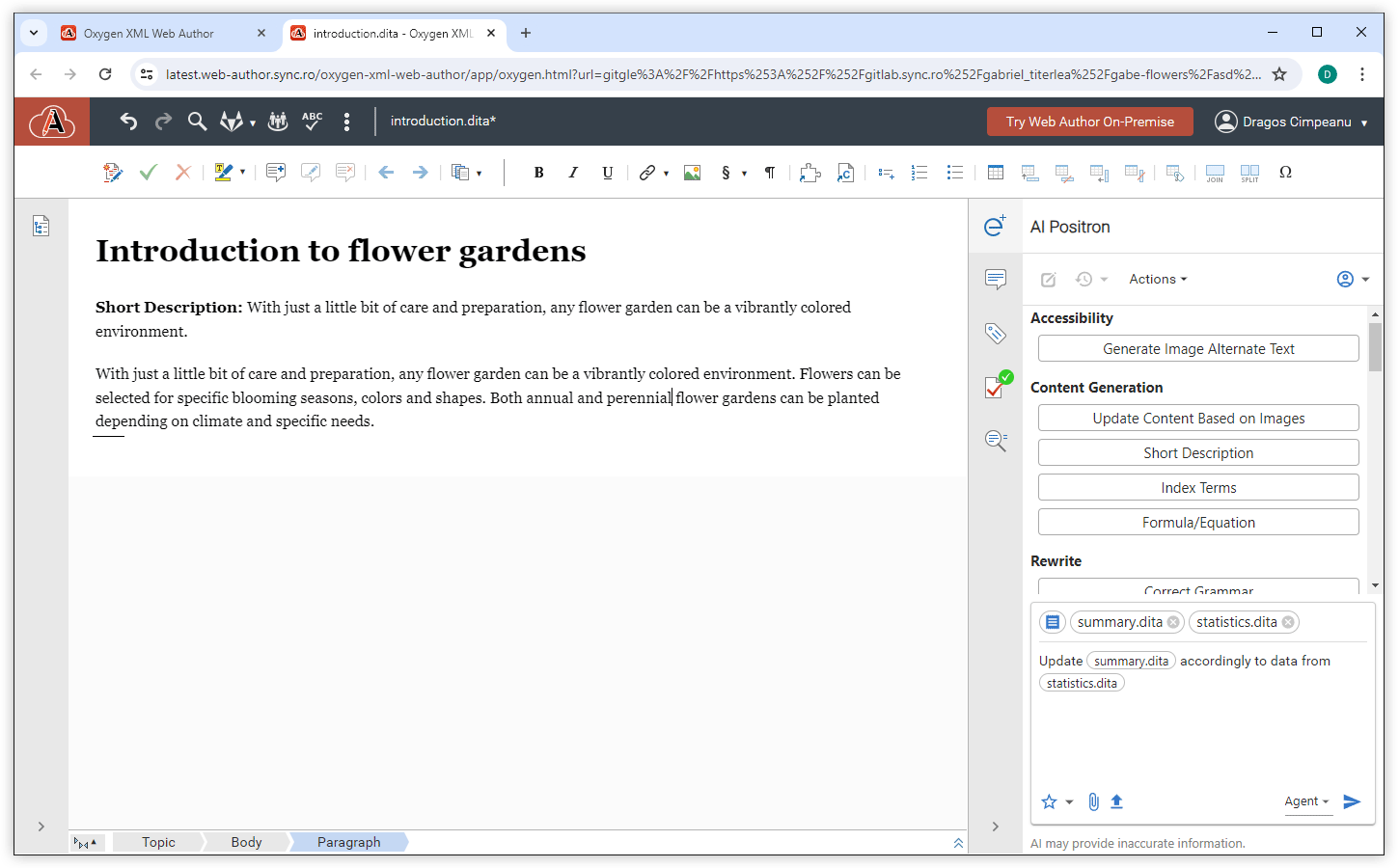
OpenAI GPT-5.1 Models Available
xAI Grok 4 Fast Models Available
Claude Sonnet 4.5 Model Available
Claude Haiku 4.5 Model Available
Inspect Chat Context

Invoke AI Actions with Keyboard Shortcut
Edit Document Tool
Easier Access to Tool Call Details
Custom Actions Prioritized
Improved Tool Names and Descriptions
Oxygen AI Positron 7.0
The latest release of the Oxygen AI Positron Assistant for desktop tools introduces support for OpenAI's cutting-edge GPT-5 models, enhancing AI capabilities for chat and AI actions. The release includes the ability to invoke tools defined on Model Context Protocol Servers, ensuring seamless integration with external AI-powered tools. AI-powered automatic fixes now ensure XML documents remain valid when an invalid or not well-formed document is generated by the AI model. Additionally, you can now manage attachments using visual chips, paste screenshots directly into the chat for better context, and edit attached resources from prompts that have already been sent to the AI. The introduction of multiple chat modes, the new search_in_project tool, and improved handling of Word (.docx) attachments further enrich the user experience.
The Oxygen AI Positron Assistant for Web Author and Content Fusion now offers support for OpenAI's GPT-5 models and introduces multiple chat modes (Agent, DITA Agent, and Ask) to cater to diverse project needs. Users can manage attachments with visual chips, ensuring easy review and removal. Automatic fixes for validation issues in AI-generated content maintain document validity, while the ability to reference AI actions in chat prompts streamlines complex tasks. Improved handling of Word (.docx) attachments ensures accurate AI responses by preserving document structure and context.
The Oxygen AI Positron Service now provides access to the latest OpenAI GPT-5 models, as well as Anthropic Claude and Google Gemini AI models, offering advanced AI capabilities. Team managers can download invoices and generate usage reports to effectively monitor and manage team credit usage.
For Eclipse users, the Oxygen AI Positron Assistant now supports the latest OpenAI GPT-5 models for improved AI-driven interactions. It also adds a new XSpec template for testing AI actions, ensuring robust and reliable results. Additionally, enhanced handling of Word (.docx) attachments further improves the user experience.
There are changes in:
Oxygen AI Positron Service
OpenAI GPT-5 Models Available
Anthropic Claude and Google Gemini AI Models
Download Invoices for Your Team
Generate Usage Report for Your Team
Oxygen AI Positron Assistant
Support for OpenAI GPT-5 Models
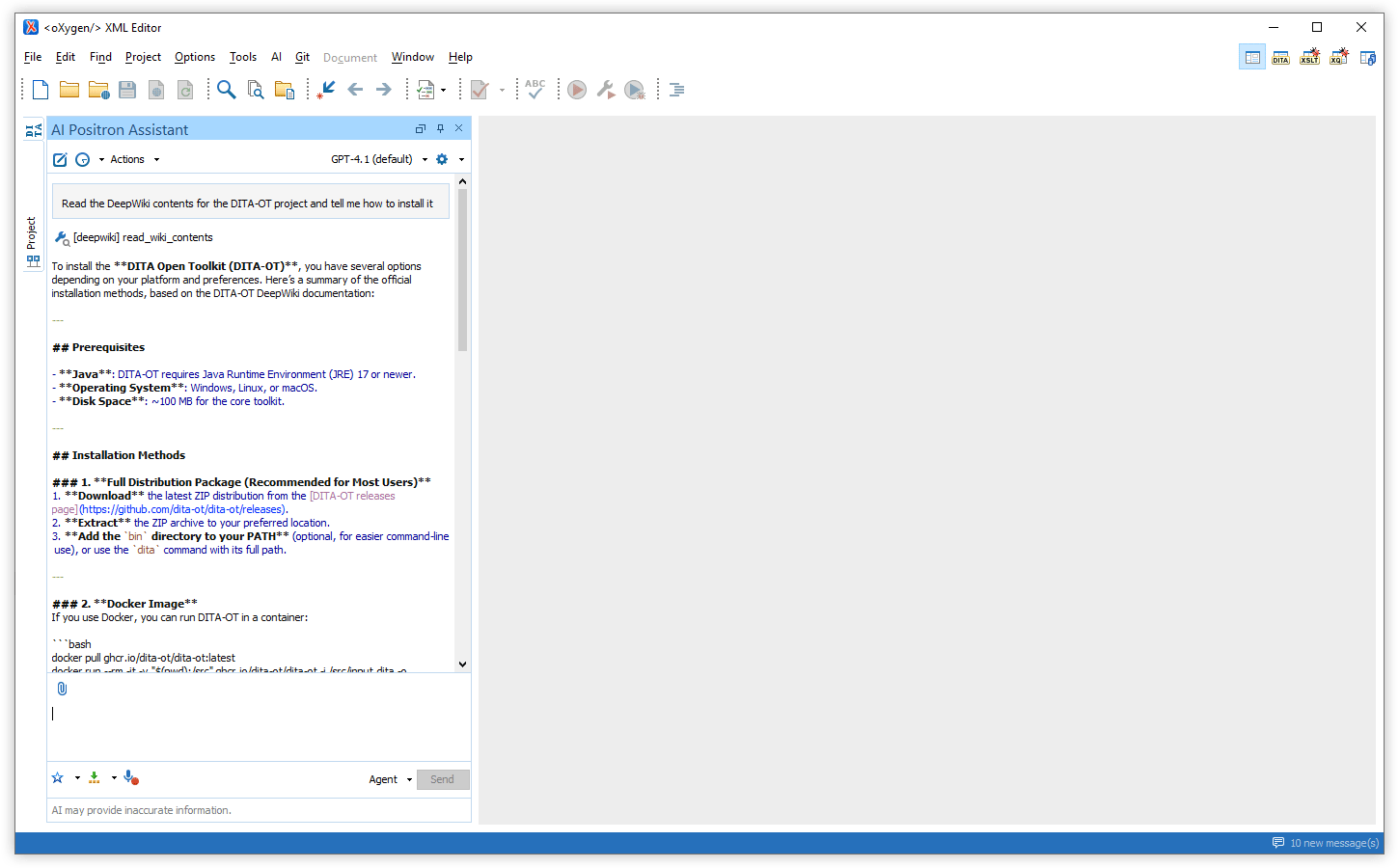
Invoke Tools Defined on Model Context Protocol Servers
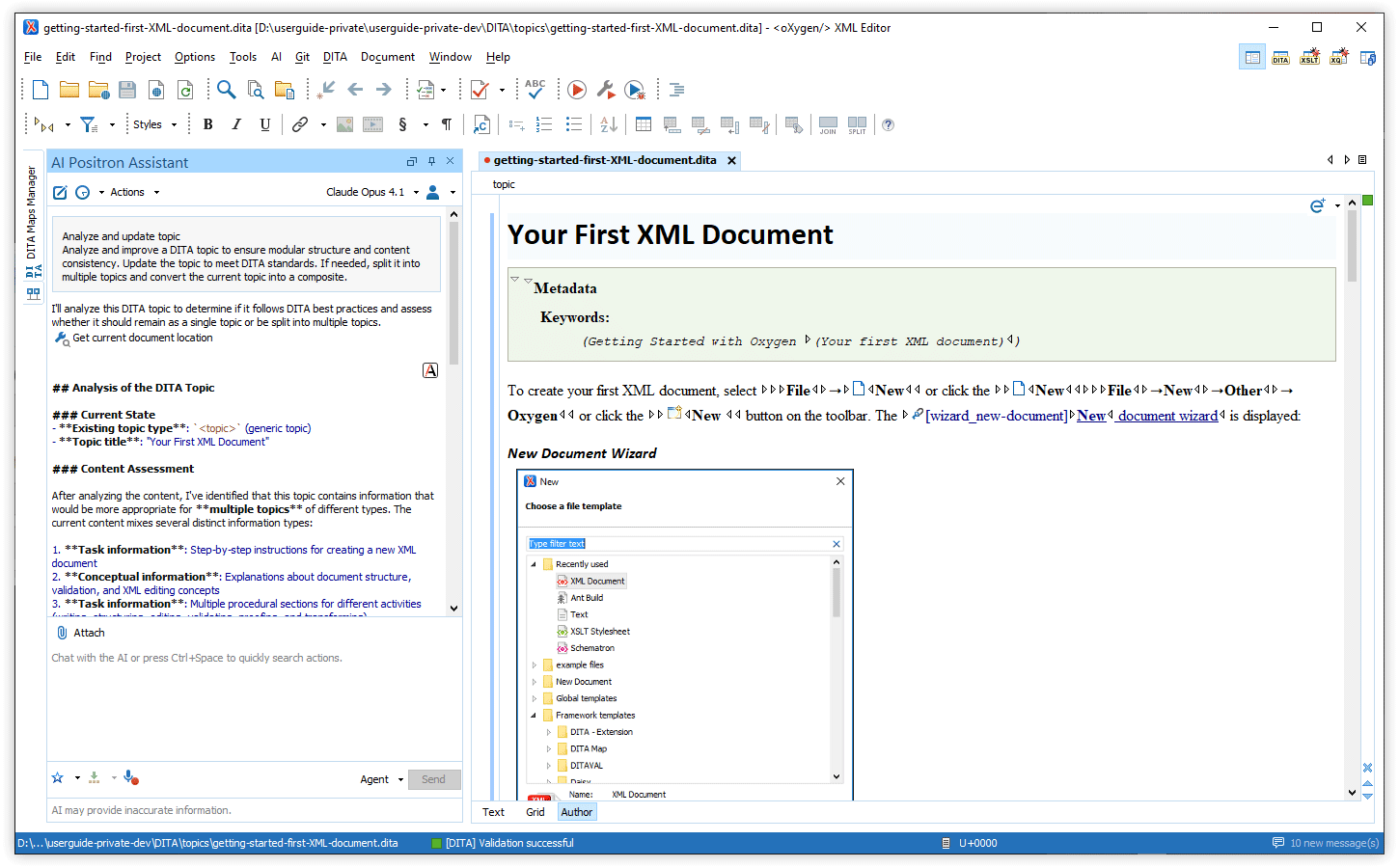
AI-powered Automatic Fixes for Invalid XML Responses
Fix Validation Problems in the Editor with AI Positron Fix
Attach Files to Edited Message Prompts
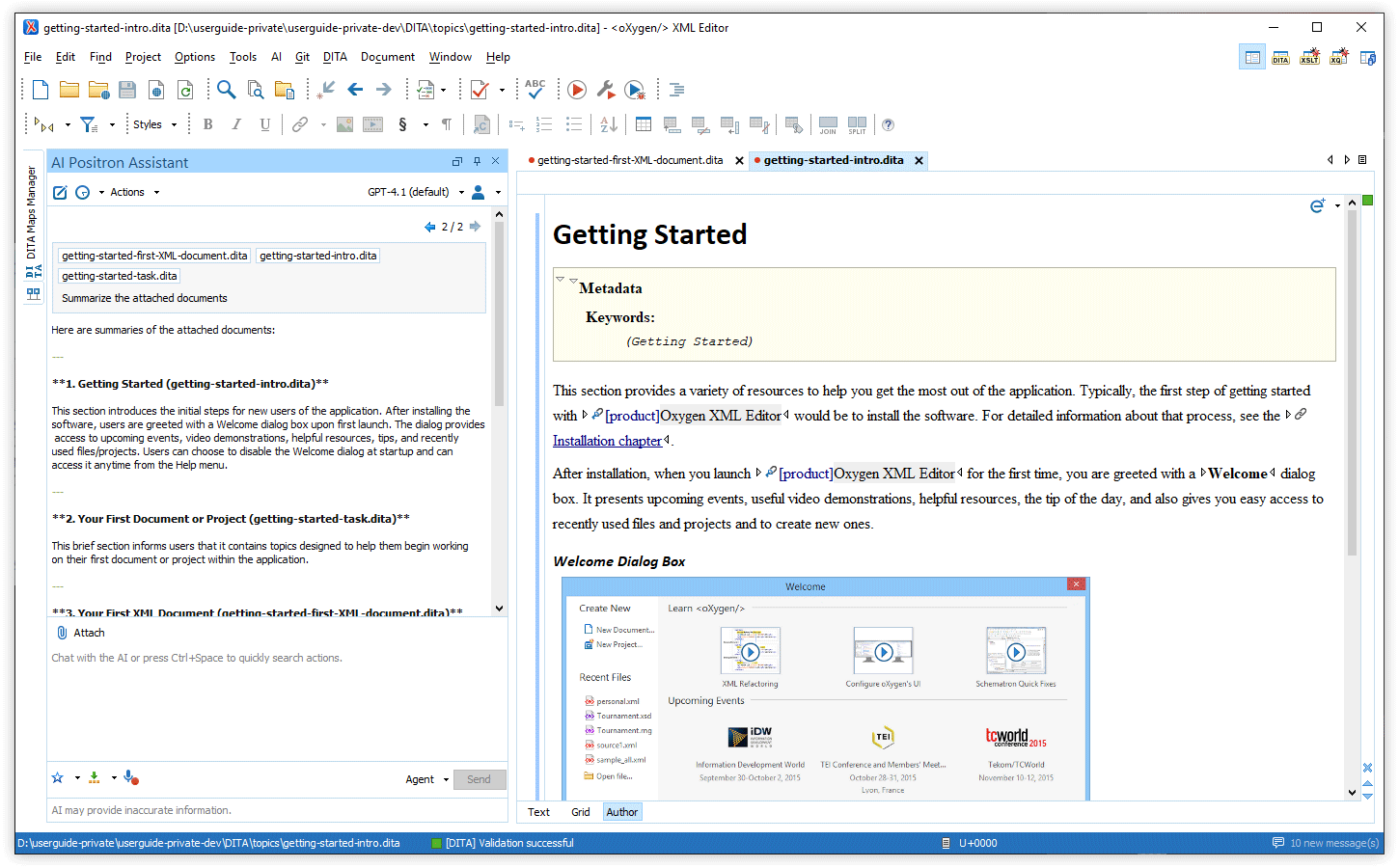
Manage Attachments with Visual Chips
You can now see your attached files as chips in the chat input
area, making it easy to review and remove individual attachments. If you want more
control, you can optionally use @ to reference specific files in your
instructions. Unreferenced attachments are still included automatically at the end of
your message.
Attachments are also displayed as chips in the chat, so you can quickly identify and access files sent to the AI.
Additionally, when you select content in the editor, a chip named
selection appears in the AI Positron chat input area. It represents
your current selection and updates whenever you change it. You can reference it by
typing @selection.
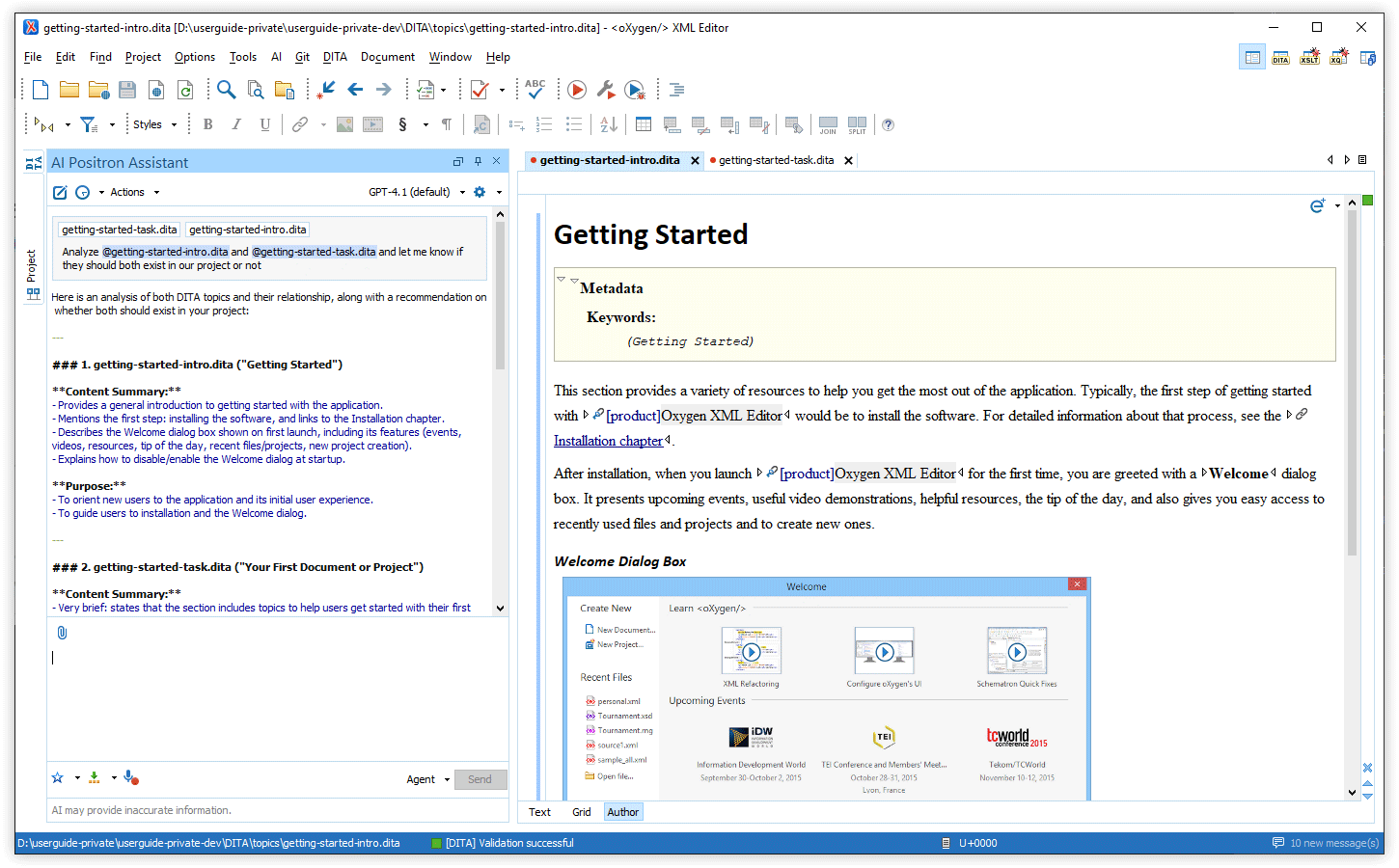
Paste Screenshots into Chat
Multiple Chat Modes
You can now choose between three chat modes in the Chat view:
- Agent - Discuss your project, set goals, or give instructions. The AI proposes changes and you are required to review and approve them.
- DITA Agent - Specially tuned for DITA-specific projects, provide goals or instructions and let the AI explore your project and apply project-wide changes with your approval.
- Ask - Get answers and explanations from the AI. This read-only mode uses search tools when needed and does not change your files.
All modes automatically use your current context (project location, current document and type, and the DITA map in scope), so you don’t need to include this information in your prompts.
Flexible OAuth2 Configuration via the Positron Custom Connector Add-on
POSITRON_CONNECTOR_AUTH_TOKEN_URL environment variable and set the
OAuth2 scope with POSITRON_CONNECTOR_AUTH_SCOPE. This lets you use
identity providers that require custom token URLs or scopes.Improved Word (.docx) Attachment Handling
Dedicated Connector for xAI Grok
Search In Project Tool
*.dita), regular expressions, and XPath filters, making searches both
flexible and powerful. With this feature, the AI can ground its answers in your project
content.Debug Custom AI Action Prompts
oxygen.ai.positron.development.mode system property with the value of
true in the parent Oxygen application.New XSpec Template for Testing AI Actions
Enhanced Generate Code Experience
Flexible AI Validation and Correction Controls
Oxygen AI Positron Assistant for Web Author and Content Fusion
OpenAI GPT-5 Models Available
Multiple Chat Modes
You can now choose between three chat modes in the Chat view:
- Agent - Discuss your project, set goals, or give instructions. The AI proposes changes and you are required to review and approve them.
- DITA Agent - Specially tuned for DITA-specific projects, provide goals or instructions and let the AI explore your project and apply project-wide changes with your approval.
- Ask - Get answers and explanations from the AI. This read-only mode uses search tools when needed and does not change your files.
All modes automatically use your current context (project location, current document and type, and the DITA map in scope), so you don’t need to include this information in your prompts.
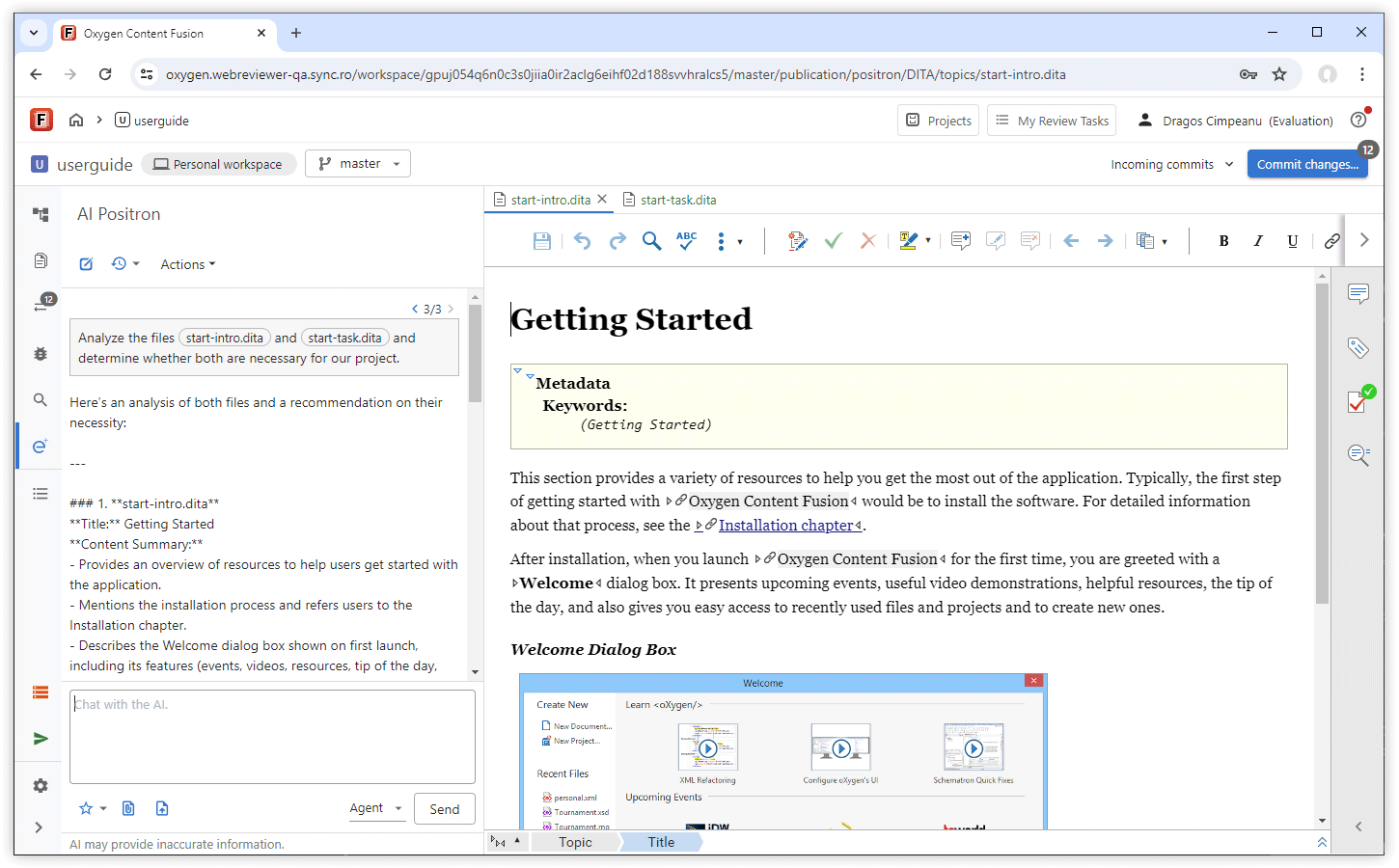
Manage Attachments with Visual Chips
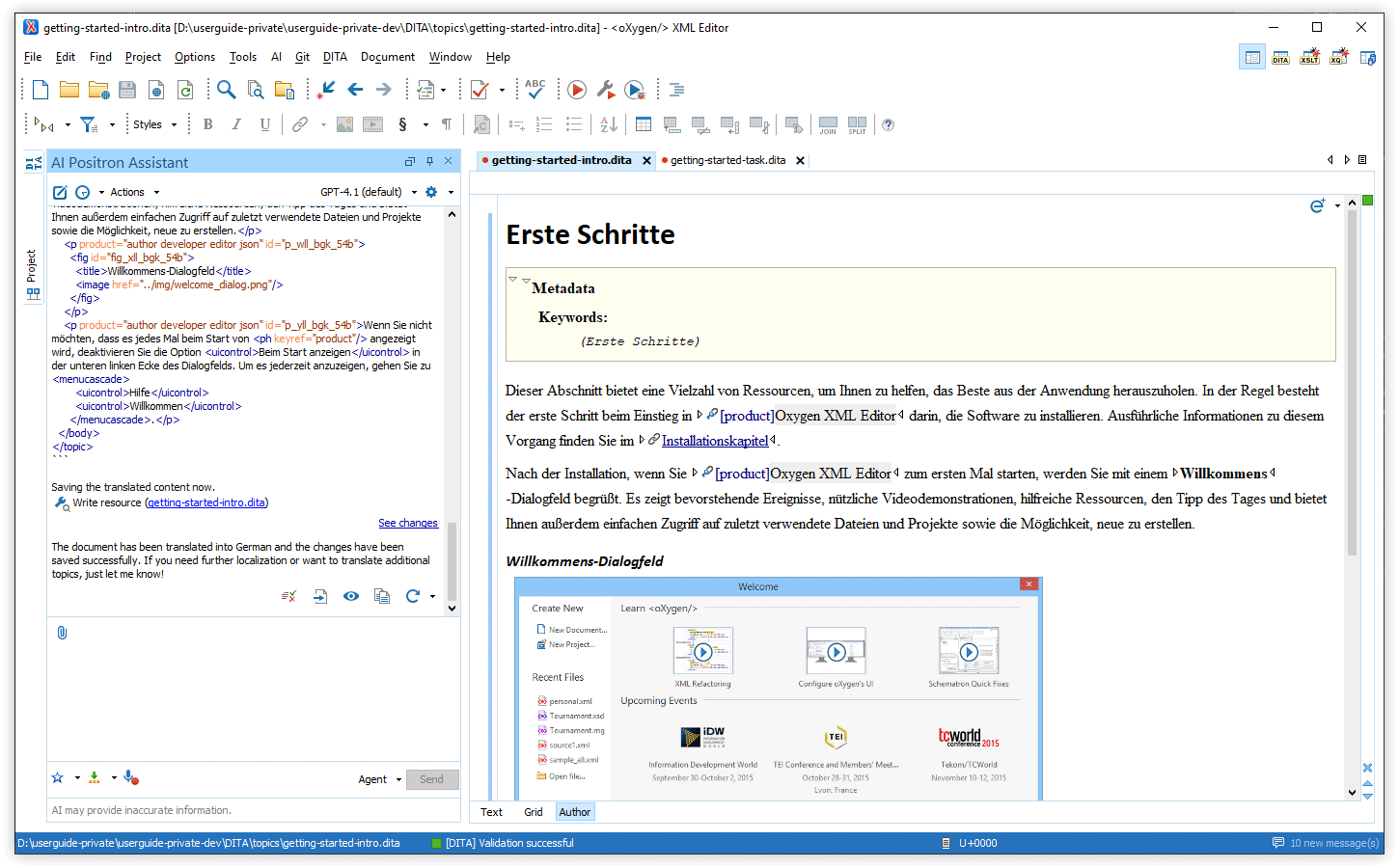
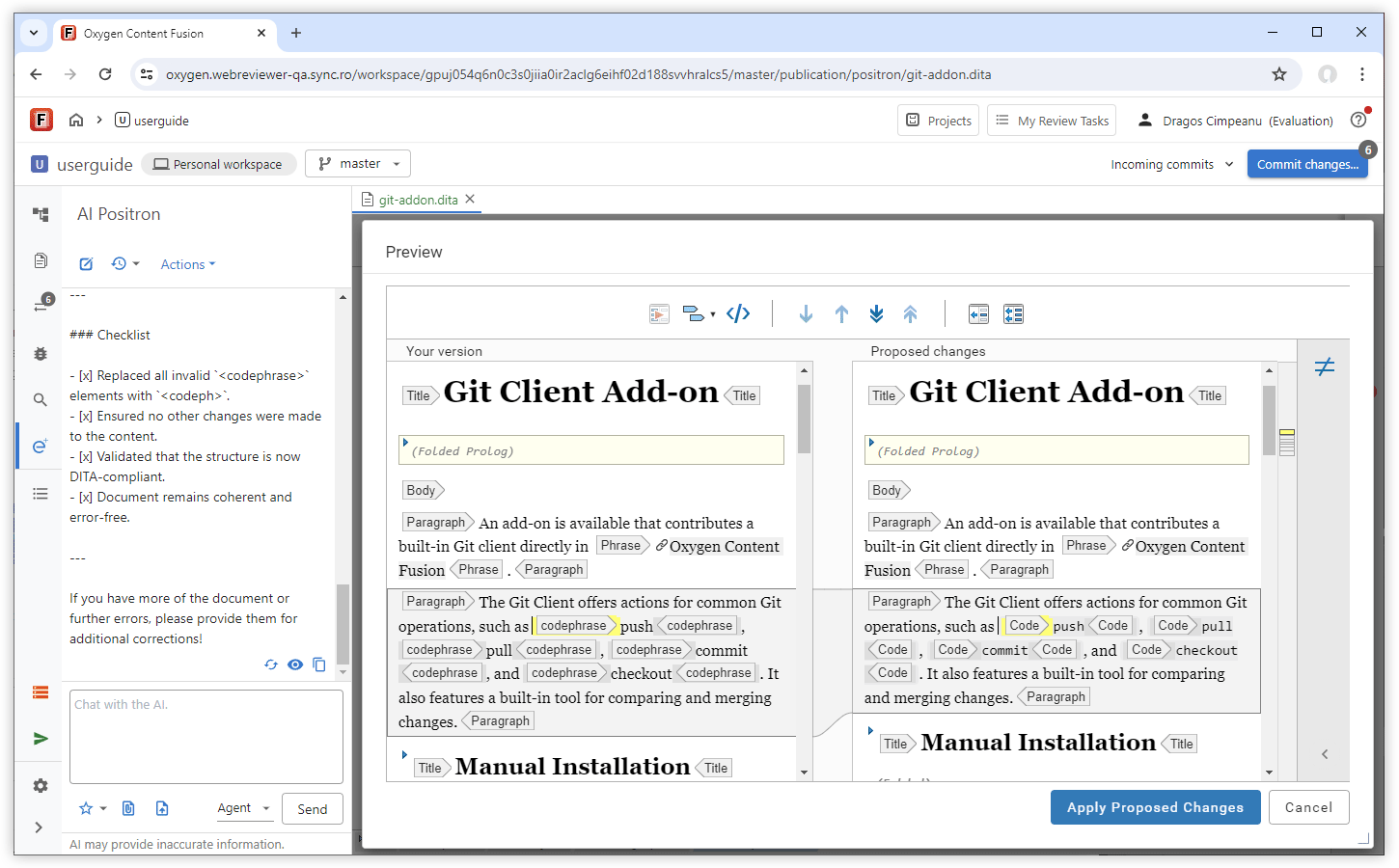
Automatic Fixes for Validation Issues in AI-Generated Content
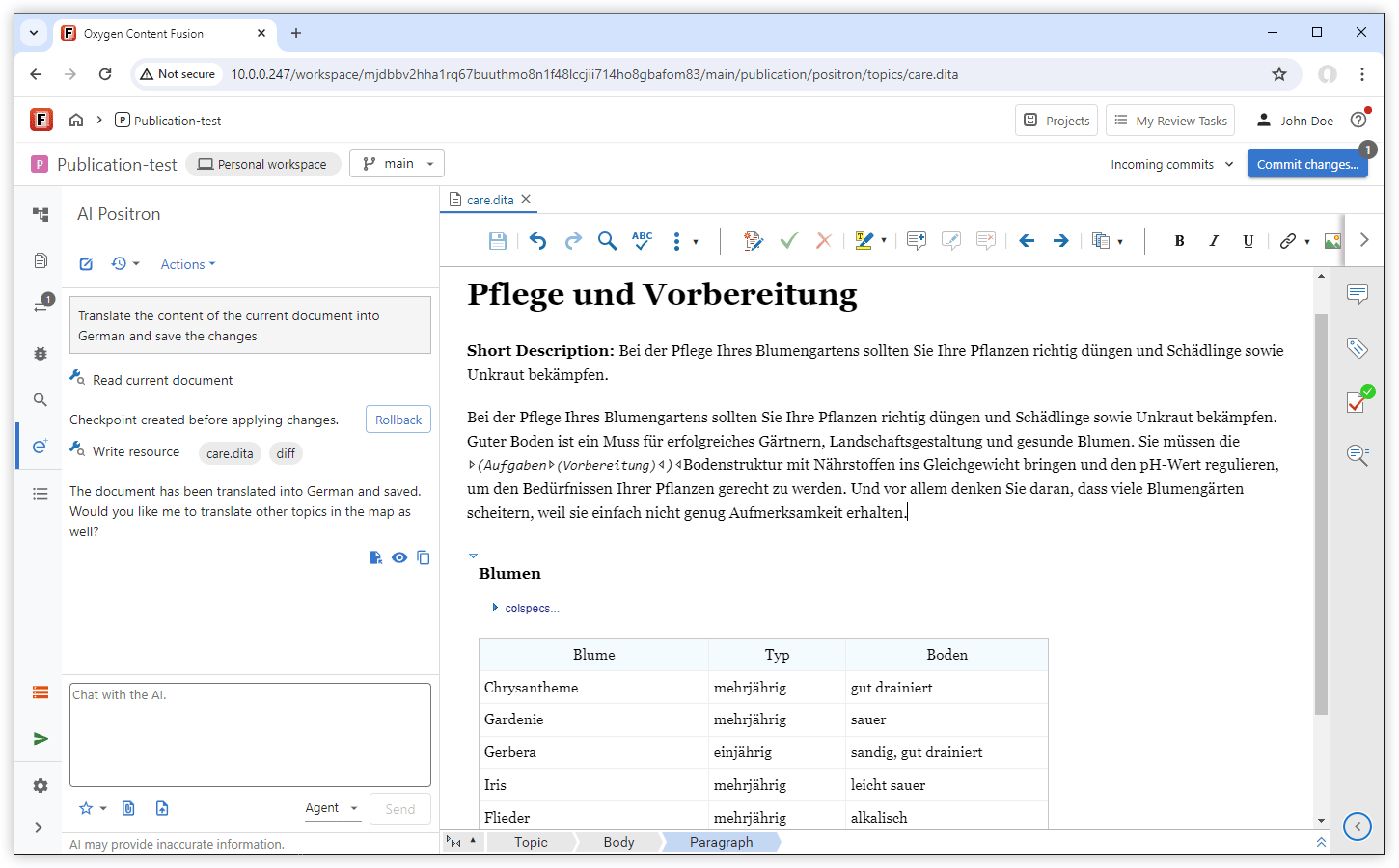
Refer AI Actions in Chat Prompts
Invoke correct grammar on the current
            document and save the updated content
. This approach streamlines your workflow
by letting you quickly apply changes or transformations in one place.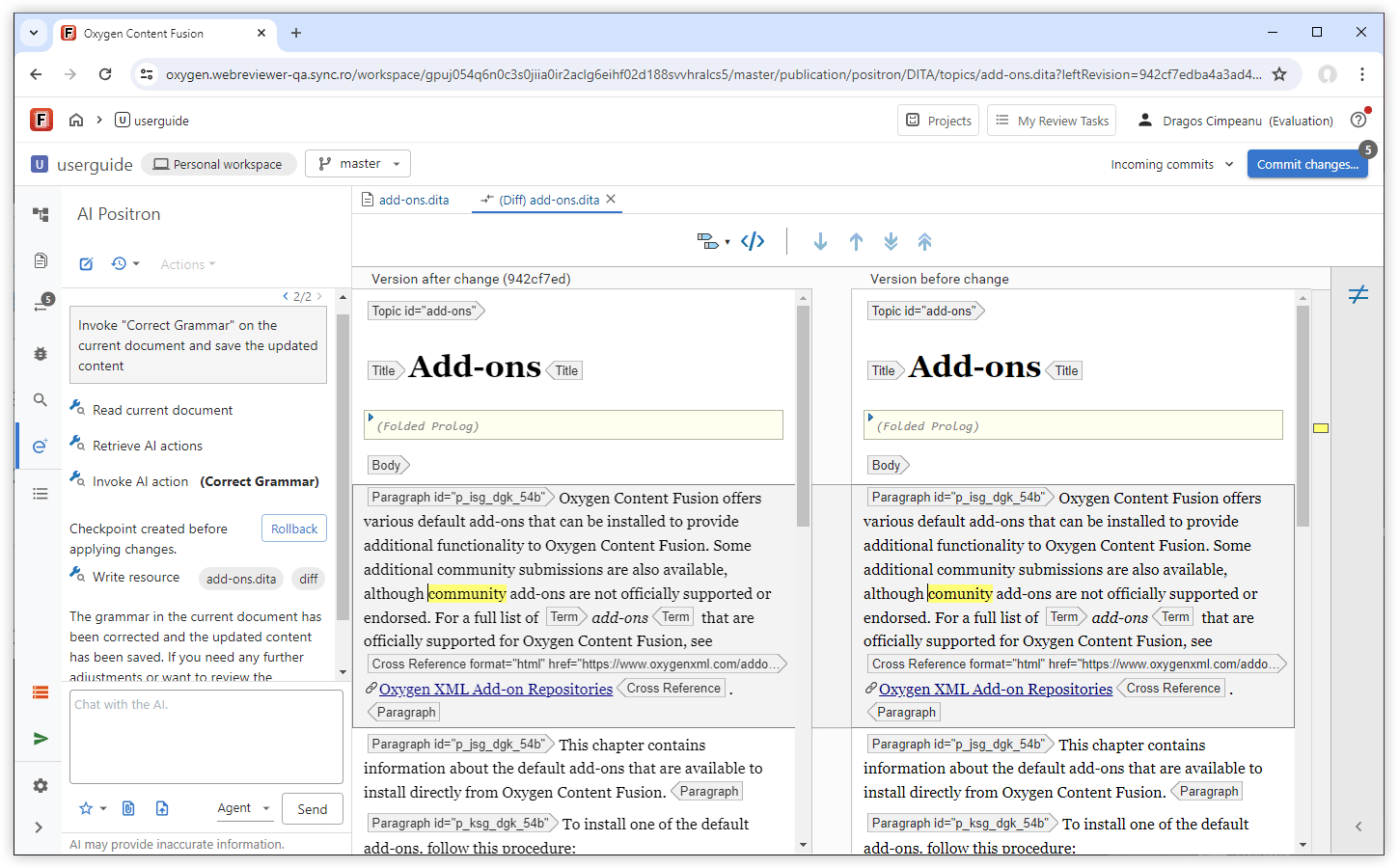
Improved Word (.docx) Attachment Handling
Oxygen AI Positron 6.0.1
The Oxygen AI Positron update introduces support for the latest OpenAI GPT-5, GPT-5-mini, and GPT-5-nano models, along with improvements to the AI Positron Fix feature for better context expansion when resolving issues in documents. This release also includes various bug fixes and stability enhancements.
Oxygen AI Positron 6.0
The Oxygen AI Positron Service brings model updates, subscription management for teams, allowing centralized purchase or renewal, and requires AI Positron add-ons version 4 or newer.
All Oxygen AI Positron Assistant 6.0 distributions feature the advanced GPT-4.1 OpenAI model as default. All AI action prompts were reviewed and improved for better quality, consistency, and reuse. The users of the Enterprise distribution benefit from new connectors for Google Gemini and Vertex AI, as well as enhanced Microsoft Azure OpenAI integration and simplified configuration.
Oxygen AI Positron Assistant (for Oxygen desktop tools) brings automatic validation and correction of AI-generated content, and smarter document context expansion for the AI Positron Fix action. User preferences and rules can be saved as persistent memories,the AI context can be supplemented with additional files automatically, or by manually attaching files to conversations, and prompts can be entered using voice input. AI actions can be invoked directly from chat, just by referring to them, the Improve Readability action now supports audience level customization, and AI development actions are available for more document types.
Oxygen AI Positron Assistant for Eclipse now works with a broader range of editors (Java, Python, C/C++, Perl, and plain text), enabling AI-powered code generation and explanation across more file types. It offers a dedicated framework for developing custom AI actions, DITA documentation draft generation from configuration files, and AI-enabled templates for rapid creation of XSLT, XSD, Schematron, JSON Schema, and DTD files. Installation and updates are streamlined with the Eclipse update site support.
In addition to the core updates, Oxygen AI Positron Assistant for Web Author and Content Fusion allows file attachments to AI conversations, persistent chat content across editors, and, for Content Fusion users, chat history retention. Prompts can be saved to favorites after invocation and the interface is enhanced with improved function call information and smart scroll for easier review of long conversations.
There are changes in:
Oxygen AI Positron Service
GPT-4.1 AI Models
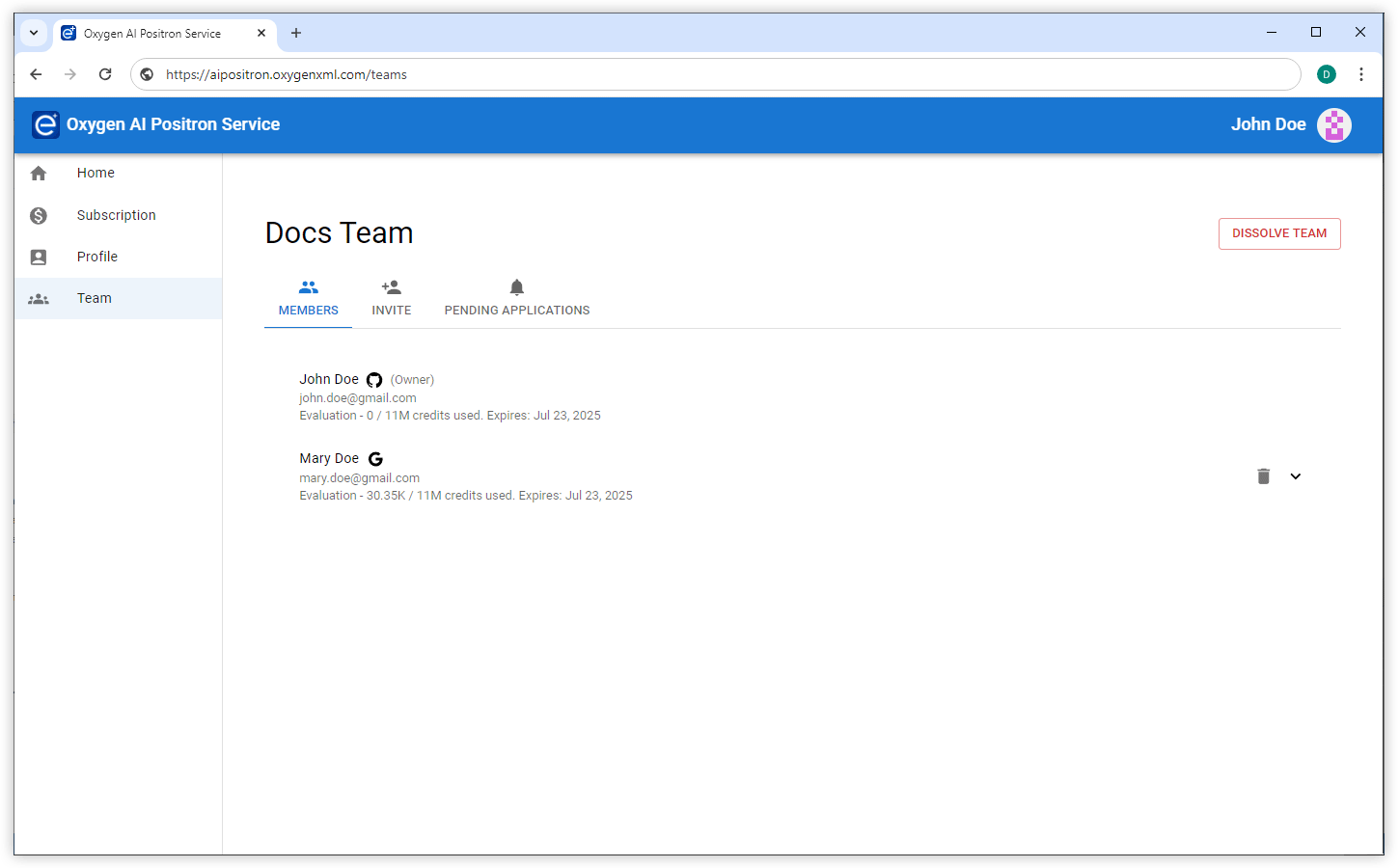
Team Subscription Management
AI Positron Service Compatibility Update
Oxygen AI Positron Assistant
Default OpenAI Model Updated to GPT-4.1
Improved All AI Action Prompts
Automatic Validation and Correction of AI-Generated Content
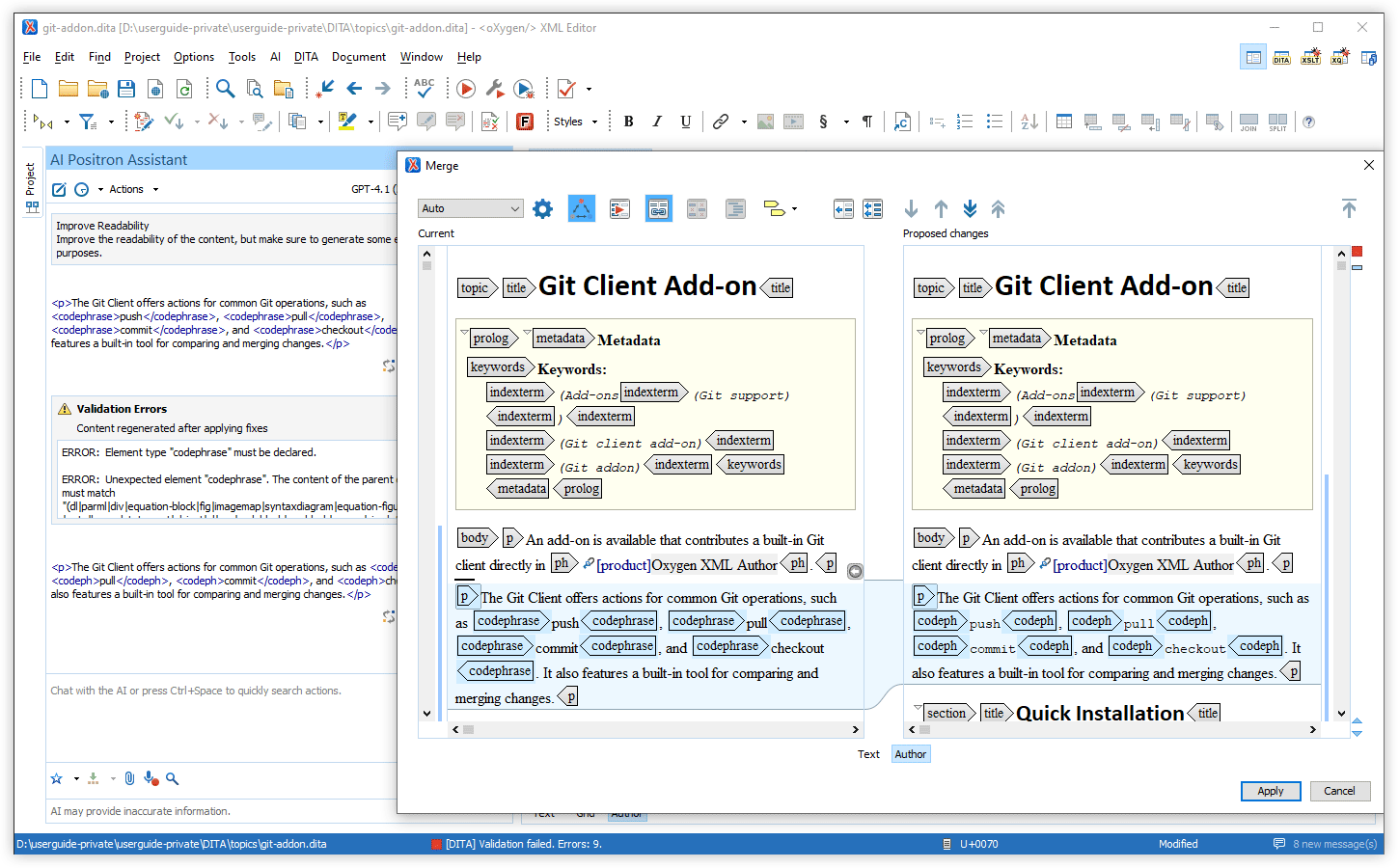
AI Positron Fix Uses More Context
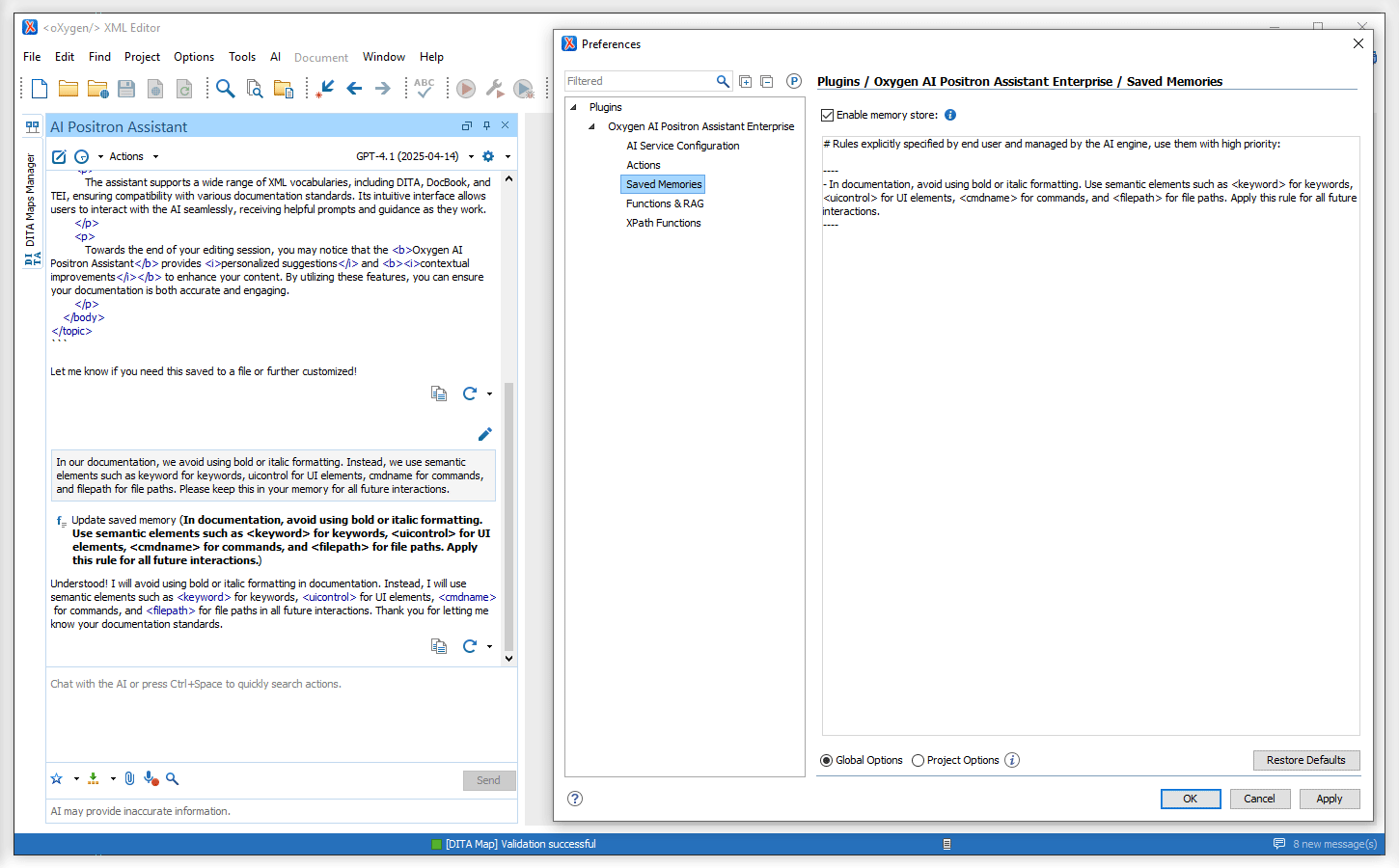
Rules Saved as Persistent Memories
New "Additional Context File" Setting
Attach Files to AI Conversations Using Drag and Drop or Copy/Paste
Record Prompts with Your Voice
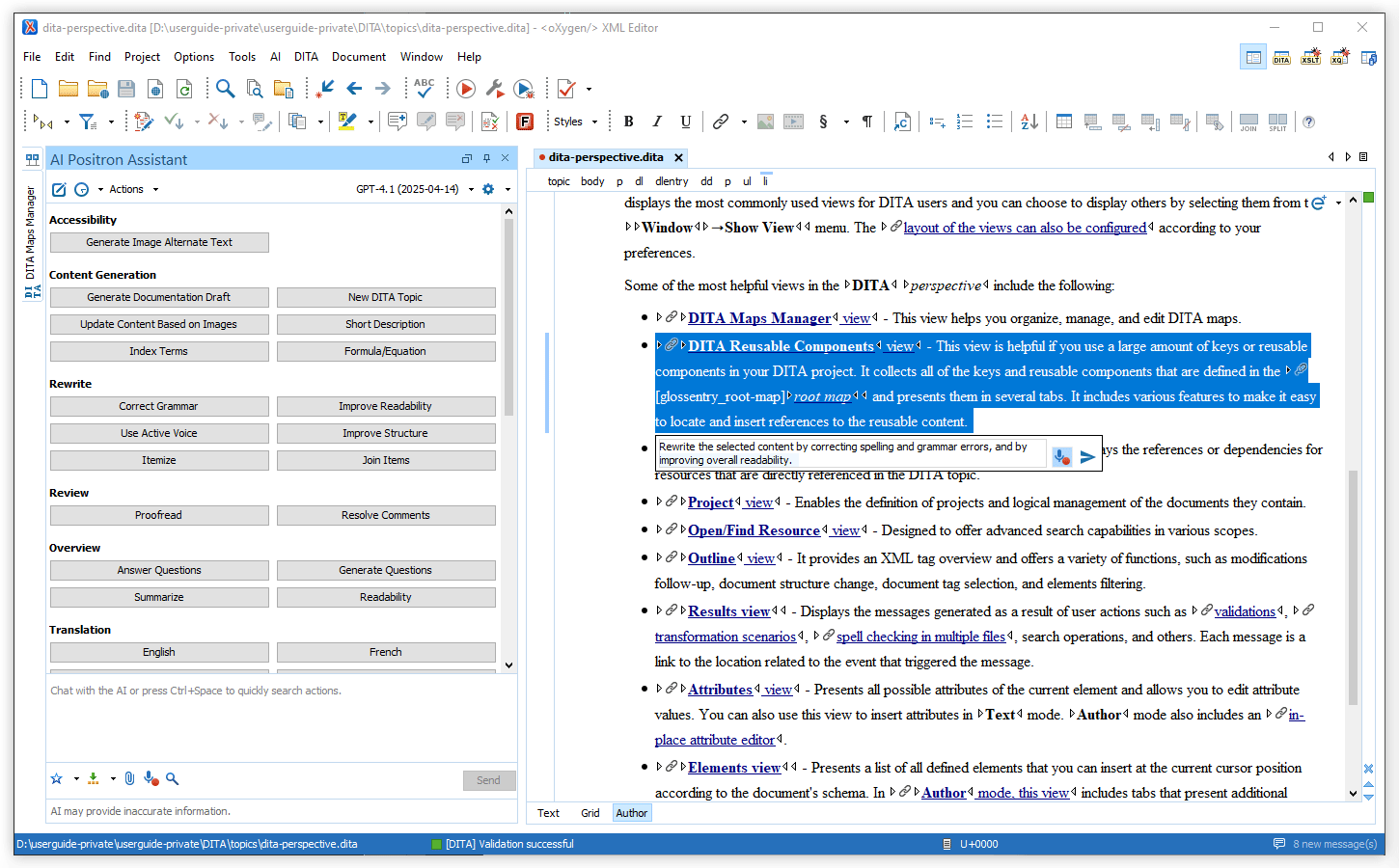
Refer AI Actions in Chat Prompts
Invoke correct
                        grammar on the current document and save the updated content
. This
approach streamlines your workflow by letting you quickly apply changes or
transformations in one place.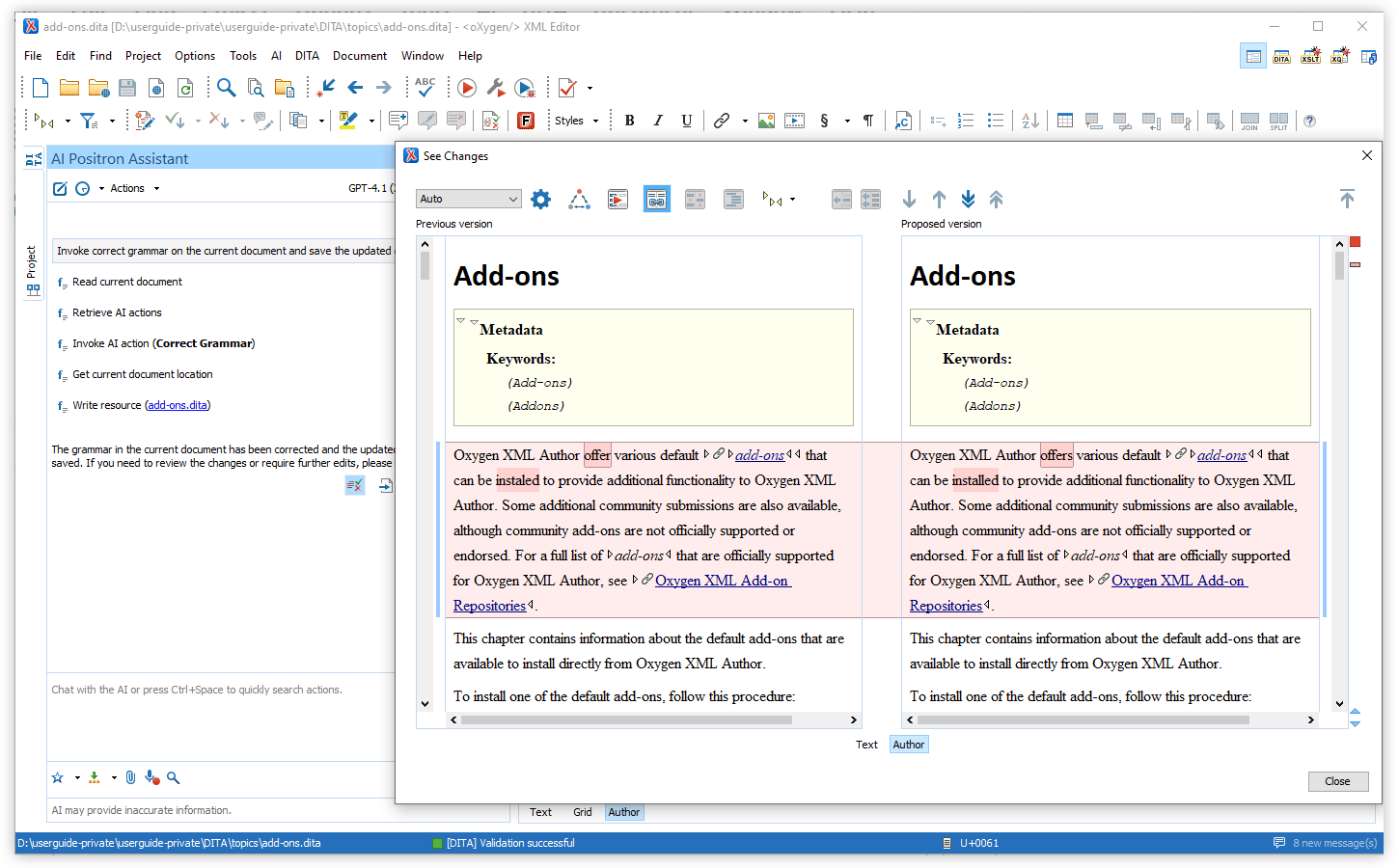
Grouped Function Call Information
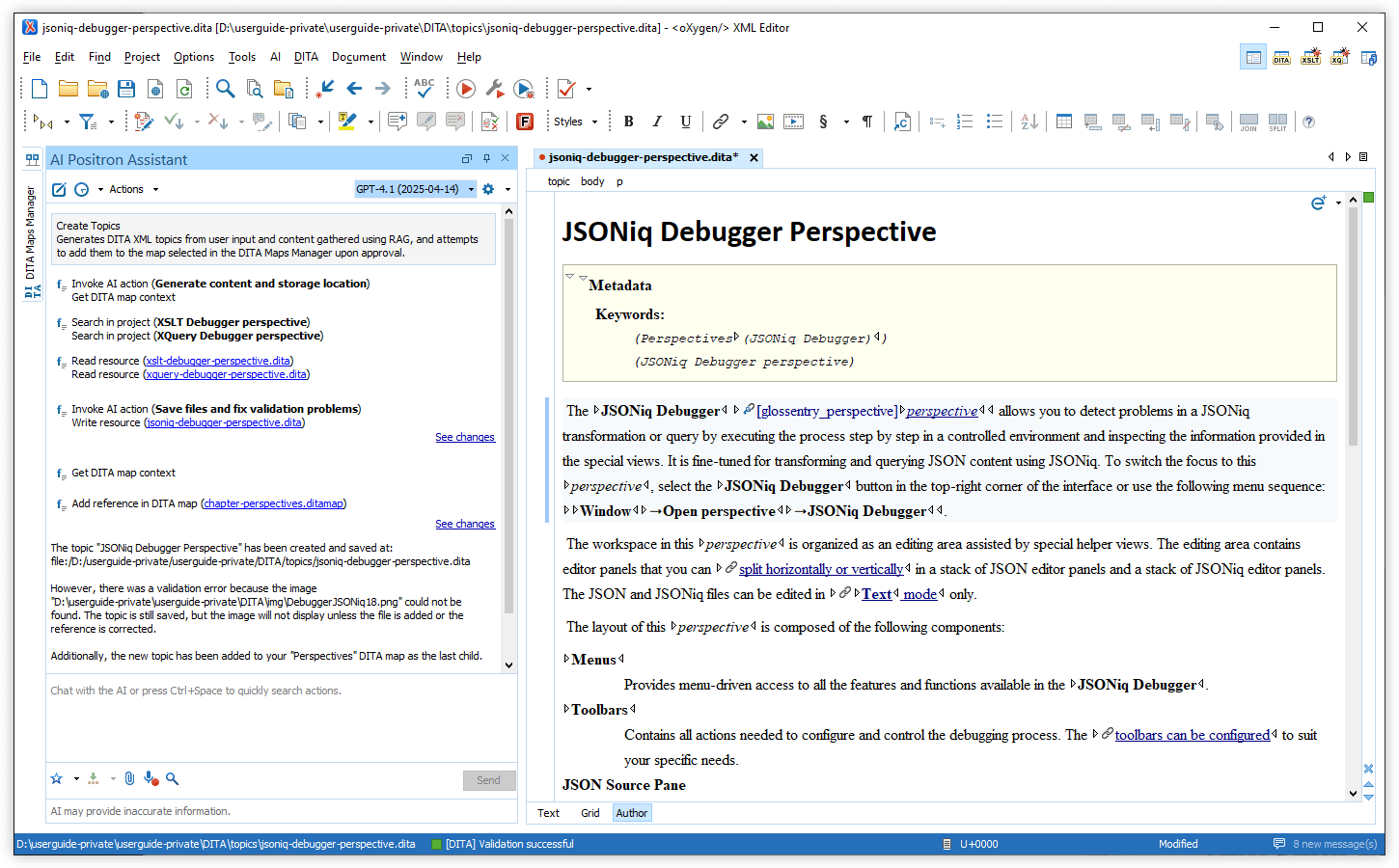
Compact AI Message Presentation
Uninterrupted AI Chat When Switching Editors
New AI Connector for Google Gemini
New AI Connector for the Vertex AI Service
Connect with Microsoft Entra ID to Microsoft Azure OpenAI Connector
Simplified Configuration for Microsoft Azure OpenAI
Configure the AI Service Using a JSON File
Specify Audience Level for the Improve Readability Action
AI Development Actions for More Document Types
Create Custom AI Actions More Easily
Oxygen AI Positron Assistant Enterprise for Eclipse
AI Positron Assistant Now Supports Java, Python, and More Editors
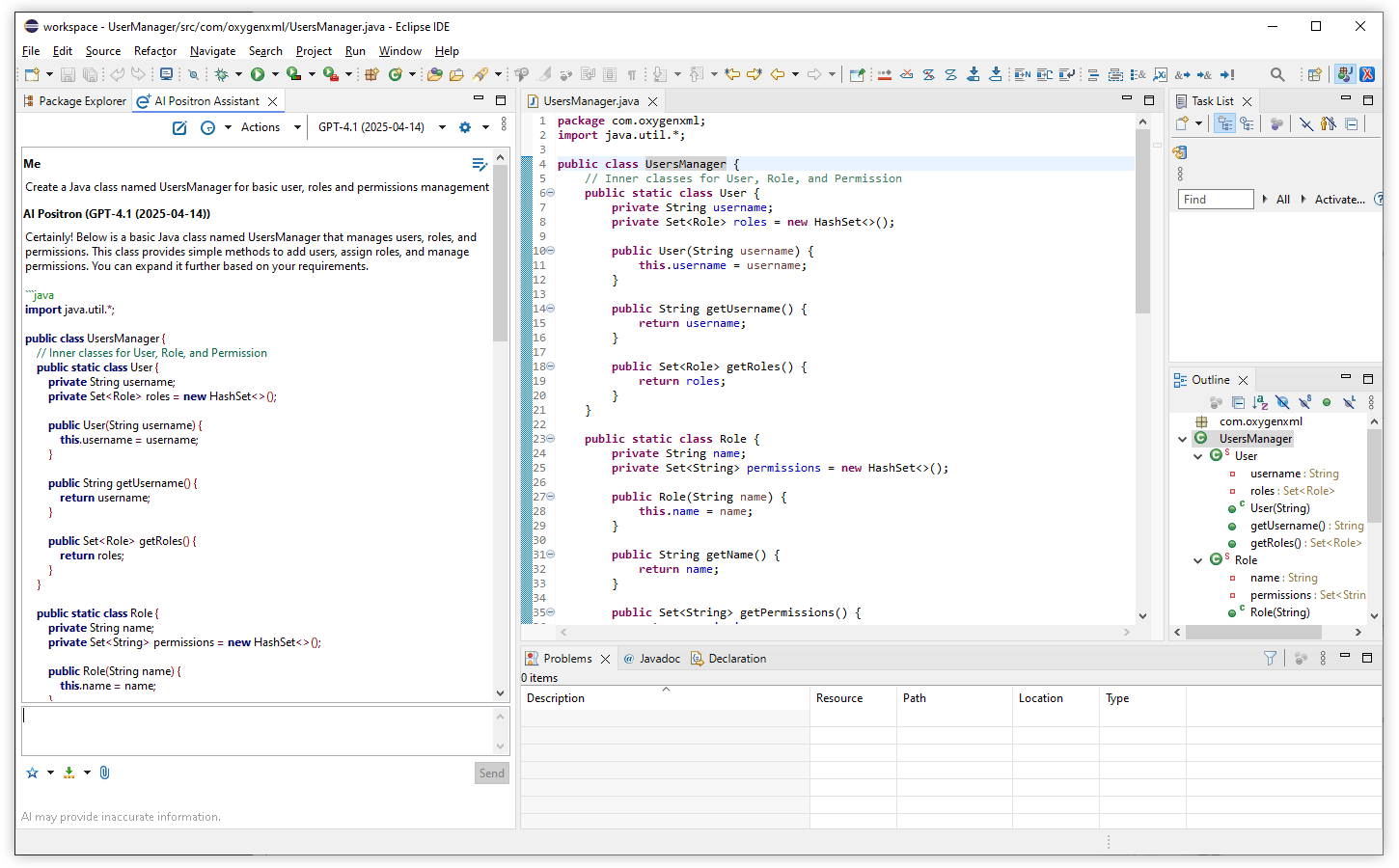
Default OpenAI Model Updated to GPT-4.1
Improved All AI Action Prompts
Develop Custom AI Actions
The Oxygen AI Positron Assistant for Eclipse installs an Oxygen framework that lets you edit your custom AI action descriptor files in both Text and Author mode. The new framework provides new file templates, content completion, validation, and visual editing features such as custom rendering, drop-down menus, and form controls. These tools help you create and manage custom AI actions more efficiently.
Create Documentation Drafts
AI-Enabled New File Templates
New Connector for Google Gemini
Simplified Configuration for Microsoft Azure OpenAI
Create Custom AI Actions More Easily
Easier Installation and Updating of the AI Positron Assistant Plugin
Oxygen AI Positron Assistant for Web Author and Content Fusion
Default OpenAI Model Updated to GPT-4.1
Improved All AI Action Prompts
Attach Files to the Conversation Using Drag/Drop or Copy/Paste
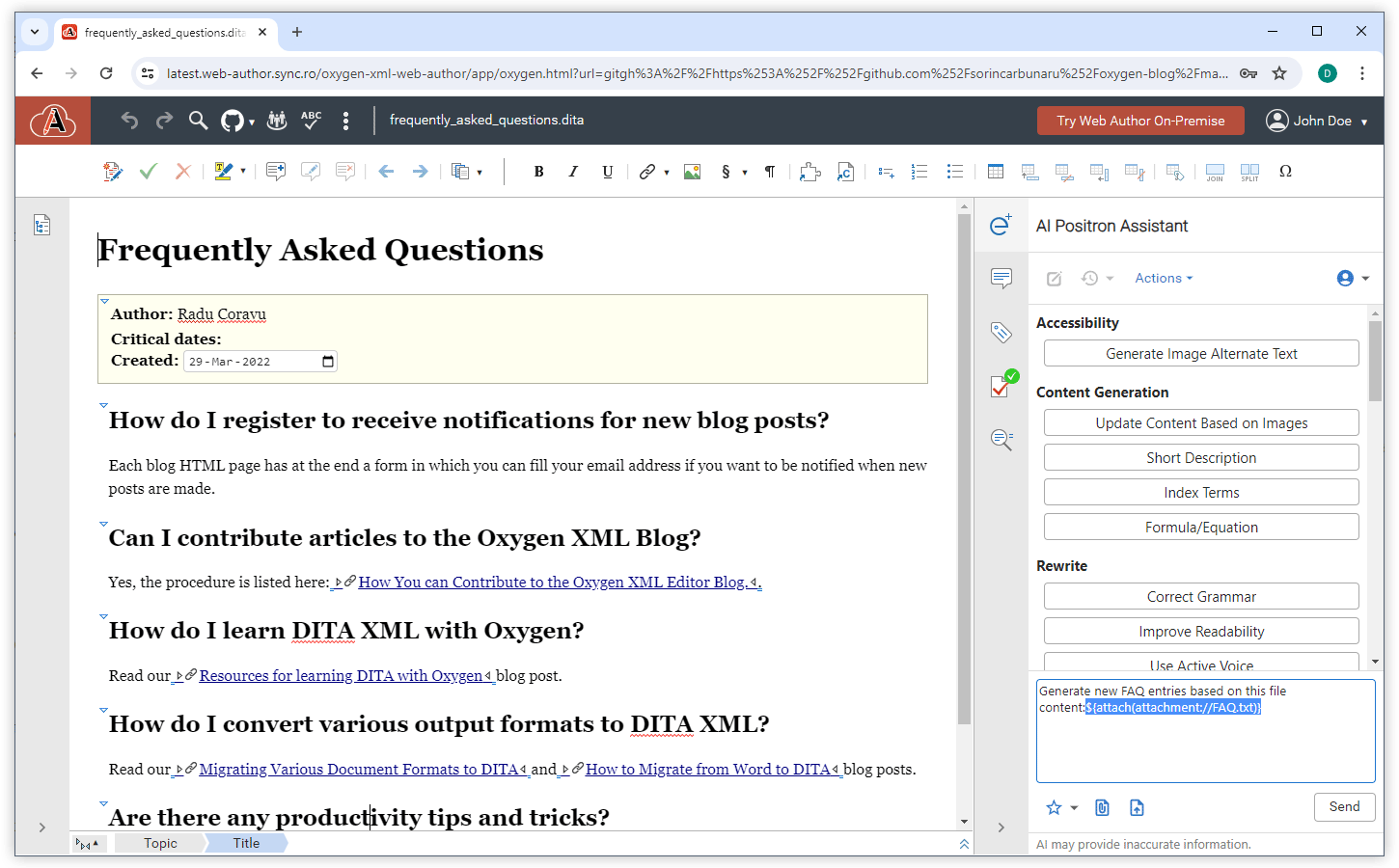
Persistent Chat Across Editors
Persistent AI Positron Chat History in Content Fusion
Compact AI Message Presentation
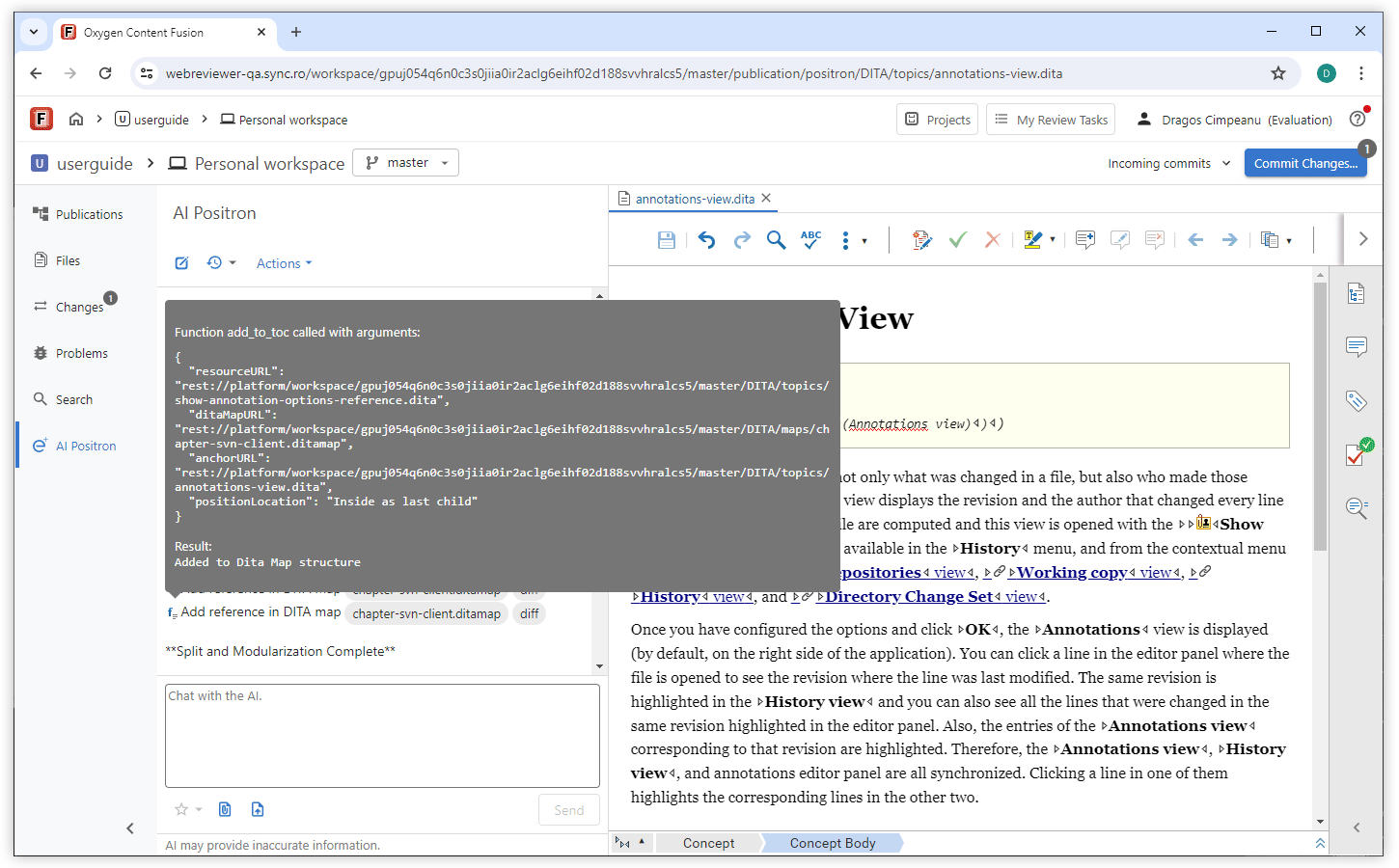
Improved Function Call Information
Save Prompt to Favorites After Invocation
Smart Scroll
New AI Connector for Google Gemini
New AI Connector for the Vertex AI Service
Simplified Microsoft Azure OpenAI Configuration
Oxygen AI Positron Assistant 5.0
The Oxygen AI Positron Assistant 5.0 release focuses on enhancing your AI-driven content authoring workflows. You can now create initial content for files such as XSLT, XSD, Schematron, JSON Schema, and DTD just by providing a quick text description. The AI engine can also create or update files, and you can oversee what happened using the visual file comparison tool. DITA users gain powerful content transformation actions, easily converting to various DITA document types or leveraging AI to detect and restructure content into more appropriate topic structures.
Integration with Eclipse plugin distributions of Oxygen, the ability to exclude specific files from AI processing, and new callback functions that connect to external tools or validate content in real time further boost workflow efficiency. You can attach Word, PowerPoint, and PDF files for multi-format content sourcing, tap into new problem-solving reasoning models ("o3", "o1", "o4-mini", and "o3-mini"), and even integrate with xAI Grok or other custom AI services through specialized connectors.
Additional refinements, such as the translated AI action labels, improvements to the "Resolve Comments" and "Fix Validation Problems" actions, and support for referencing external resources or prompt files, round out the feature set. These enhancements streamline the AI-assisted creative process, enabling more powerful, context-aware content authoring and editing experiences.
There are changes in:
Oxygen AI Positron Assistant
AI Positron Assistant Now Available in Eclipse Plugin Distributions
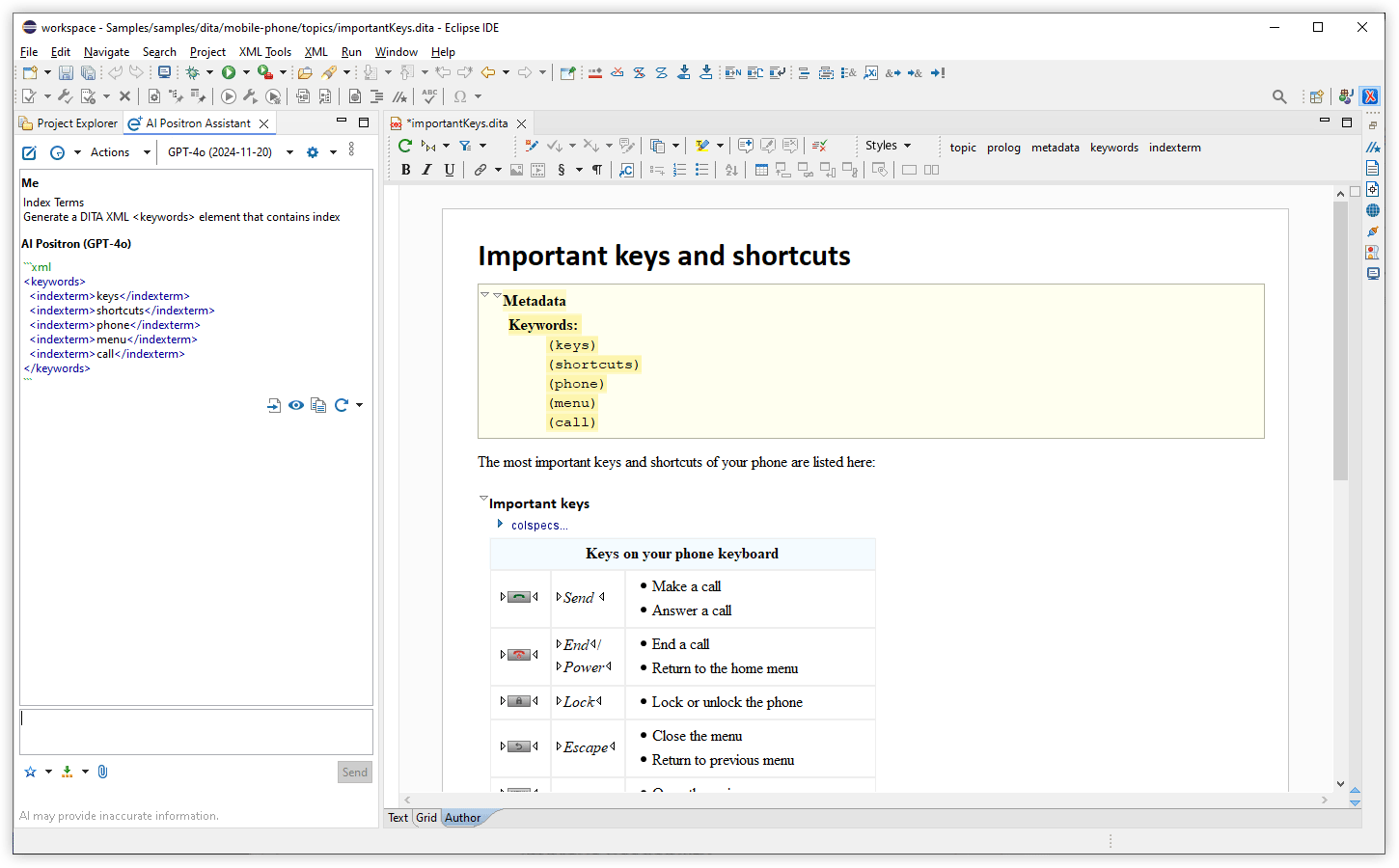
Create Files with AI
AI Creates and Updates Files with User Control
save_document callback function to create new files or to update
existing files while keeping you in control. You can view the changes in the built-in
visual file comparison tool and choose to accept or revert them, ensuring that you
maintain oversight over your documents.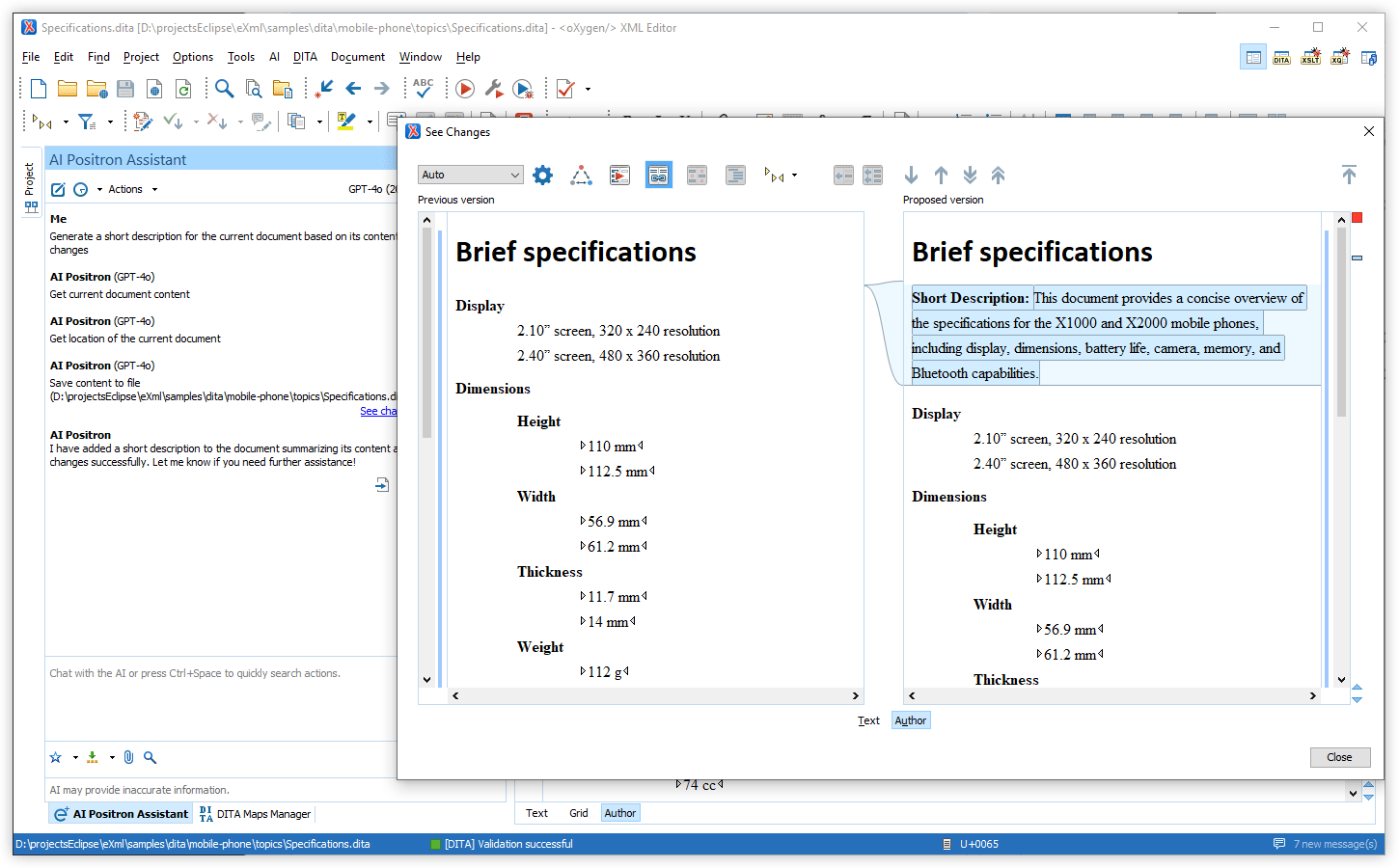
AI-based DITA Conversion, Analysis, and Update Tools
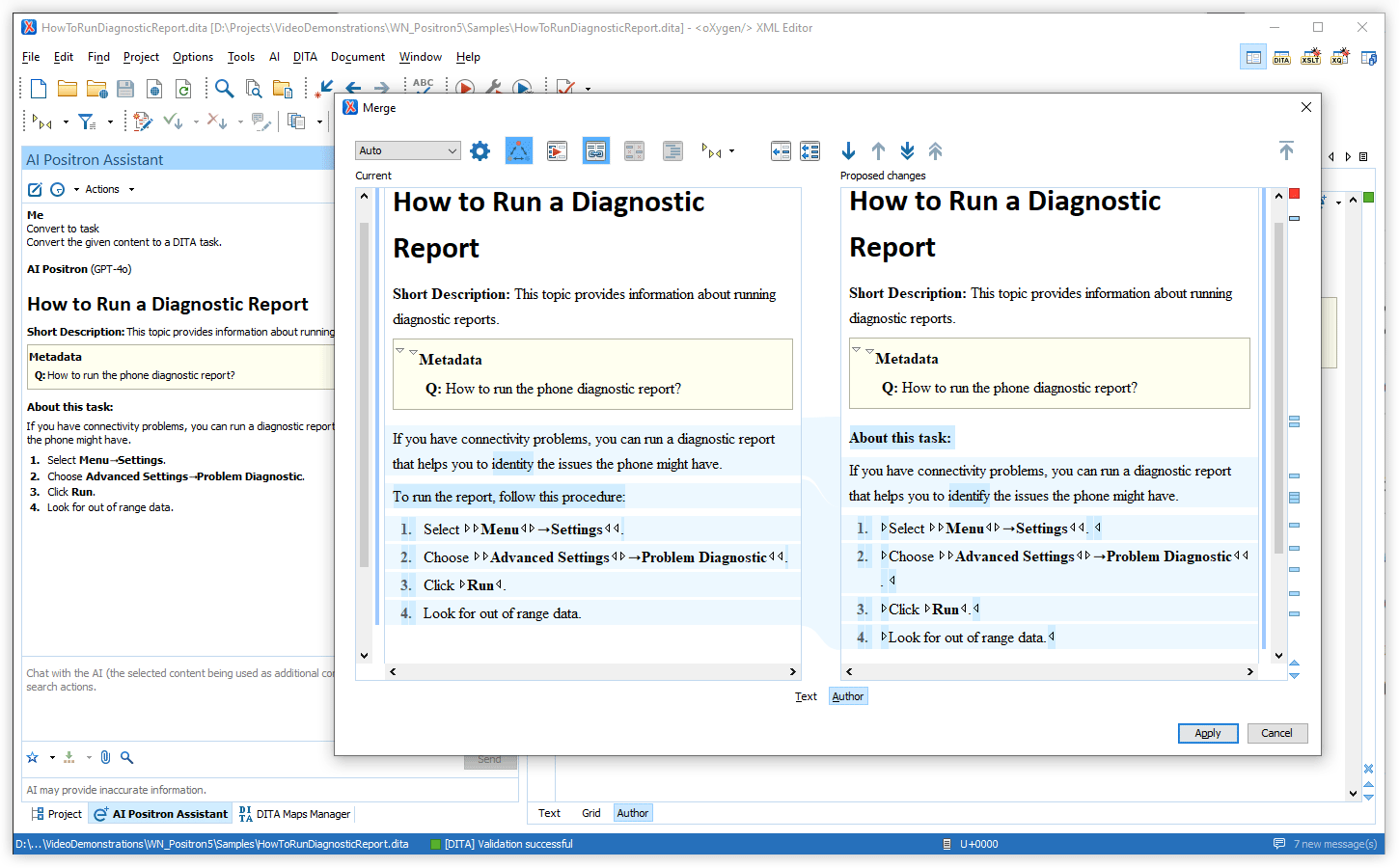
Exclude Resources from AI Processing
.ai-ignore file. You can easily add resources to the ignore
file by using a new contextual menu action (named Exclude from AI
processing) that is available in the Project view,
DITA Maps Manager, and the Text and
Author pages of your current editor.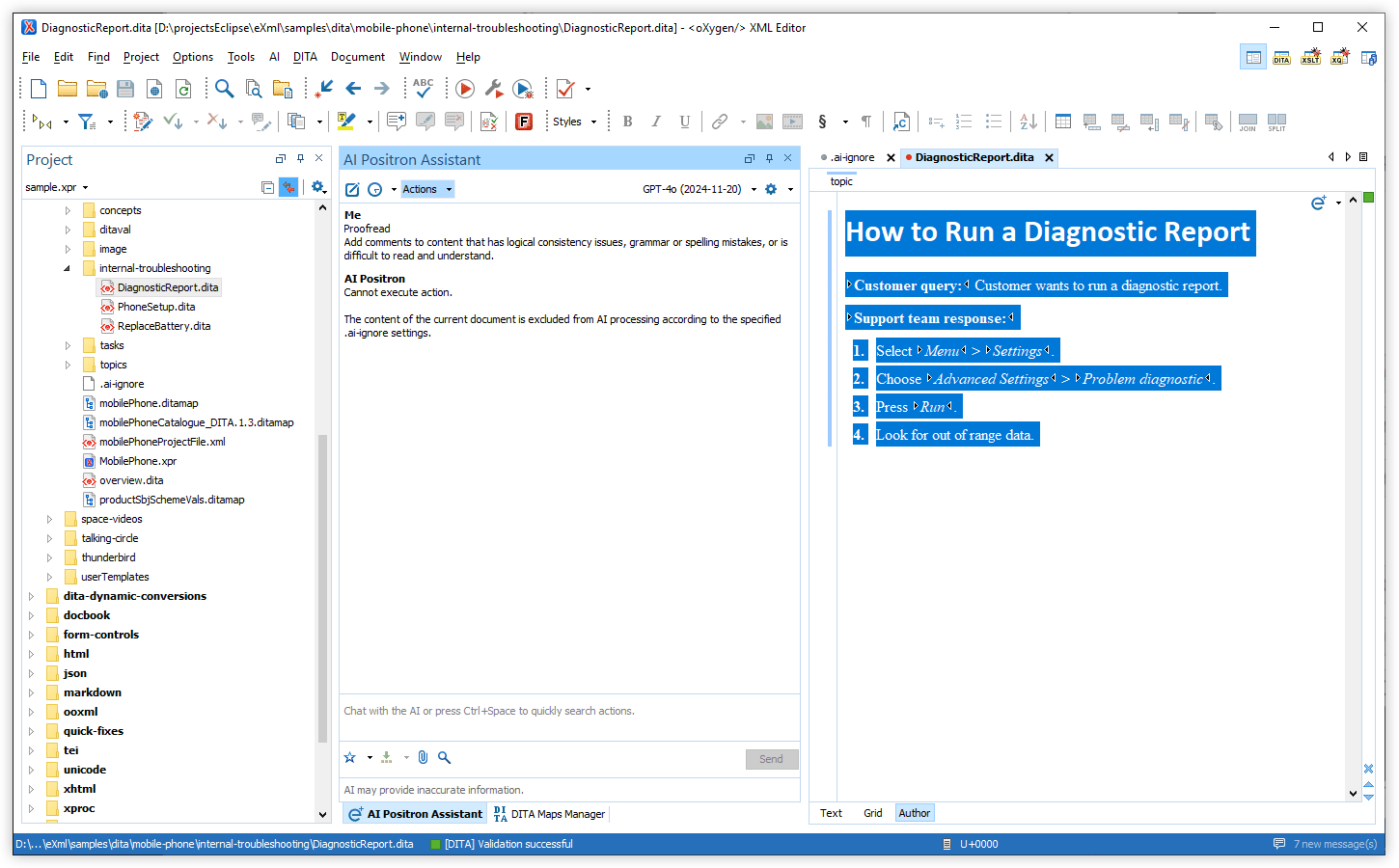
Attach Word, PowerPoint, and PDF Files
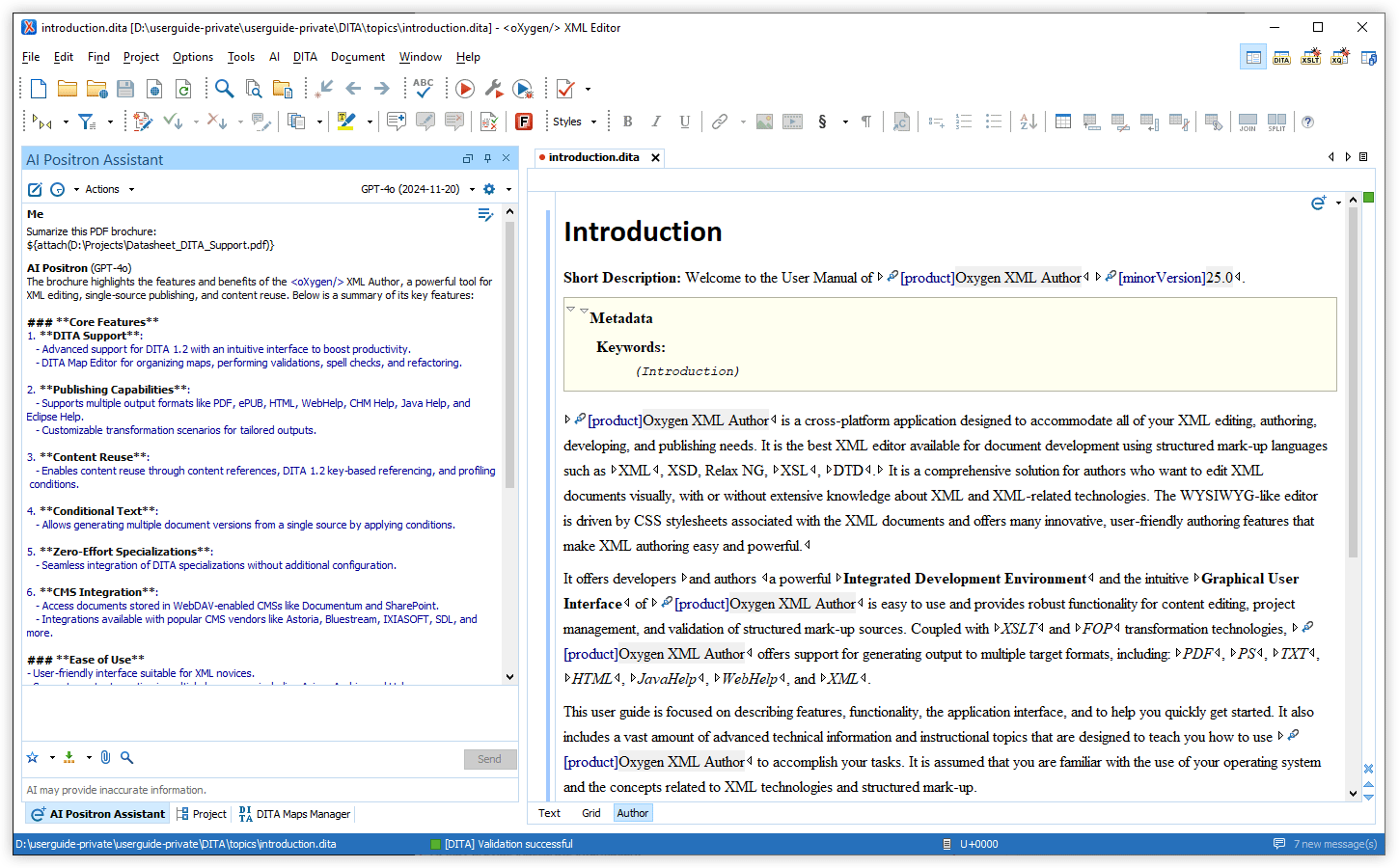
Generate Documentation Draft Can Read External Files
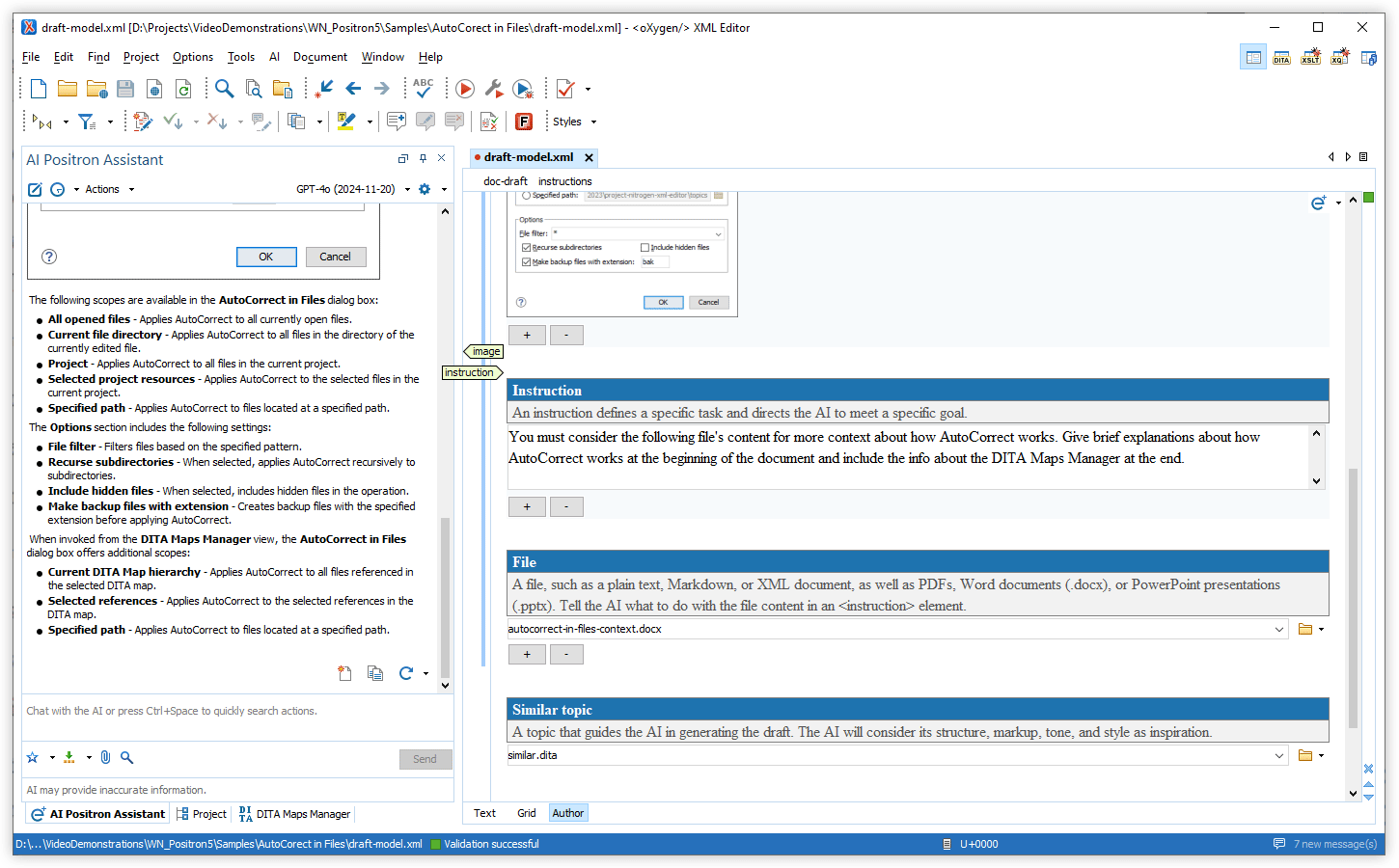
Reasoning Models in AI Positron Service
Integration with xAI Grok
Quickly Find AI Actions
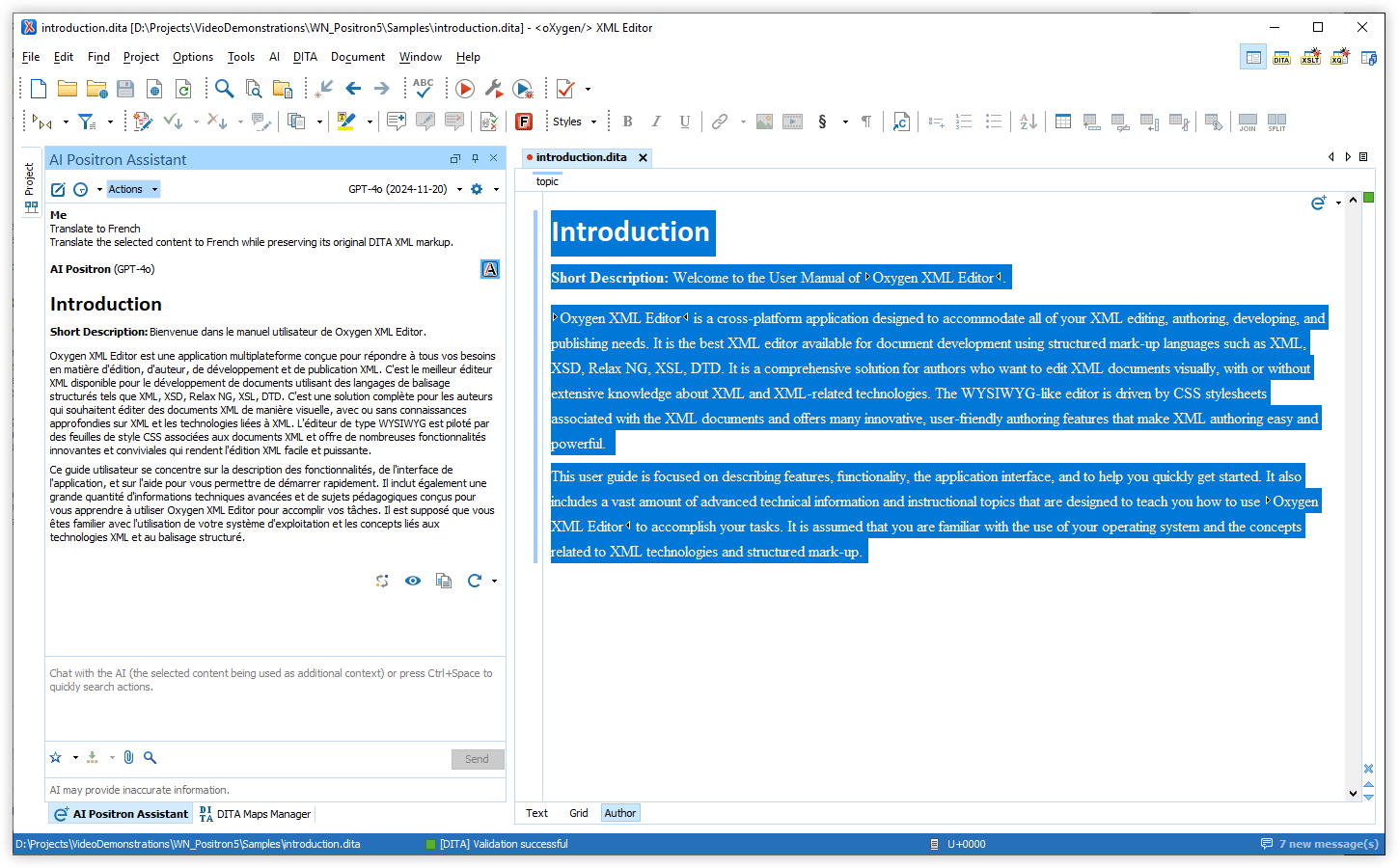
Generate Image Alternate Text from the Floating Toolbar
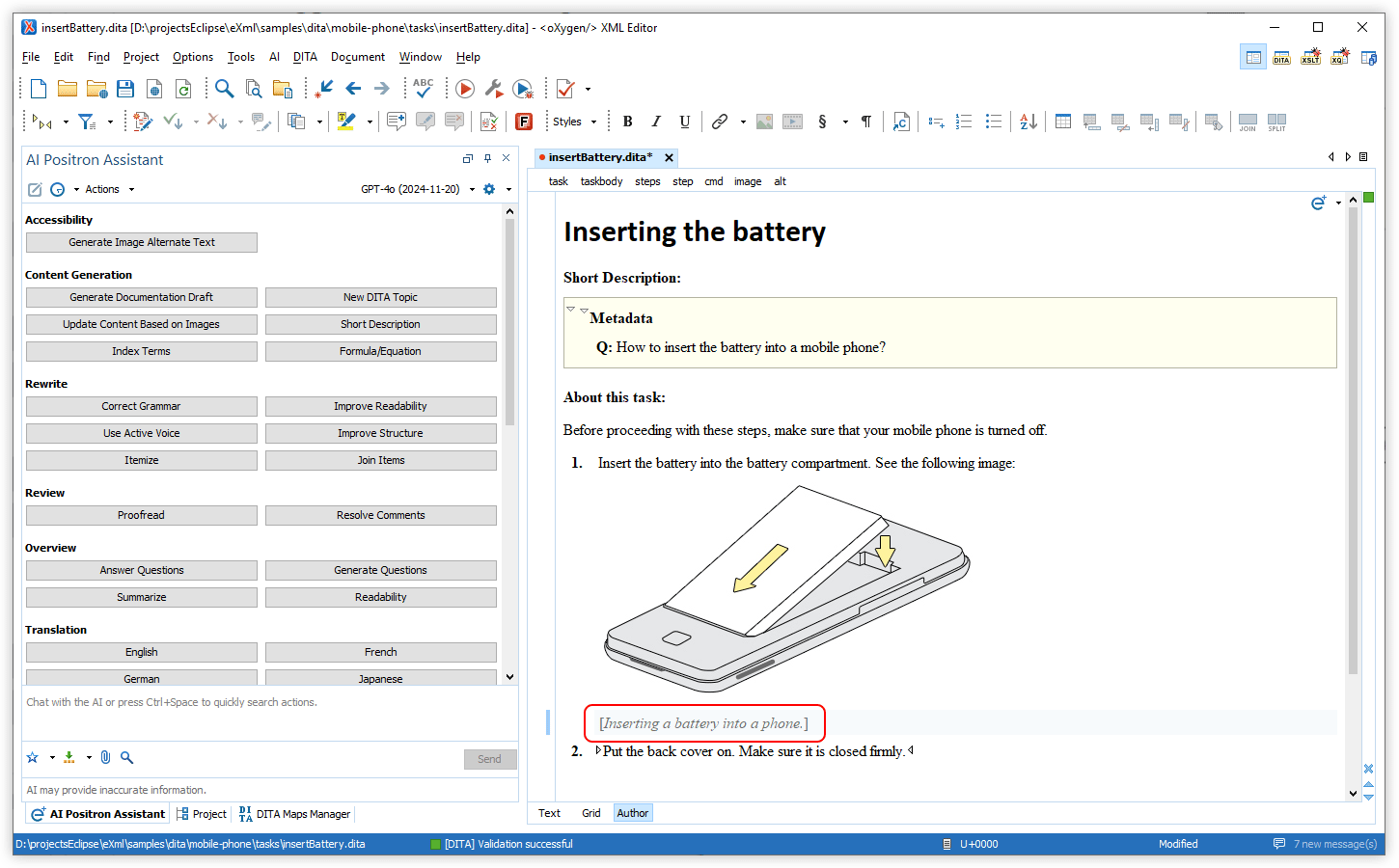
Improved Resolve Comments Action
Performance Optimization for Fix Validation Problems
New AI Callback Functions for Dynamic Workflows
get_related_content_from_specific_feedback_site- Retrieve content from a specified feedback site using an Oxygen Feedback WebHelp token. This function is available when external retrieval sources are enabled in your preferences.validate_current_document- Validate your current document and receive a list of any validation issues, allowing the AI to suggest fixes for the detected errors.term_check_document_content- Check specified content for terminology issues and get suggestions based on rules from the Oxygen Terminology Checker, ensuring consistency in your documents.term_check_current_document- Check your current document for terminology issues and receive suggestions based on rules from the Oxygen Terminology Checker, helping you maintain quality and consistency.- The
get_content_for_document_urlandget_current_document_marked_up_contentfunctions can now be used to retrieve content with line numbers included.
Distribute or Filter AI Actions via Plugins and Frameworks
Reference Prompt Files in AI Actions
Integrate Custom AI Connectors and Custom Callback Functions
New AI Custom Connector Add-on
Translated AI Actions
GPT-3.5 Turbo Model Removed
Oxygen AI Positron Assistant for Web Author and Content Fusion
AI-based DITA Conversion, Analysis, and Update Tools
Attach Word, Powerpoint, and PDF Files
Reasoning Models in AI Positron Service
Integration with xAI Grok
Quickly Find AI Actions
Distribute or Filter AI Actions via Plugins and Frameworks
Reference Prompt Files in AI Actions
New AI Custom Connector Add-on
Translated AI Actions
GPT-3.5 Turbo Model Removed
Oxygen AI Positron Assistant 4.1
The Oxygen AI Positron Assistant add-on is a powerful tool that helps users increase their productivity by providing support for using AI-generated content. Version 4.1 introduces some helpful new AI-powered actions to fix validation problems, generate MathML formulas, and generate XML comments for annotating code.
Some of the intelligent agent actions were upgraded to enhance their functionality. The Resolve Comments AI action is now accessible directly from the editor or Review view, making it a breeze to resolve all comments in a document with AI assistance. Message labels were also improved to indicate when submitted content requires no AI changes, new functions were implemented, and some features were added to assist with debugging and for security purposes.
Some of the features were also implemented for Oxygen XML Web Author, such as the new Fix Validation Problems action and its corresponding function. In addition, you can use the new Attach from Computer to incorporate files from your local machine into prompts.
There are changes in:
Desktop
Preview All AI-Proposed Changes to Files
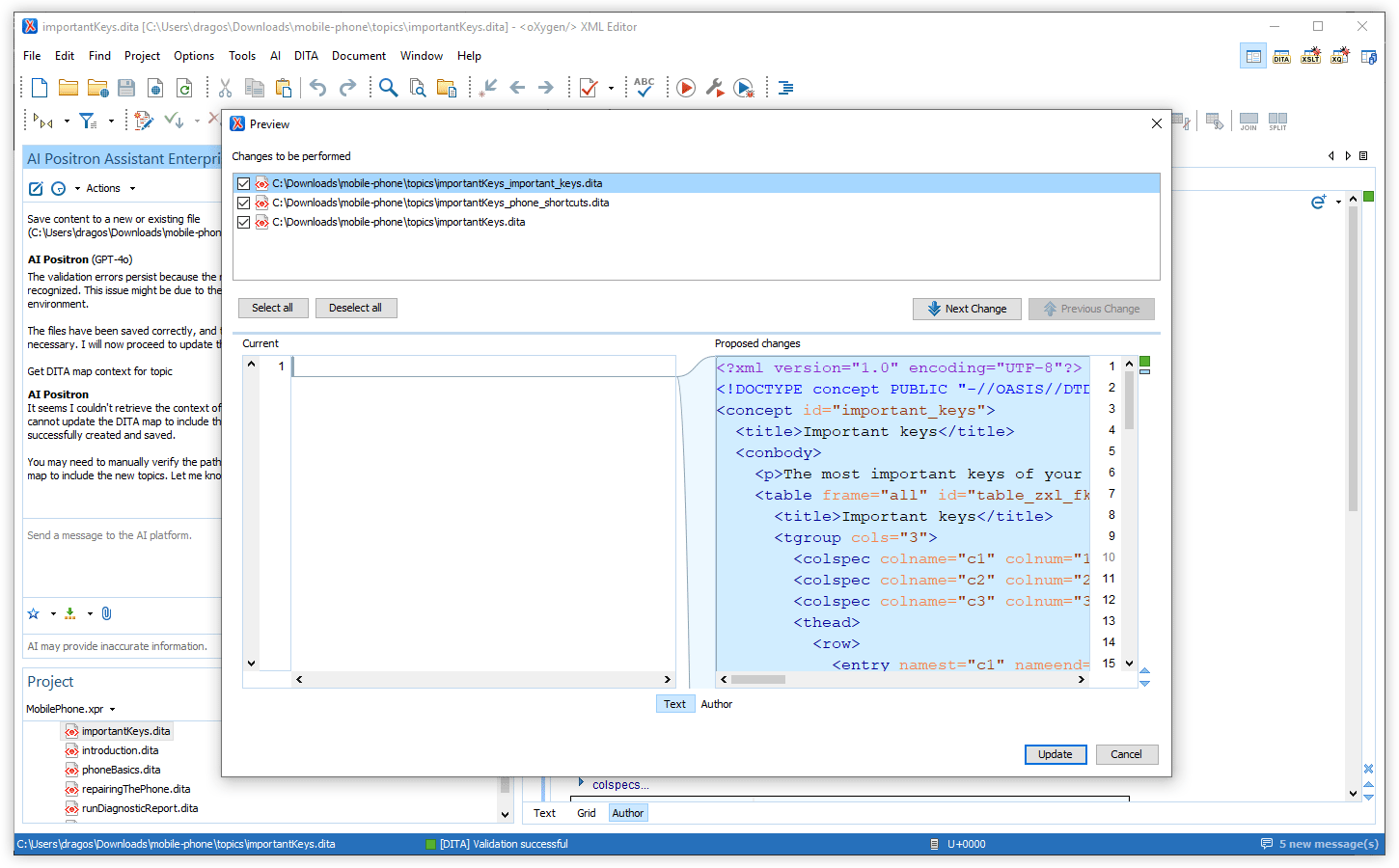
Notification for Unchanged Content
When an AI action processes content but does not result in any changes, you are now informed, eliminating the need for unnecessary previews or visual inspection. This improvement saves time and ensures a smoother workflow.
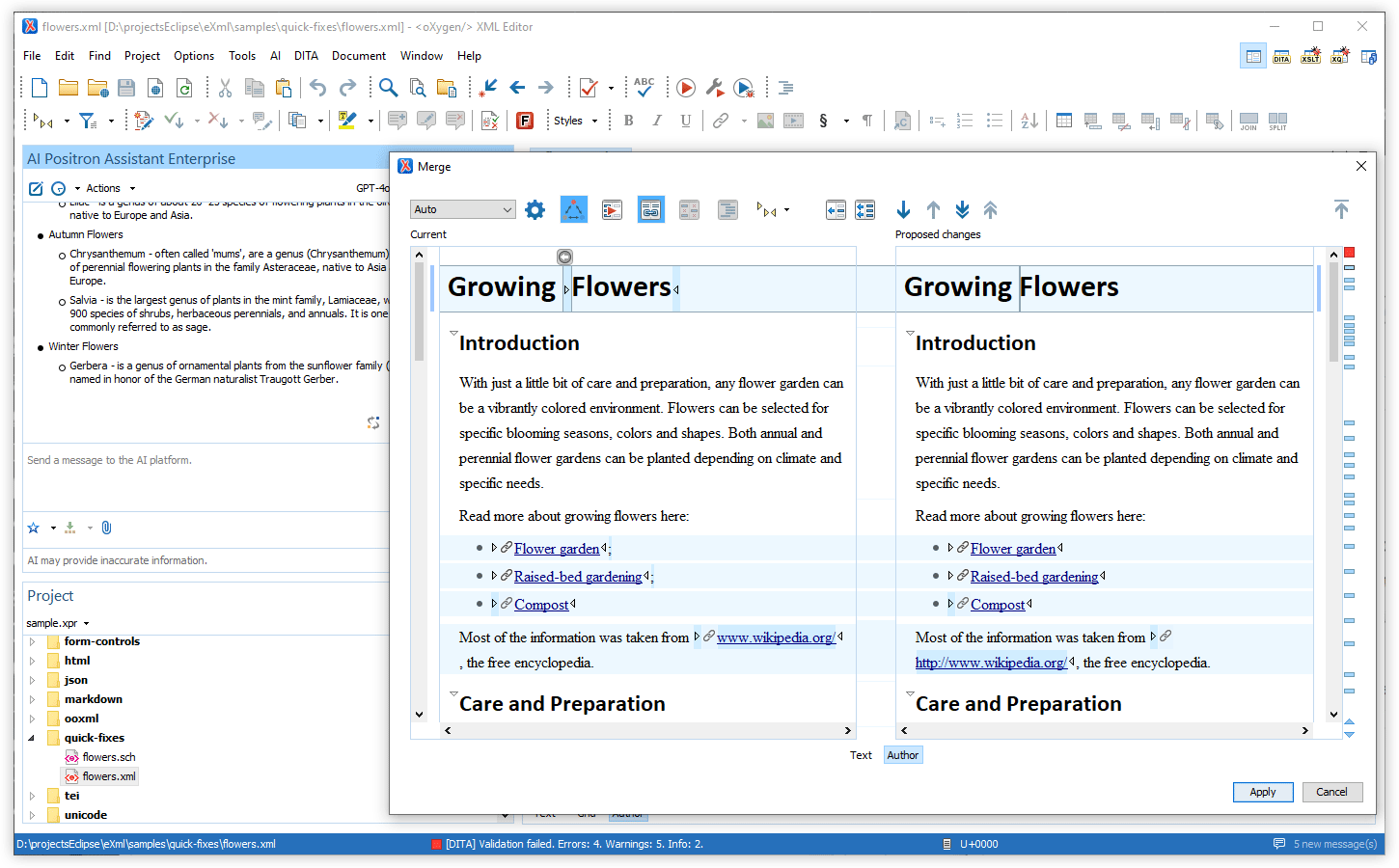
Fix Validation Problems
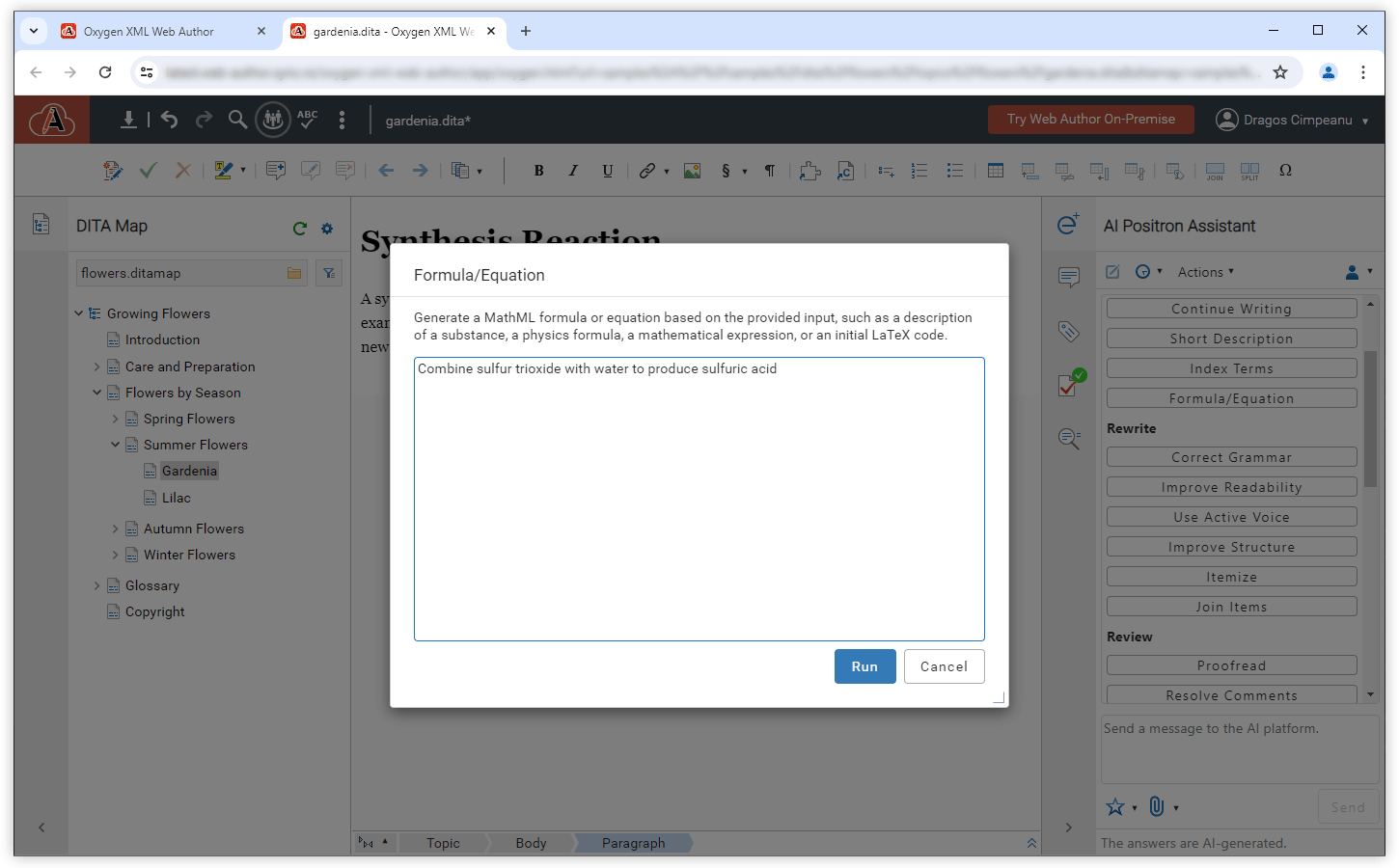
AI-based MathML Generation
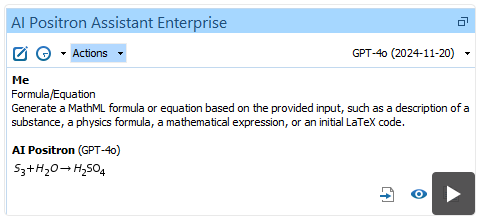
The new Formula/Equation action (located in the Content Generation category) leverages AI to generate MathML formulas based on your descriptions. This feature simplifies the creation of complex mathematical representations and enhances technical documentation workflows.
AI-based Code Annotations
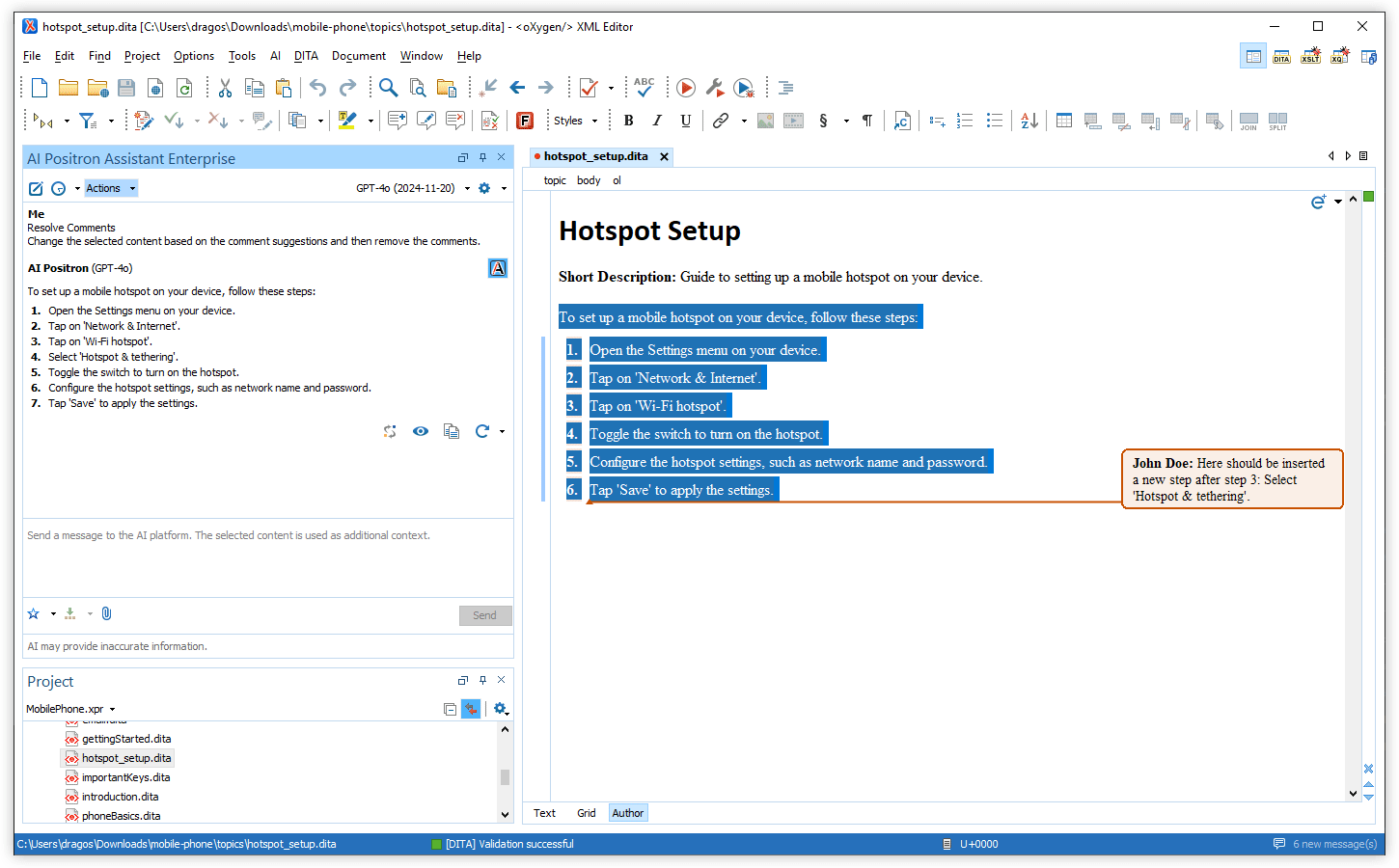
Resolve Comments from Contextual Menu
New AI Callback Functions to Enable Dynamic Workflows
invoke_ai_action- This callback function invokes an AI action that enables the delegation of processing to other AI actions, allowing you to use a divide-et-impera approach to simplify and optimize the AI action processing.retrieve_all_ai_actions- Instead of specifying a predefined set of AI actions that can be invoked, you can use this callback function that returns all the defined actions. This allows the AI to discover all the available AI actions and invoke them dynamically as needed.validate_document_content- When processing or generating content, an AI action can now use this callback function that validates a document, ensuring that the generated content is valid. In case of errors, it offers the opportunity to automatically correct the detected problems.
Invoke Positron Actions from XPath
A new XPath function (ai:invoke-action) has been introduced,
enabling you to seamlessly invoke an AI Positron action from any XPath context (such as
XSLT, XQuery, Schematron, etc.) by providing the action ID, contextual text, and the
content to be processed.
XSLT Support Improved for Suggest Refactoring Action
xsl:try' and 'xsl:catch' instructions, and XML
comments were added to help clarify the purpose and functionality of the
code.Multi-agent Architecture for Create Topics
invoke_ai_action()
function. These improvements ensure better adherence to system instructions and more
consistent execution. Export and Import Chat Sessions
Disable/Enable All AI Features for a Specific Project
Updated Default Model
gpt-4o-2024-11-20,
the latest gpt-4o snapshot from OpenAI. This model is more cost-effective
than the previous default one and supports four times as many maximum output tokens while
maintaining very similar performance.Web Author
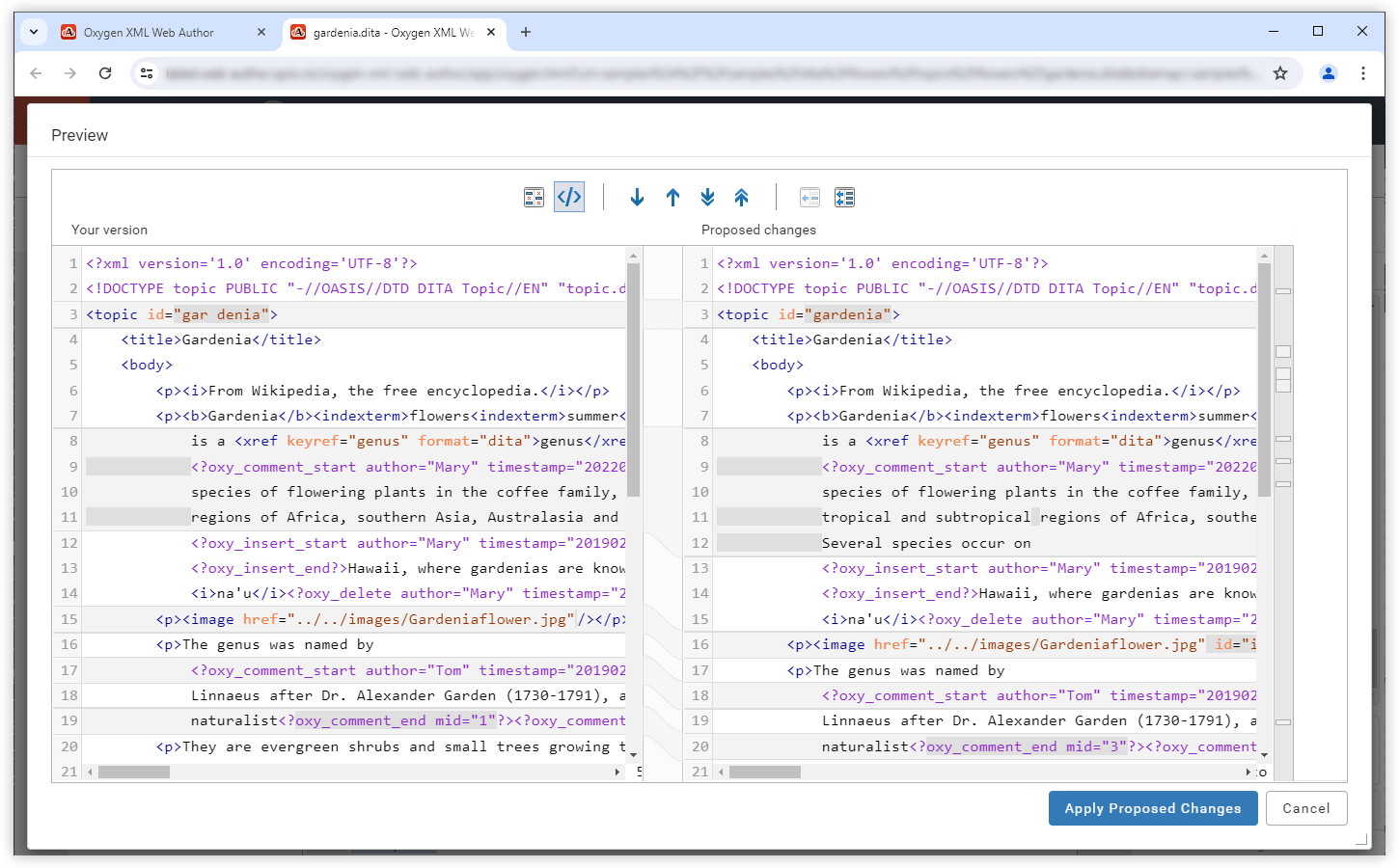
Fix Validation Problems
Attach Local Files
AI-based MathML Generation
New AI Tool Function
validate_document_content, that validates a document,
ensuring that the generated content is valid. In case of errors, it offers the opportunity
to automatically correct the detected problems.Notification for Unchanged Content
Oxygen AI Positron Assistant 4.0
There are changes in:
Retrieval-Augmented Generation (RAG)
Improved AI Fixes
RAG using the search provided by Oxygen Feedback
New AI tool functions
add_to_toc- Modifies a DITA map and adds a specified topic reference to it.find_similar_reusable_content- Retrieves a list of reusable DITA XML components that match keywords provided by the AI.get_content_for_document_url- Retrieves the content of a certain document.get_corresponding_dita_keyrefs- Can be used to find if there are key definitions for corresponding values.get_current_editor_file_location- Retrieves the location (URL) of the current file that is open in the editor.get_related_content_from_webhelp- Accesses the search functionality provided by the Oxygen Feedback product when a connection to Oxygen Feedback is defined in the preferences page.get_topic_context_in_toc- Returns the hierarchical structure path that references the selected topic from the DITA map that is open in the DITA Maps Manager view, providing context such as its parent, siblings, and surrounding nodes within the DITA map. This is useful for understanding the topic's location in relation to other elements in the DITA map.resolve_dita_key_or_content_reference- Resolves a DITA XML key reference, content key reference, or content reference to the target content.save_document- Saves the document at the specified path within the project and writes content to it. If a resource already exists at the specified URL, the content of the document is overridden with the new content.
Intelligent Agents
Expand DITA Topic Draft
Split Large DITA Topics
Create DITA Topics
Interface Improvements
Current Element Highlighted When Applying an AI Action in Text Mode
AI-Powered Actions
Reuse DITA XML Component
Find Product Names
keyref) if keys are defined for the
particular product names. If keys are not defined for specific product names, those names
are wrapped in <keyword> elements instead.Suggest Refactoring for Selected Code
Generate Code Action Reuses Components
New Action Types
prompt-user- Prompts the user for extra details passed to the action prompt.replace-selection-based-on-image-analysis- Uses details obtained from the referenced DITA XML images when performing the action prompt.
Miscellaneous
Document Type Sent to AI for Context
Intuitive Identification of XML Content in Markdown
```xml marker. This type of response is now detected and
the block of XML code can be inserted or previewed.Security Enhancements
Web Author
Attach Image, XML, or Text File to a Chat
Document Type Sent to AI for Context
Intuitive Identification of XML Content in Markdown
```xml marker. This type of response is now detected and
the block of XML code can be inserted or previewed.Expand DITA Topic Draft
Split Large DITA Topics
New AI tool functions
get_content_for_document_url- Retrieves the content of a certain document.get_current_editor_file_location- Retrieves the location (URL) of the current file that is open in the editor.get_related_content_from_webhelp- Accesses the search functionality provided by the Oxygen Feedback product when a connection to Oxygen Feedback is defined in the preferences page.save_document- Saves the document at the specified path within the project and writes content to it. If a resource already exists at the specified URL, the content of the document is overridden with the new content.
Oxygen AI Positron Assistant 3.0
There are changes in:
Retrieval-Augmented Generation (RAG)
Retrieve Project Information to Provide More Context to the AI
RAG is also enabled by default for all chat sessions within the AI Positron Assistant. If you wish to configure the various RAG-specific settings, you can access the new Retrieval-Augmented Generation (RAG) preferences page.
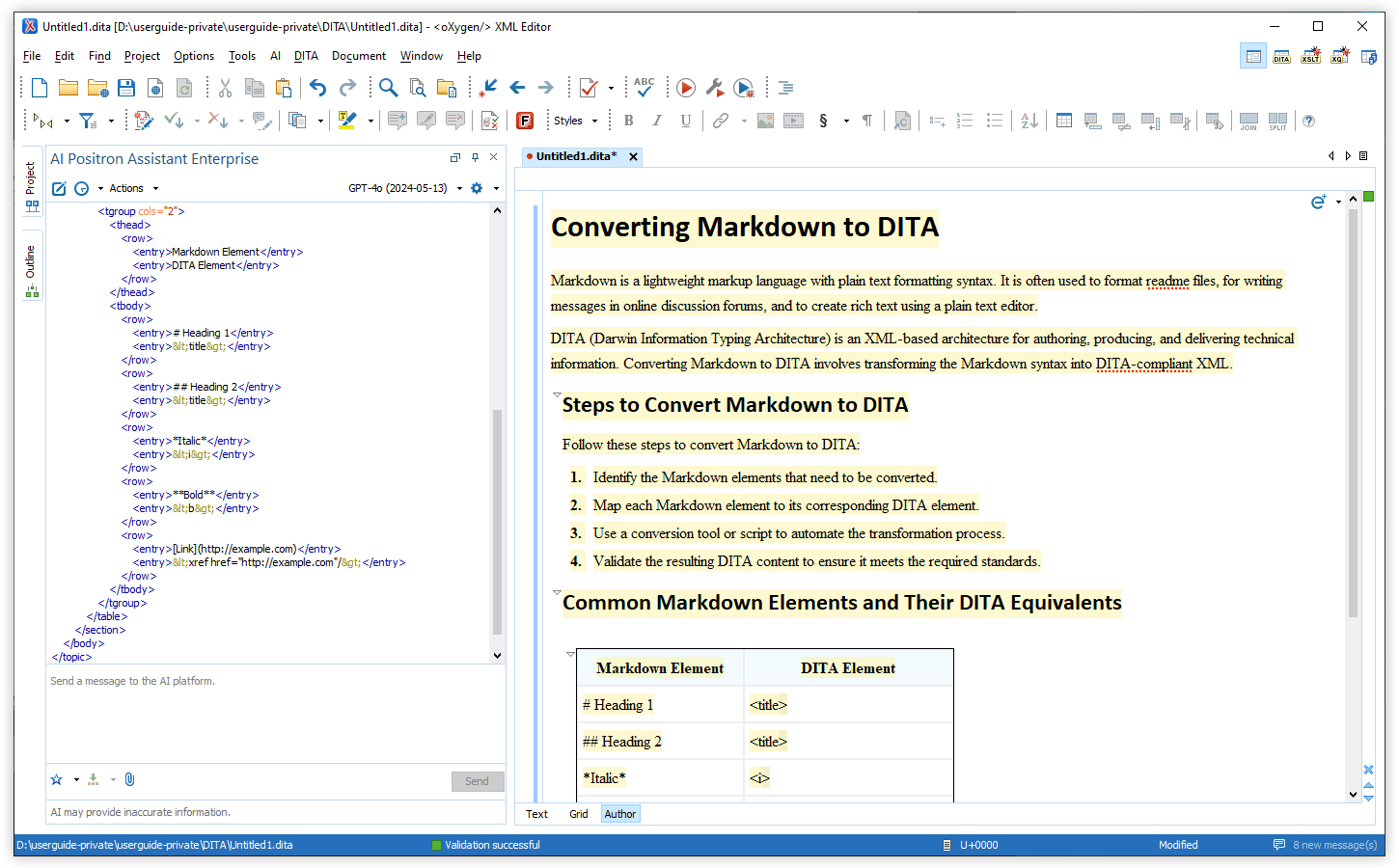
Function Calls
get_related_content_from_project- Retrieves content from the user's local project based on given key words. It is limited to return a maximum of 50k characters and works with Oxygen version 26.1 or newer.get_related_resources_overview_from_projectandget_content_for_document_id- Retrieves an overview of a maximum of 5 documents that each contain an ID along with the most relevant information from each document (usually titles, key words, short descriptions). The second function can be called by the AI to retrieve the content of a certain document. It is also limited to return a maximum of 50k characters and works with Oxygen version 26.1 or newer.get_current_document_plain_text_content- Obtains all text without markup from the current document open in the editor.get_current_document_marked_up_content- Obtains all text with markup from the current document open in the editor.get_content_around_caret- Obtains size-limited content around the current cursor location within the document open in the editor.
Interface Improvements
AI Positron Assistant Widget
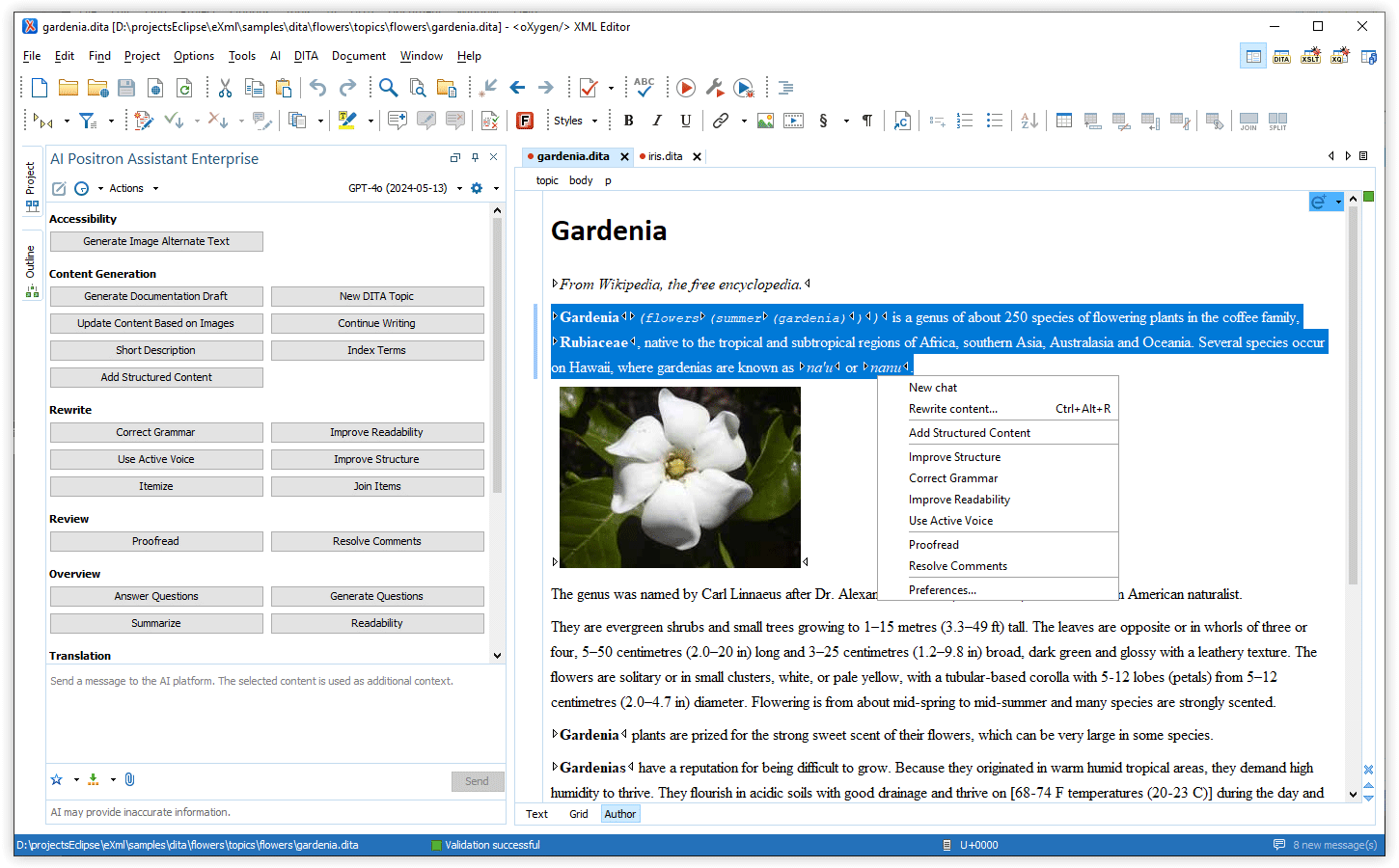
In-place AI Prompt Input Field
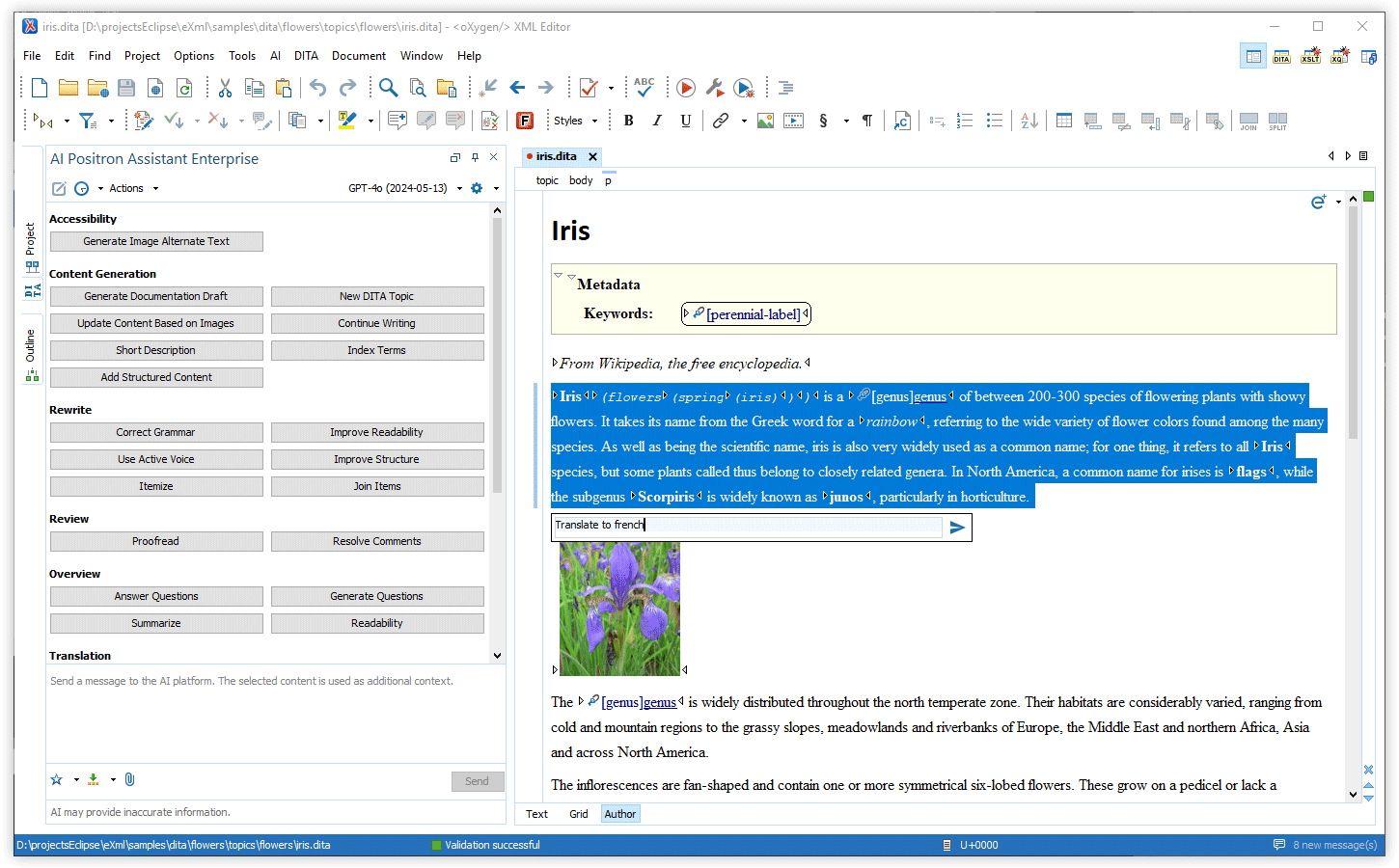
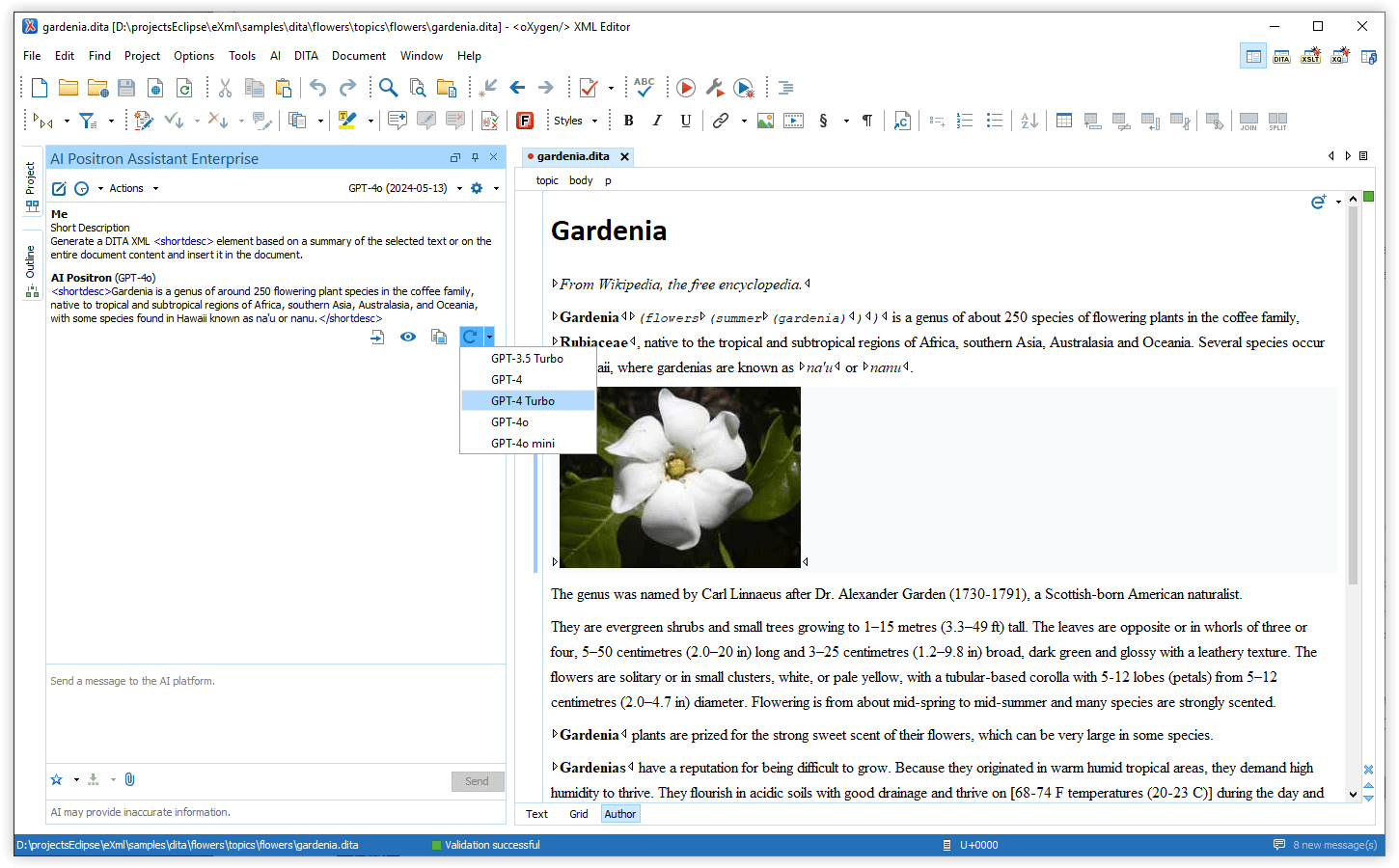
Regenerate Response
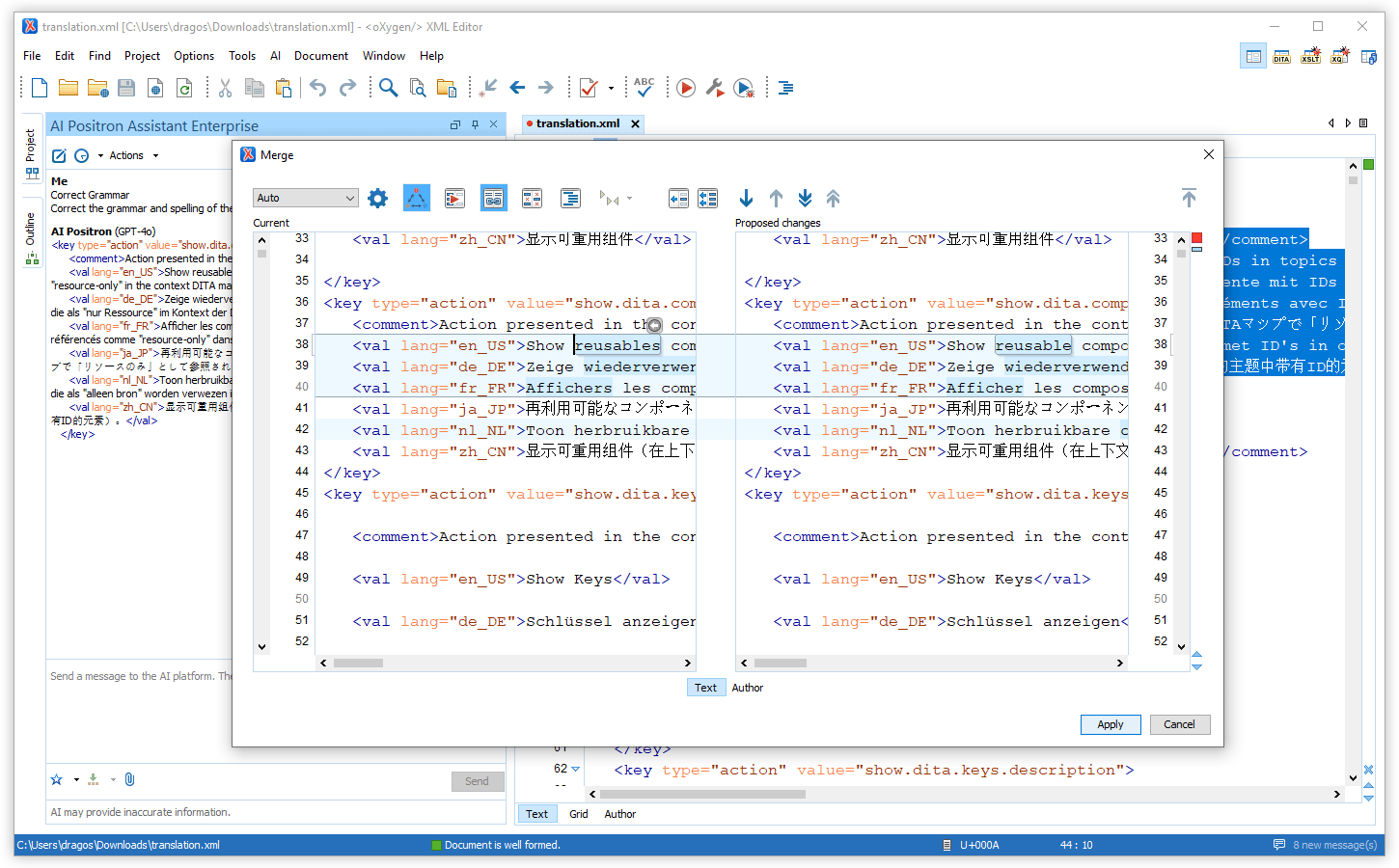
Preview Responses When Using AI Features in Text Mode
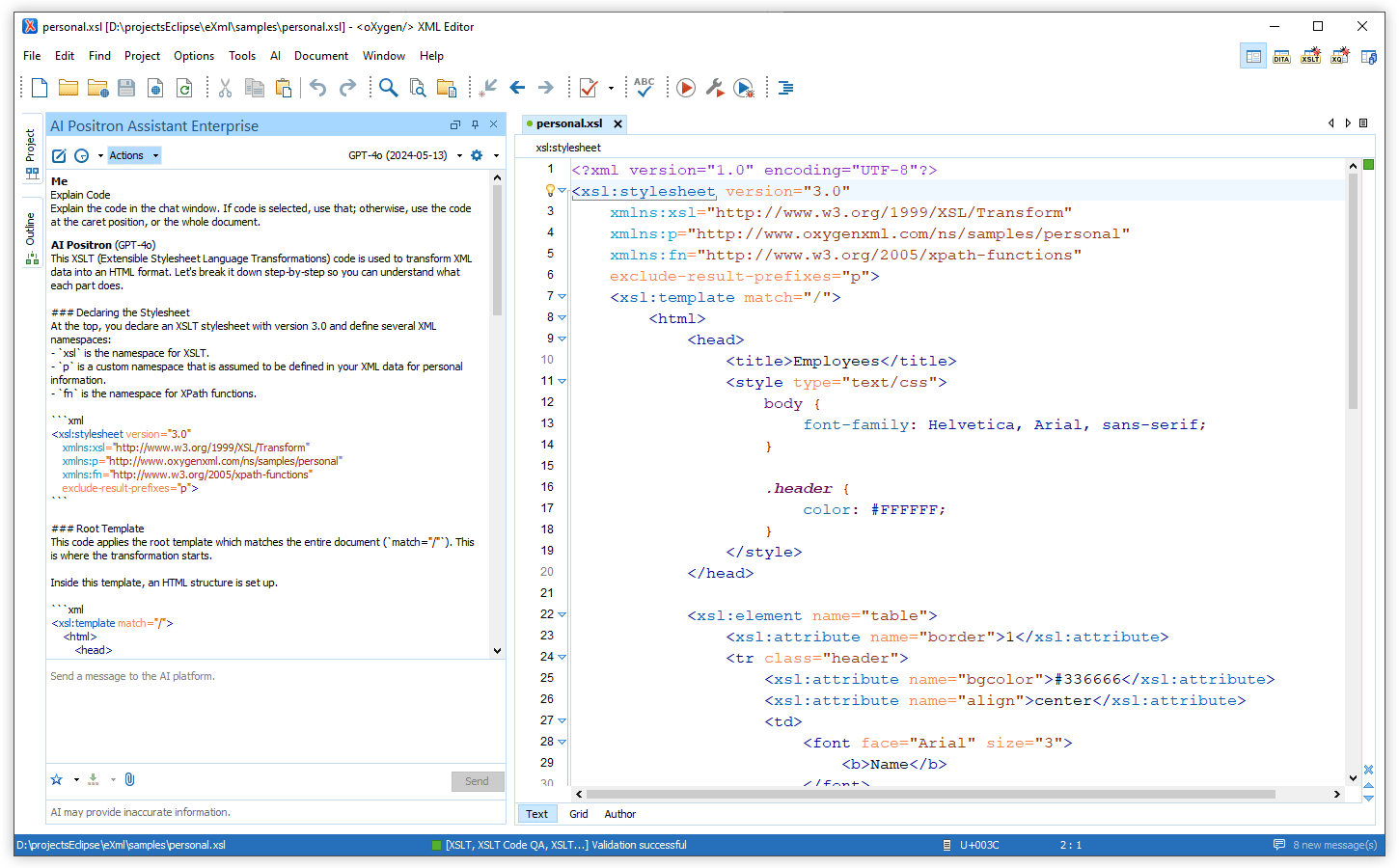
Access Quick Assist Actions From Vertical Stripe Icon
Easily Choose Between AI Models
Additionally, the chat panel now specifies which AI model was used for each response.
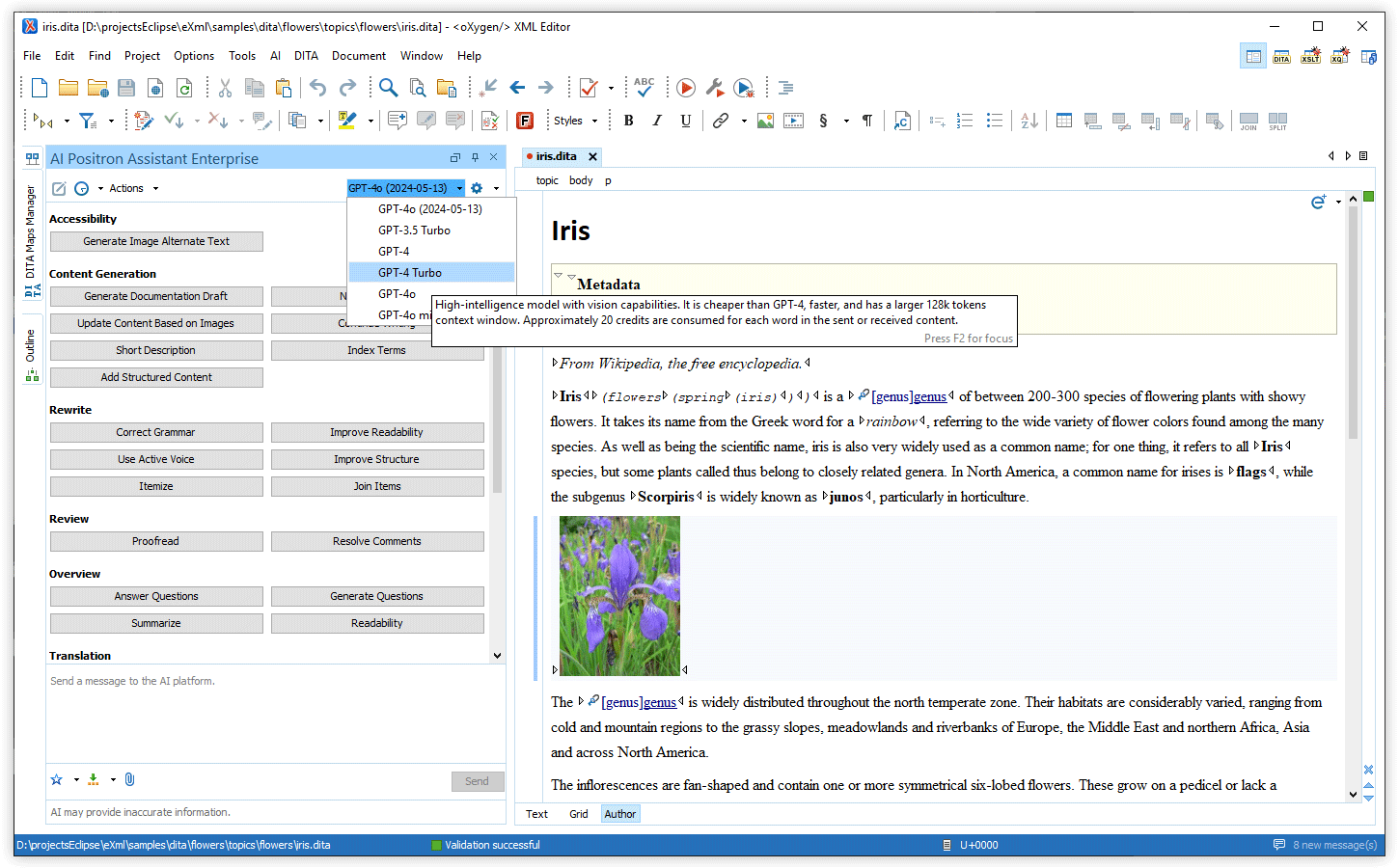
AI Models
GPT-4o-mini AI Model
Improved Credit Usage Efficiency
AI-Powered Actions
Proofread Action
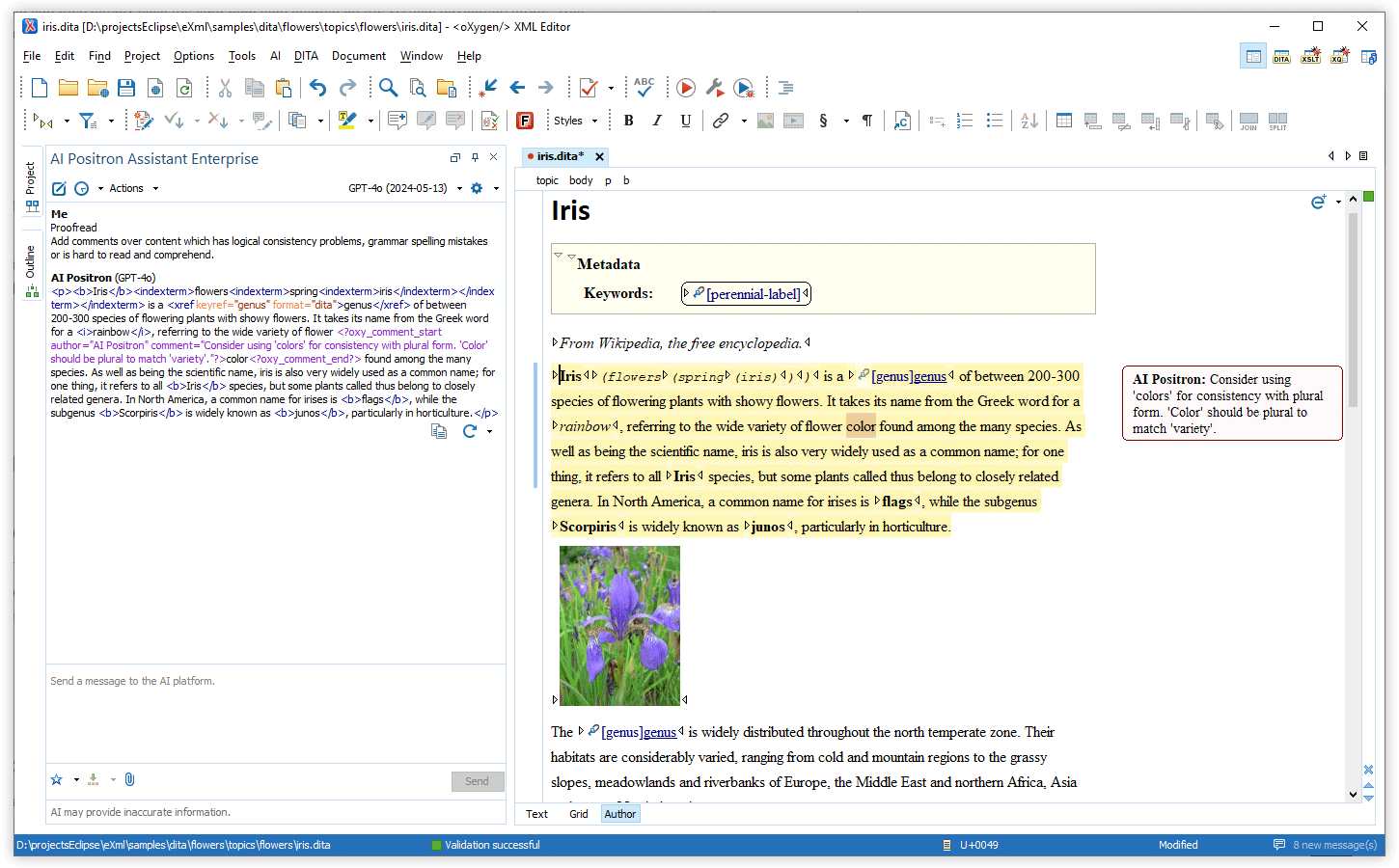
Resolve Comments Action
Improve Structure Action
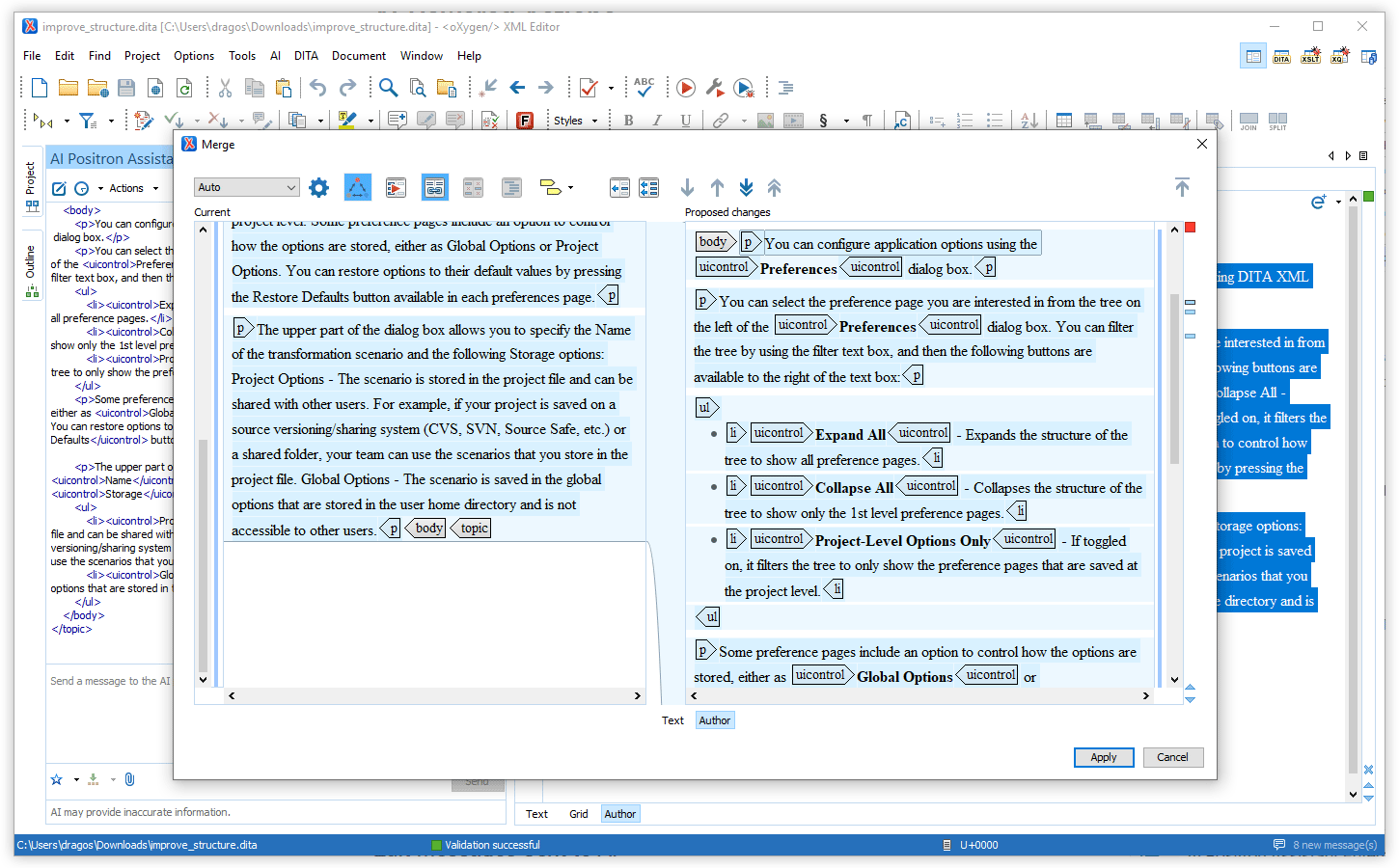
Add Structured Content Action
Web Author
Edit Messages Sent to AI
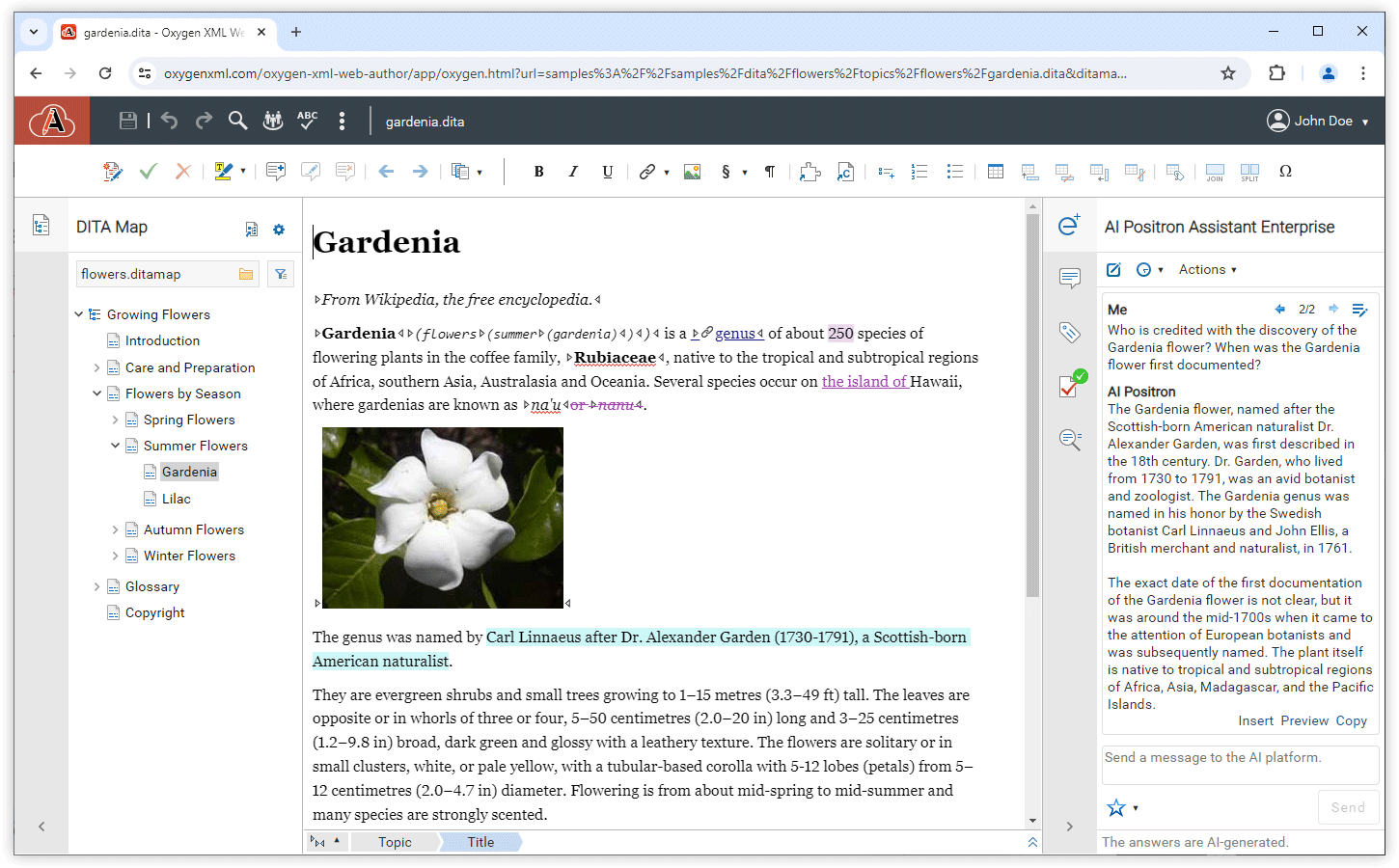
Selected Content Sent to AI for Context
Improve Structure Action
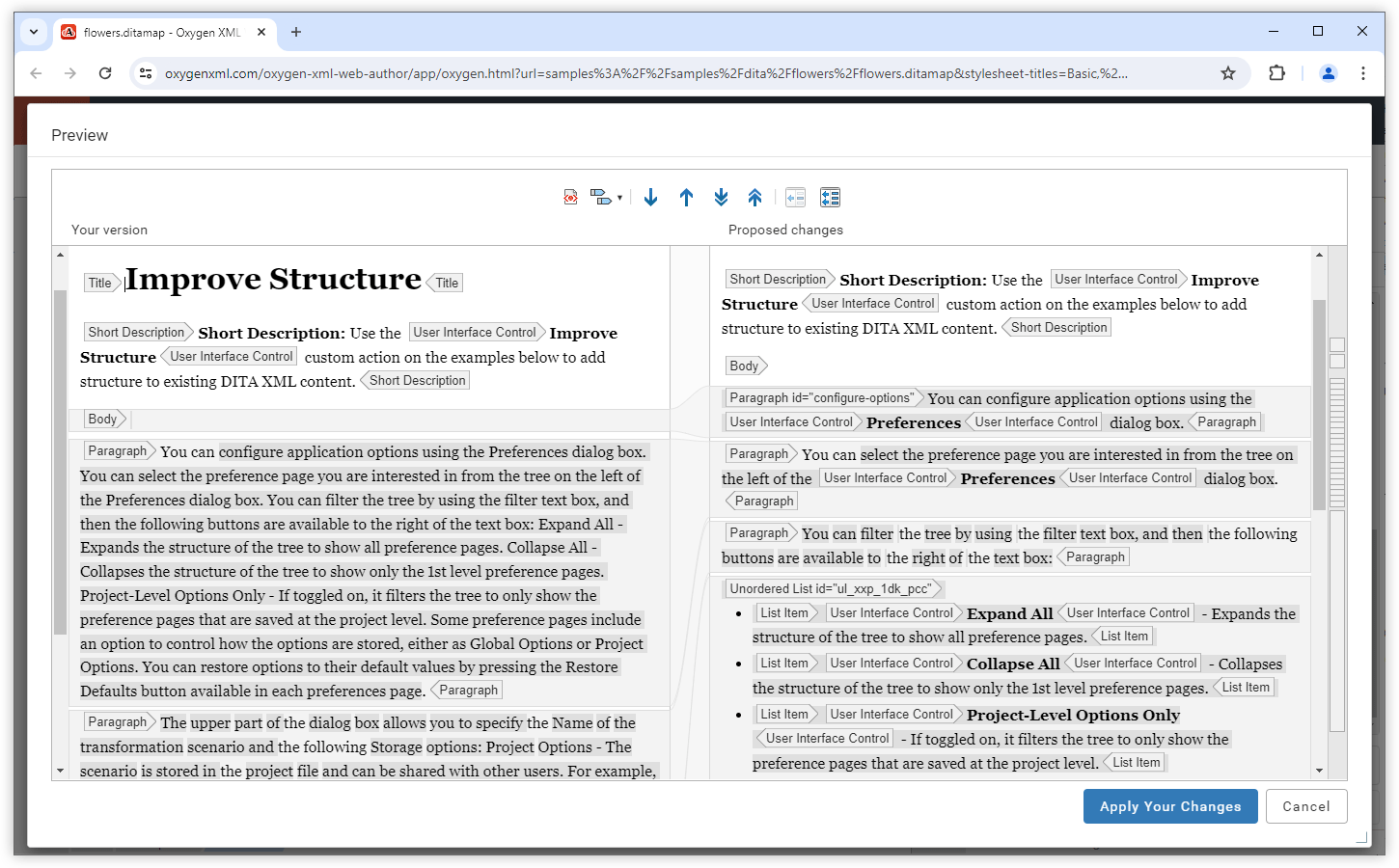
Proofread Action
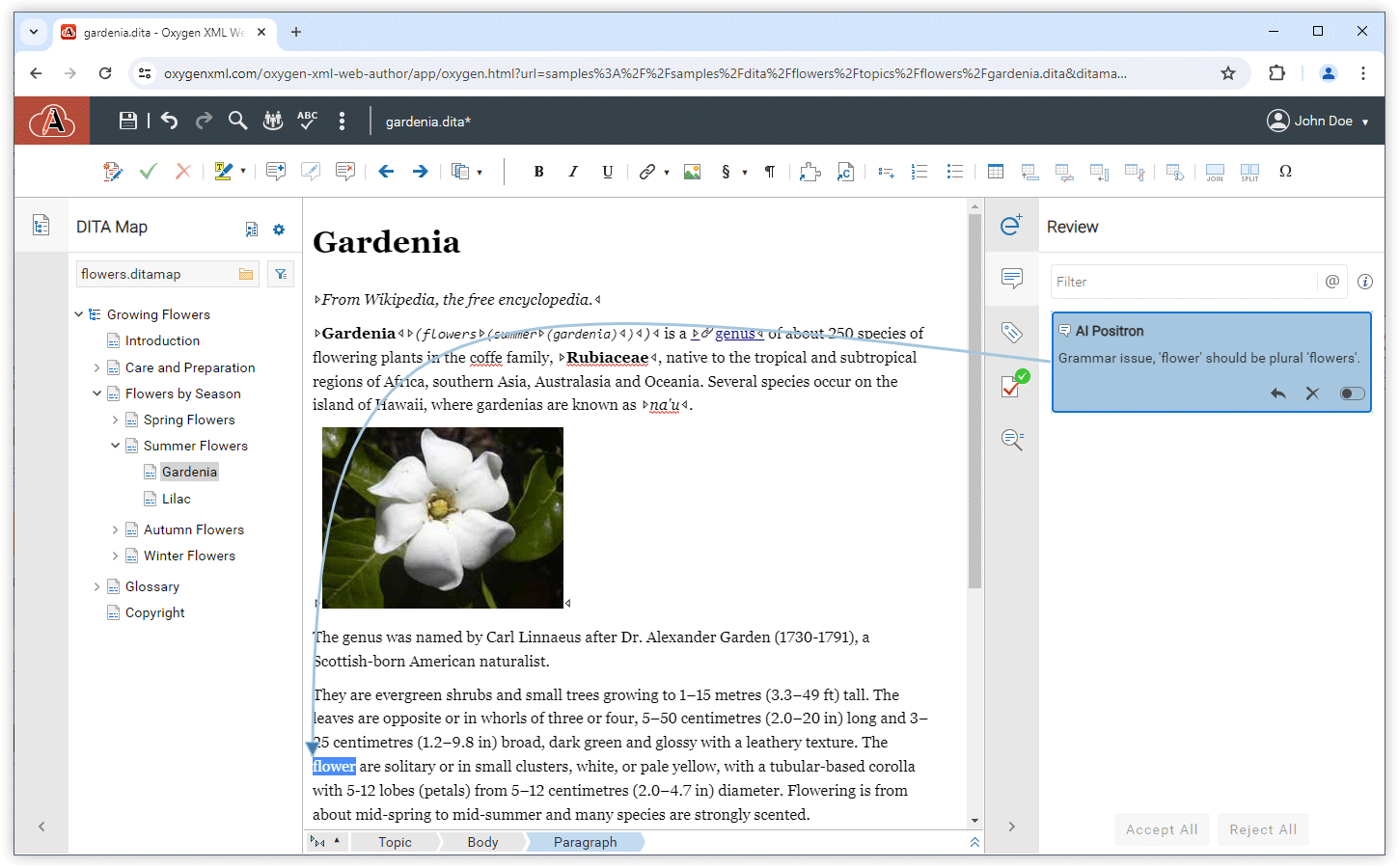
Resolve Comments Action
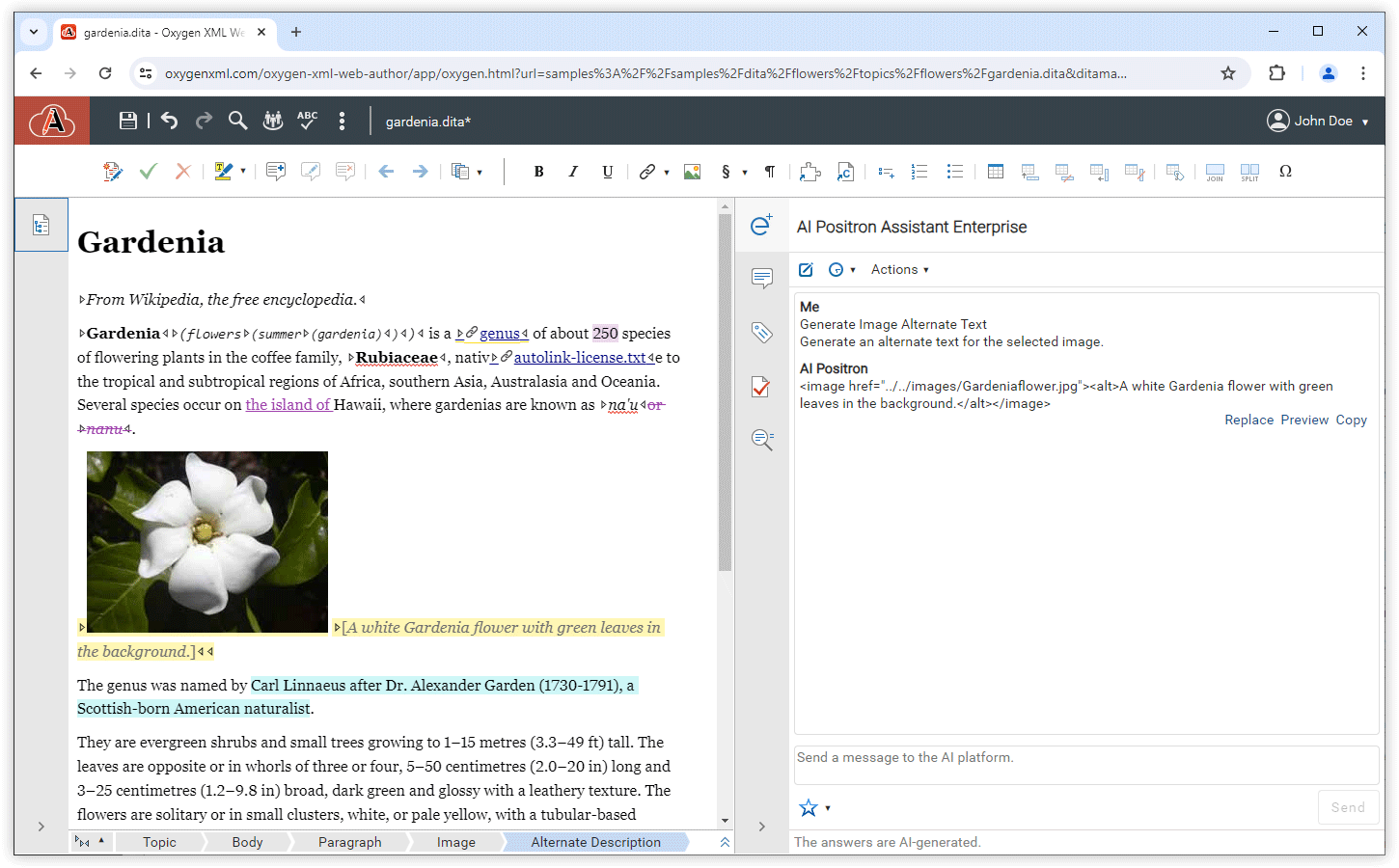
Generate Image Alternate Text AI Action
Function Calls
get_current_document_plain_text_content- Obtains all text without markup from the current document open in the editor.get_current_document_marked_up_content- Obtains all text with markup from the current document open in the editor.get_text_around_caret- Obtains size-limited content around the current cursor location within the document open in the editor.
Oxygen AI Positron Assistant 2.1
The Oxygen AI Positron Assistant add-on is a powerful tool that helps users increase their productivity by providing support for using AI-generated content. Version 2.1 expands upon the enhancements of the previous version by adding the advanced multi-modal GPT-4o to the list of models to choose from, as well as the Microsoft Azure OpenAI Service connector now supporting authentication using Microsoft Entra ID.
New AI actions have been introduced in this version, allowing users to generate, document, or explain specific code, initiate a conversation with the AI regarding certain code, and create alternate text for images. Furthermore, version 2.1 also introduces three AI XML refactoring actions aimed to improve the efficiency for users working with DITA XML topics.
For Web Author users who integrate the Oxygen AI Positron Assistant Enterprise for Web Author plugin, the ability to filter the list of AI actions is now available.
There are changes in:
Optimization
GPT-4o Model
When utilizing the Oxygen AI Positron Assistant Enterprise add-on, access to the GPT-4o model is possible when connected to the OpenAI platform.
Enhanced Microsoft Azure OpenAI Service Connector Using Microsoft Entra ID Authentication
AI-Powered Actions
Explain Code AI Action
Chat About Code AI Action
Document Code AI Action
Generate Code AI Action
Generate Image Alternate Text AI Action
AI XML Refactoring Actions
Web Author
Filter List of Available Actions for Web Author
Miscellaneous
Selected Content Sent to AI for Context
Oxygen AI Positron Assistant 2.0
The Oxygen AI Positron Assistant add-on is a powerful tool that helps users increase their productivity by providing support for using AI-generated content. Version 2.0 adds support for Vision models, allowing the AI to also read and interpret images and thus supporting more use cases. The new Generate Documentation Draft action makes it possible for users to provide instructions and images to help the AI engine create a draft DITA topic. Furthermore, this version also introduces an action that enables users to simply update the images from a topic and have the AI analyze the images and propose content updates.
Oxygen XML Web Author users can now benefit from the new Oxygen AI Positron Assistant Enterprise plugin. Moreover, the Oxygen XML Enterprise edition license for Oxygen XML Editor, Author, and Developer products now includes access to the Oxygen AI Positron Assistant Enterprise add-on at no extra cost.
There are changes in:
Oxygen XML Enterprise Edition Includes Free Access to AI Positron Assistant Enterprise Add-on
Oxygen AI Positron Assistant Enterprise Connector for Anthropic Claude
Vision Support
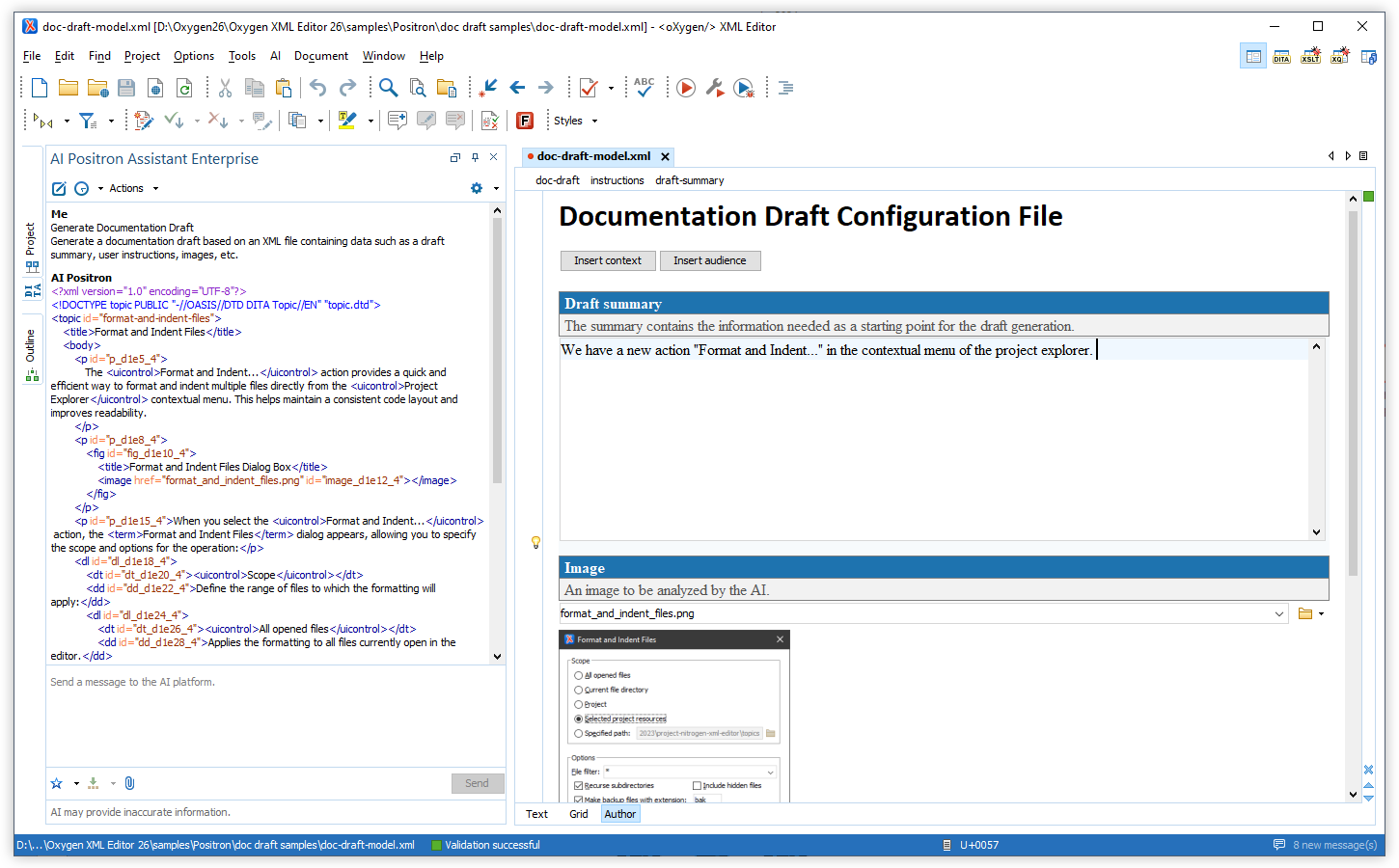
Generate Documentation Drafts
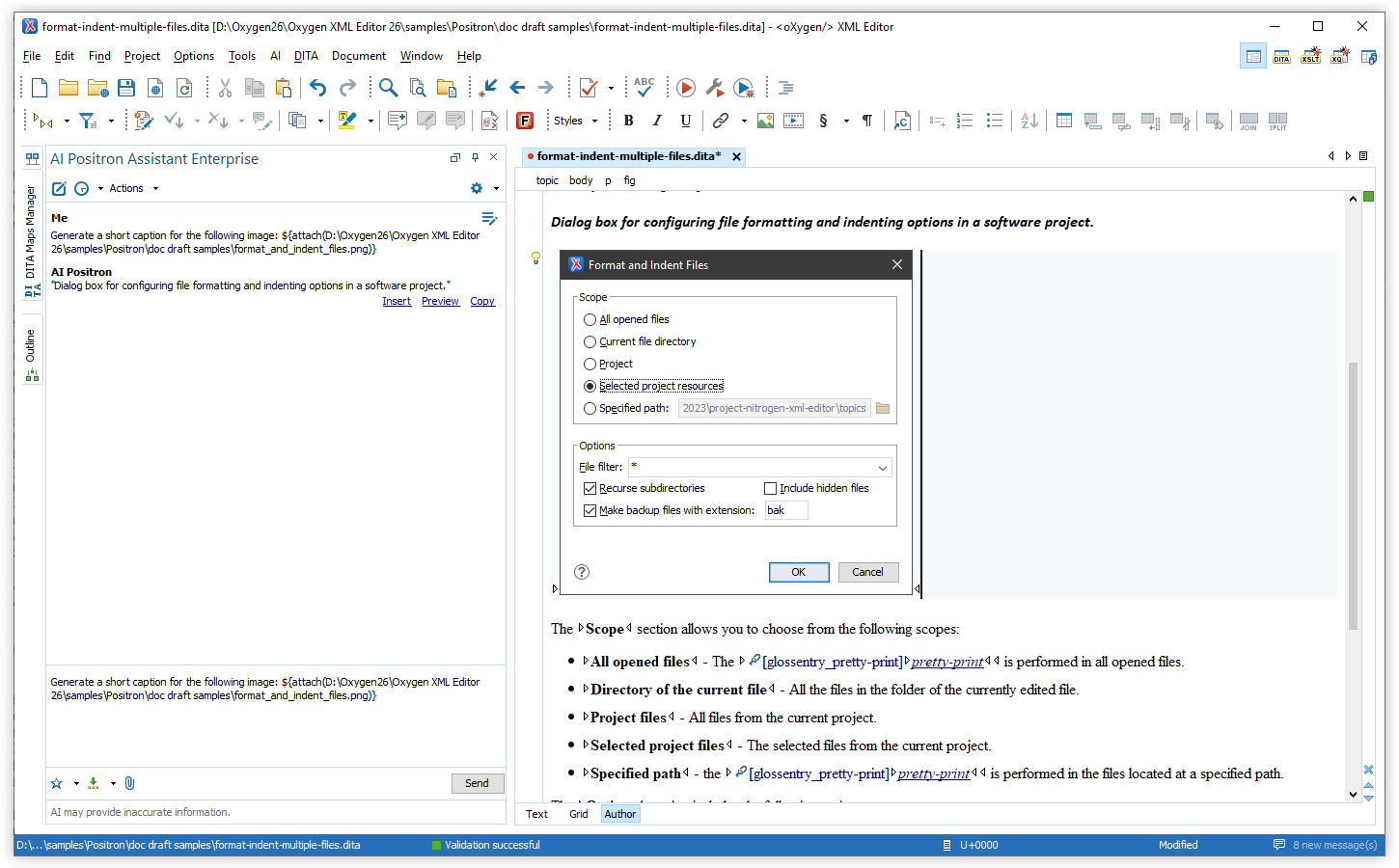
A new action called Generate Documentation Draft is available that can be used to create a draft DITA topic. To control the draft generation process, users can specify the context for the new topic, instructions, and images that will be analyzed using the vision support in a dedicated drafting configuration file that gathers all this information. Oxygen provides a customized editing experience in the visual Author editing mode for these draft configuration files so you can easily create such files just by following the instructions from the visual editor.
Update the Content of a DITA Topic Based on the Images that it References
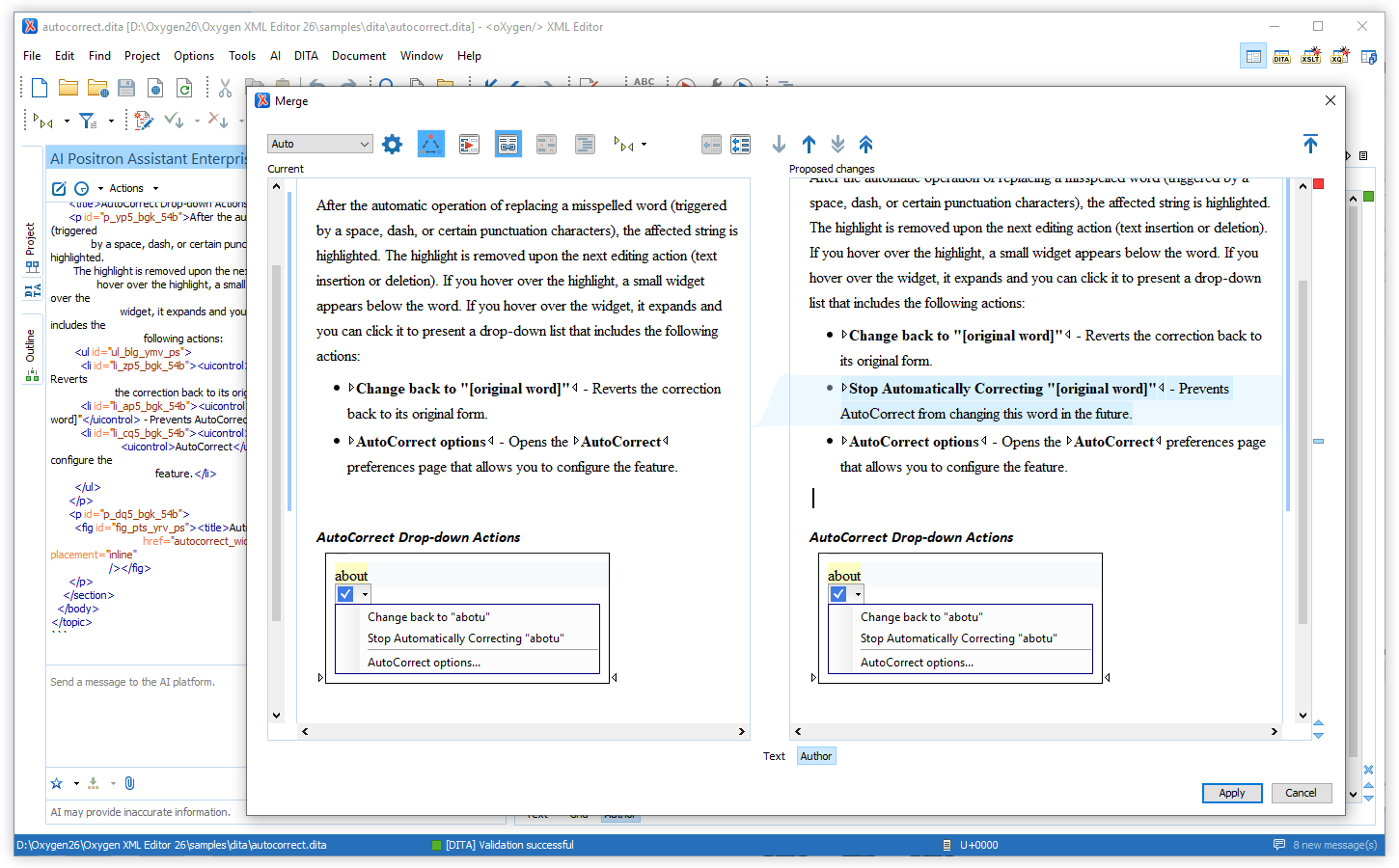
Quick Assist Actions
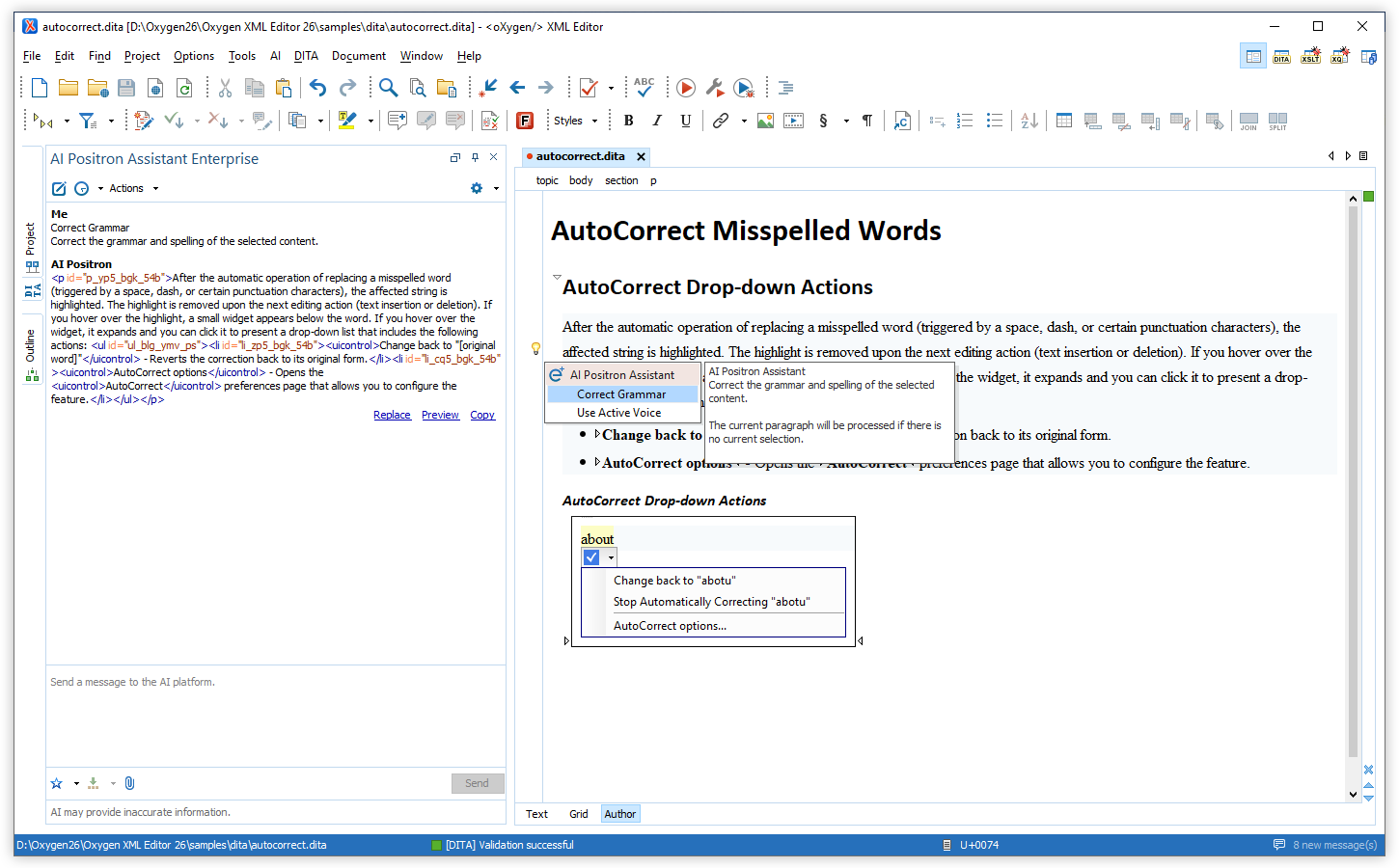
Variables to Obtain Selection with Track Changes Accepted/Rejected
Filter the List of Actions
GPT-4 Turbo
Oxygen AI Positron Assistant Enterprise Plugin for Web Author
AI XPath Functions Updated to Allow Adding a Conversation History
ai:transform-content
and ai:verify-content were modified to allow adding a conversation
history when the functions are used. You can add multiple pairs of user-agent data that
will be passed to the AI as the history of the conversation. This can be used for more
complex actions that need to also set a context for the AI operation.Oxygen AI Positron Assistant 1.1
Oxygen AI Positron Assistant Enterprise
Create Custom AI Actions
Translate Content to Any Language
AI Refactoring Available for Remote Resources
Easier Access to Actions
XML Syntax Highlights
Introducing Oxygen AI Positron Assistant 1.0
There are changes in:
AI-Powered Actions
AI Positron Actions
The AI Positron Assistant side-view and various menus offer an extensive array of AI-powered predefined actions that enable users to:
- Generate content such as DITA topics, document fragments, short descriptions, and index terms.
- Improve existing content in terms of grammar, readability, and the use of active voice.
- Get various insights to understand how readable the content is and how it responds to questions.
- Translate to various languages while preserving the XML structure.
- Write better marketing content with support for generating press releases, marketing posts, applying marketing frameworks, and for enhancing search engine optimization.
Custom AI Actions
Additional Features
AI Chat
AI Fixes for Validation Problems
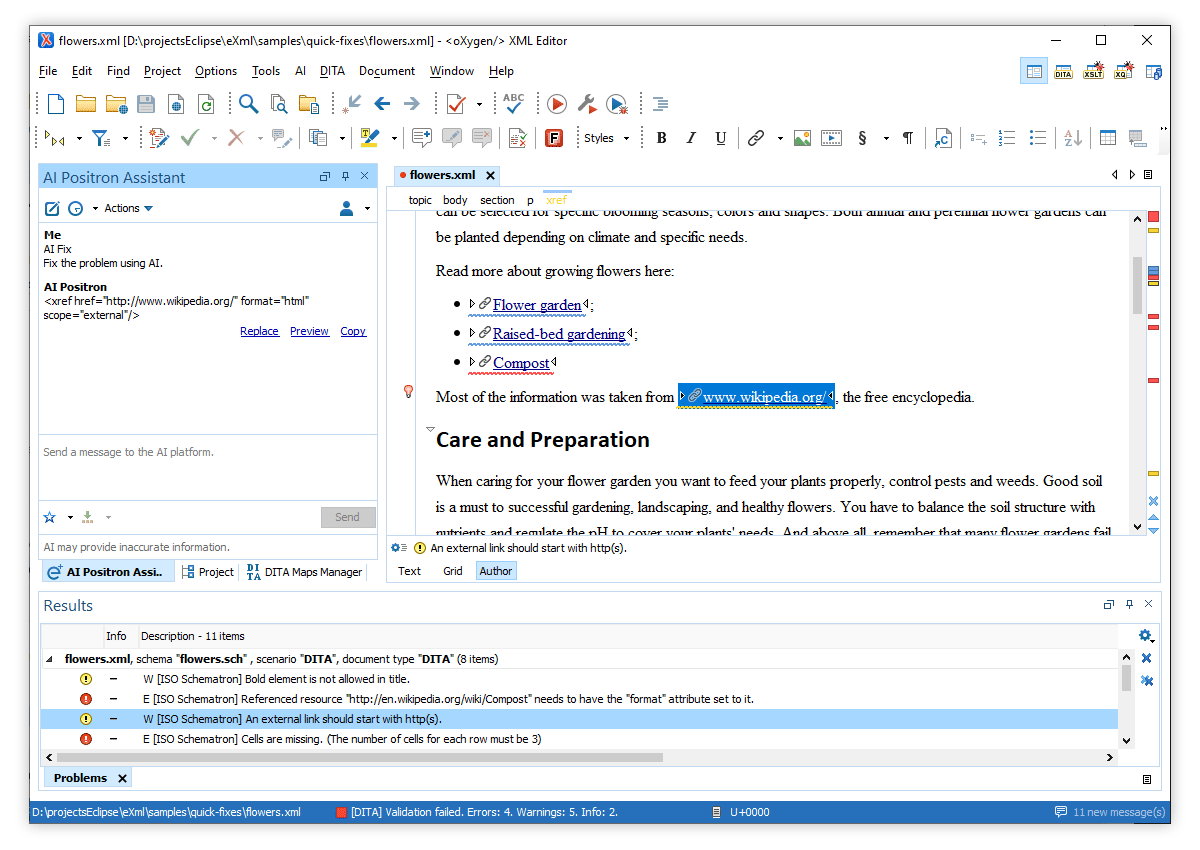
AI Refactoring
Record Examples for a Set of Instructions
Subscriptions
Customization
AI Positron Preferences
Change Default Model
AI-based XPath Functions
ai:transform-content(instruction, content) and
ai:verify-content(instruction, content)] that can be used from custom
Schematron schemas or XML Refactoring actions to rephrase content or to perform validation
checks on existing content.